

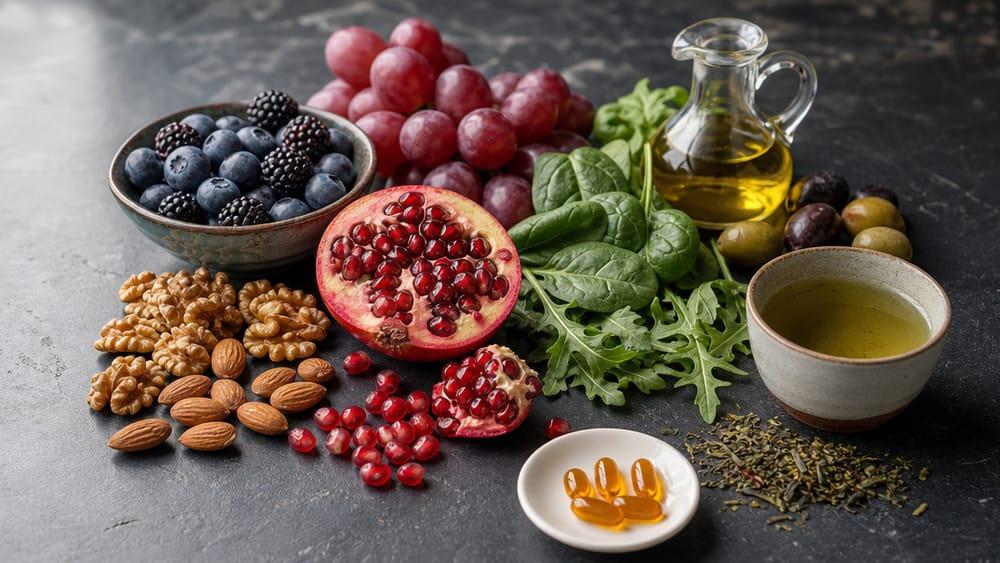
"Antioxidant" is not a nutrient. It is a description of a chemical behaviour performed by thousands of different compounds — which is precisely why it cannot be honestly compressed into a single number on a package. When isolated antioxidants were given at high doses in large randomised trials, they failed to deliver general protection, and in some groups they caused harm. Antioxidant-rich foods remain genuinely worth eating — but most likely for reasons other than "mopping up free radicals". This article separates what the test tube shows from what human trials found, and ends with what you can actually do about it today.
What are antioxidants, really — and why aren't they one thing? 🔬
An antioxidant is not a nutrient in the way iron or calcium is a nutrient. It is a job description: any molecule that can donate an electron to an unstable molecule — a free radical — and stop a chain reaction that would otherwise damage the fats, proteins or DNA inside a cell.
Under that one label sit wildly different things: vitamins (C and E), minerals that act as cofactors for the body's own antioxidant enzymes (selenium, zinc), plant pigments (the carotenoids), and an enormous family of plant compounds called polyphenols — flavonoids, anthocyanins, phenolic acids, lignans and more. There are thousands of them in food, and they behave very differently from one family to the next.
More importantly, your body is not waiting for food to defend itself. It runs its own internal antioxidant system — enzymes and molecules such as glutathione and uric acid — around the clock. So when you swallow a capsule, you are not filling an empty tank. You are intervening in a system that is already regulated.
Are free radicals simply an enemy to be erased?
This is where the biggest misunderstanding lives. Free radicals are not only a design flaw; some of them are a signal. The clearest practical demonstration comes from exercise. Training itself generates oxidising molecules, and the body reads those molecules as an instruction to adapt — build mitochondria, improve how the muscle responds. As we will see below, switching that signal off with high-dose supplements has measurable consequences.
Why did the USDA withdraw its ORAC database? 📉
For years a number called ORAC — Oxygen Radical Absorbance Capacity — appeared on packages and in articles. The idea was simple and seductive: put a food extract in a test tube, measure how many free radicals it can neutralise, then rank foods from highest to lowest. The US Department of Agriculture published a database of those values.
Then it took the database down. Harvard T.H. Chan School of Public Health's Nutrition Source explains why in one sentence: "The USDA retracted the information and removed the database after determining that antioxidants have many functions, not all of which are related to free radical activity."
That sentence deserves a pause. The problem was never that the assay was wrong inside the tube. The problem is that what happens in a tube does not automatically travel into a human being who digests, absorbs, metabolises and excretes. The number stayed true as chemistry and lost its meaning as a health promise.
The practical upshot: if you see a package today boasting a high ORAC value, or the phrase "highest in antioxidants", you are looking at a number the agency that popularised it stopped publishing. That does not make the food bad. It means that number is not the reason to buy it.
What happened when the capsules were tested on people? 🧪
The hypothesis was so logical it felt already proven: if people who eat more fruit and vegetables get sick less often, and if those foods are rich in antioxidants, then give people antioxidants in a pill. That hypothesis was tested on tens of thousands of human beings.
The two beta-carotene trials, where the result reversed
In the ATBC study, "29,133 male smokers age 50–69 years" received "20 mg/day beta-carotene" for five to eight years. The result, as reported by the NIH Office of Dietary Supplements: "The beta-carotene supplements increased the risk of lung cancer by 18%", and "The overall rate of death, primarily from lung cancer and ischemic heart disease, was 8% higher."
In the CARET trial, "18,314 male and female current and former smokers" plus asbestos-exposed workers took "30 mg beta-carotene plus 25,000 IU (7,500 mcg RAE) retinyl palmitate" daily. The finding: "the supplements were unexpectedly found to have increased lung cancer risk by 28% and death from lung cancer by 46%; the supplements also increased the risk of all-cause mortality by 17%." The trial was stopped early.
The Office's conclusion is blunt: "The CARET and ATBC study results suggest that large supplemental doses of beta-carotene with or without retinyl palmitate have detrimental effects in current or former smokers and workers exposed to asbestos."
Vitamin E and prostate cancer: the SELECT trial
SELECT was designed to test whether "daily supplementation with 400 IU of synthetic vitamin E (180 mg, as dl-alpha-tocopheryl acetate)" would reduce prostate cancer in "35,533 healthy men age 50 and older". On extended follow-up, "the men who had taken the vitamin E had a 17% increased risk of prostate cancer compared to men only taking placebos, a statistically significant difference."
The whole picture: 78 trials, 296,707 participants
A Cochrane review (Bjelakovic and colleagues) pooled "78 randomised clinical trials involving 296,707 participants". On mortality, beta-carotene "significantly increased mortality" with a risk ratio of 1.05 (95% CI 1.01 to 1.09); vitamin E "significantly increased mortality" at 1.03 (1.00 to 1.05); vitamin A "did not significantly affect mortality" (1.07; 0.97 to 1.18).
The authors' conclusion is worth reading exactly as written: "We found no evidence to support antioxidant supplements for primary or secondary prevention. Beta-carotene and vitamin E seem to increase mortality, and so may higher doses of vitamin A. Antioxidant supplements need to be considered as medicinal products and should undergo sufficient evaluation before marketing."
And the National Cancer Institute summarises nine major randomised trials in a single line: "these nine randomized controlled clinical trials did not provide evidence that dietary antioxidant supplements are beneficial in primary cancer prevention."
Does that mean every supplement is useless? (The brake)
No — and the precision matters. The National Center for Complementary and Integrative Health puts it carefully: "In general, except for age-related macular degeneration, there is currently no evidence that antioxidant supplements have a positive impact on these diseases." That exception is real and comes with a specific medical protocol prescribed by an eye doctor.
Equally, correcting a deficiency confirmed by a blood test is a completely different act from taking a high dose "preventively" when you are not deficient. That is the same rule we drew in our articles on iron deficiency and vitamin D and bone health: a supplement is a treatment for a condition, not general insurance.
The polyphenol you swallow is not the polyphenol in your blood 🍇
If polyphenol-rich foods are beneficial — and they appear to be — why doesn't the pill work? The deeper answer is not about dose. It is about what happens between the mouth and the bloodstream.
The Linus Pauling Institute at Oregon State University states it plainly: "In general, the bioavailability of flavonoids is low due to limited absorption, extensive metabolism, and rapid excretion." They are "rapidly and extensively metabolized in intestinal and liver cells such that they are likely to appear as metabolites (e.g., phase II metabolites) in the bloodstream and urine", and "Free (unconjugated) aglycones are generally absent from the bloodstream."
Then comes the decisive passage: "Flavonoids are effective scavengers of free radicals in the test tube (in vitro). However, even with very high flavonoid intakes, plasma and intracellular flavonoid concentrations in humans are likely to be 100 to 1,000 times lower than concentrations of other antioxidants, such as ascorbate (vitamin C), uric acid, and glutathione." Therefore, "The relative contribution of dietary flavonoids to plasma and tissue antioxidant function in vivo is likely to be very small or negligible."
Read that again. Whatever benefit berries, olive oil and tea confer, it is most likely not that they scavenge radicals in your bloodstream. The stronger candidates today are other routes entirely — effects on the blood-vessel lining, on intracellular signalling pathways, and metabolites produced by gut bacteria from these compounds. Which explains why a food cannot be reduced to a powder: you would not be transferring "antioxidant capacity", you would be transferring one small fragment of a whole system.
When the supplement cancels the benefit: the exercise lesson 🏃
The clearest evidence that more is not better comes from training. The NIH Office of Dietary Supplements notes that large doses of vitamins C and E "significantly lowered levels of biochemical markers related to mitochondrial creation and exercise-induced cell signaling, thereby diminishing the desirable training-induced adaptations within skeletal muscle."
In another trial the supplements "did not affect muscle growth, but they significantly reduced the gain in arm strength as measured by biceps curls and blunted cellular signaling pathways linked to muscle hypertrophy."
The Office's overall verdict is direct: "Little research supports the use as ergogenic aids of antioxidant supplements containing greater amounts than those available from a nutritionally adequate diet. In fact, they can adversely affect some measures of exercise and athletic performance."
New in 2026: a brake on the hype, and a brake on the pessimism
On 28 August 2026, Zhu, Shi, Wang and colleagues published a multilevel meta-analysis in Frontiers in Nutrition covering "11 randomized controlled trials involving 360 unique participants" on whether polyphenol supplements improve the gains from resistance training. For strength: "Hedges' g = 0.25, 95% CI −0.01 to 0.51, P = 0.060". For lean mass: "g = 0.13, 95% CI −0.07 to 0.33, P = 0.211". Their conclusion: "Current evidence does not establish a reliable additional effect of chronic polyphenol supplementation on resistance training-induced strength, lean-mass, or direct muscle-morphology adaptations."
Honesty requires quoting their brake as well. The authors write that "the limited number of independent trials, substantial clinical and methodological indirectness, and low-to-very-low certainty of evidence prevent firm conclusions regarding either benefit or lack of benefit." In other words: this is not a paper saying polyphenols are useless. It is a paper saying the evidence in this specific context is not strong enough to claim either way.
Pointing the other direction in the same year, a meta-analysis in Food & Function pooling "13 randomized controlled trials involving 849 participants" found that "polyphenol supplementation was associated with improved global cognition (pooled MD in MMSE = 2.06; 95% CI 0.62–3.49)" — with clear differences between polyphenol subclasses, as anthocyanidins, phenolic acids and lignans showed no significant cognitive effect. The message is not "case closed". It is that the family is not one thing, and the answer depends on the compound, the context and the dose.
Who should be especially careful? ⚠️
- Current smokers, former smokers and people exposed to asbestos: high supplemental doses of beta-carotene showed clear harm in ATBC and CARET. This is not theoretical.
- Anyone on anticoagulant or antiplatelet medication: per the Office of Dietary Supplements, "taking large doses with anticoagulant or antiplatelet medications, such as warfarin (Coumadin), can increase the risk of bleeding."
- Haemorrhagic stroke risk: the same source notes that "two clinical trials have found an increased risk of hemorrhagic stroke in participants taking alpha-tocopherol."
- Anyone in chemotherapy or radiotherapy: NCCIH warns that antioxidant combinations may interfere with cholesterol medications and cancer treatments. Do not start any supplement during treatment without your doctor.
- Upper limits: the Tolerable Upper Intake Level for vitamin E in adults is "1,000 mg" per day, and for vitamin C "2,000 mg/day for adults".
This article is educational and does not replace medical advice. If you take chronic medication, are pregnant or breastfeeding, have a medical condition, or are considering starting any supplement, speak to your doctor or pharmacist first — and never stop a prescribed treatment based on what you read here.
So what actually helps? ✅
The message is not "antioxidants are a myth". It is that the benefit attaches to a pattern of eating, not to an isolated molecule. Practically:
- Start with quantity before "superfood quality". The World Health Organization advises that "Everyone older than 10 years of age should aim for at least 400 grams of fruits and vegetables per day". That is a measurable target, unlike "eat antioxidant-rich foods".
- Vary the colours instead of chasing the highest ORAC. These compound families behave differently, and variety covers what no single "superfood" can.
- Understand why food is not the capsule. Harvard's Nutrition Source gives the example cleanly: a cup of fresh strawberries has about 80 mg of vitamin C, "But a supplement containing 500 mg of vitamin C does not contain the plant chemicals (polyphenols) naturally found in strawberries". It adds that "There are eight chemical forms of vitamin E present in foods. However, vitamin E supplements typically only include one form, alpha-tocopherol."
- Don't treat a dietary pattern with a pill. If the foundation is missing, a capsule does not replace it — much as metabolic rate is usually not why the scale is stuck, which we unpacked in our article on "slow metabolism".
- Read the package critically. Phrases like "rich in antioxidants" are not necessarily regulated claims, and they can sit happily beside a high sugar content.
The Saudi paradox: we buy the pill and skip the plate 🇸🇦
Here the local numbers become eloquent. A 2025 study in Frontiers in Public Health on determinants of fruit and vegetable consumption among Saudi adults reports that "97.4% of Saudi adults consume fewer than five servings of fruits and vegetables per day, with only 2.6% meeting the recommended intake".
Meanwhile a 2025 study in the Journal of Clinical Medicine of 445 gym-going adults in Saudi Arabia found that "73.9% of athletes use DS" — dietary supplements — with the most common category being "vitamins and minerals (77.3%)", and a substantial share relying on their own judgement rather than a health professional.
Put together, the picture is striking in its simplicity: fewer than three in a hundred adults hit the produce target, while three in four gym-goers buy the supplement. The capsule looks easier — but the large trials say the easier route is not the one that worked.
Where does Bakery 8 stand in all this? 🥖
Let us start with what we are not claiming: our products are not a source of antioxidants, no bread — ours or anyone else's — replaces servings of vegetables and fruit, and nothing in our store substitutes for your doctor. Any brand selling you "antioxidants" in a baked good is selling you a marketing phrase, not a health outcome.
What we will honestly claim is narrower and more realistic. The practical recommendation above is that your plate should have room for vegetables and fruit, and their biggest competitor in real life is starchy, high-sugar food that fills the stomach and crowds everything else out. That is the only place we belong: our almond-flour bread, made without added sugar, lets you keep the sandwich or the breakfast while leaving the room — and the calories — for the salad or the piece of fruit. By the same logic, our keto granola is meant to be served with fresh berries rather than instead of them, and the crackers to be eaten with hummus or sliced vegetables.
In short: we are not selling you antioxidants. We are trying not to be the reason the vegetables left your plate. Healthy and delicious — in that order.
Frequently asked questions ❓
Does this mean antioxidant-rich foods are not beneficial?
No. Fruits, vegetables, nuts, olive oil and tea are linked to real health benefits, and the WHO advises at least 400 grams of fruit and vegetables daily. What has not been shown is that the benefit comes from "antioxidant capacity" as such, or that it transfers into an isolated capsule.
Are antioxidant supplements dangerous for everyone?
Not necessarily, but the evidence does not support them for general prevention. The Cochrane review of 78 trials and 296,707 participants found increased mortality with beta-carotene and vitamin E. The clearest harm was in smokers taking beta-carotene. Ask your doctor before starting any supplement.
What about the ORAC value printed on some products?
It is a laboratory measure of how well a food extract neutralises free radicals in a test tube. The USDA withdrew its database of these values after determining that antioxidants have many functions, not all related to free radical activity. A number on a package is therefore not evidence of benefit.
Should I stop taking vitamin C after training?
Do not stop anything your doctor prescribed. But the Office of Dietary Supplements reports that large doses of vitamins C and E can blunt desirable training adaptations and may adversely affect some performance measures. The amounts naturally present in food are not what that warning is about.
Are the polyphenols in coffee and tea beneficial, then?
Evidence for polyphenol-rich dietary patterns is encouraging, but the mechanism is probably not direct radical scavenging, since blood concentrations are very low. Treat them as part of a good eating pattern rather than a treatment, and watch what gets added to them in sugar.
The bottom line
Antioxidants are a real scientific story that was badly abbreviated. The foods deserve their place on your plate; the number printed on the package does not deserve your trust; and the high-dose capsule was tested on hundreds of thousands of people, failed to keep its promise, and sometimes turned against the people taking it. The simplest step available to you today is not buying a supplement — it is adding one serving of vegetables or fruit to your next meal, and then doing it again tomorrow.
And if bread or breakfast is what crowds that serving out for you, browse our bread and keto granola from Bakery 8 in Riyadh, Saudi Arabia — options with no added sugar that leave room for what should have been on the plate in the first place.
References
- Harvard T.H. Chan School of Public Health, The Nutrition Source — "Antioxidants".
- National Center for Complementary and Integrative Health (NIH) — "Antioxidants: In Depth".
- National Cancer Institute — "Antioxidants and Cancer Prevention" (fact sheet).
- Bjelakovic G, Nikolova D, Gluud LL, Simonetti RG, Gluud C — "Antioxidant supplements for prevention of mortality in healthy participants and patients with various diseases", Cochrane Database of Systematic Reviews, 2012.
- NIH Office of Dietary Supplements — "Vitamin A and Carotenoids: Fact Sheet for Health Professionals" (ATBC and CARET).
- NIH Office of Dietary Supplements — "Vitamin E: Fact Sheet for Health Professionals" (SELECT, the UL, drug interactions).
- NIH Office of Dietary Supplements — "Dietary Supplements for Exercise and Athletic Performance: Fact Sheet for Health Professionals".
- Linus Pauling Institute, Oregon State University — Micronutrient Information Center, "Flavonoids".
- World Health Organization — "Healthy diet" (fact sheet).
- Zhu Y, Shi N, Wang C, et al. — "Does chronic polyphenol supplementation modify resistance training-induced strength and muscle morphology adaptations in adults? A systematic review and multilevel meta-analysis of randomized controlled trials", Frontiers in Nutrition, 28 August 2026.
- "Polyphenol consumption and neurodegeneration risk: a systematic meta-analysis of randomized controlled trials bridging nutrition and cognitive health", Food & Function (Royal Society of Chemistry), 2026.
- "Determinants of fruit and vegetable consumption among Saudi adults: an extended Theory of Planned Behavior approach", Frontiers in Public Health, 2025.
- "Prevalence and Perspectives of Use of Dietary Supplements Among Adult Athletes Visiting Fitness Centers in Saudi Arabia", Journal of Clinical Medicine, 2025.
Related keywords: antioxidants, polyphenols, antioxidant supplements, free radicals, ORAC score, antioxidant-rich foods, vitamin E, beta-carotene, flavonoids, bioavailability.