

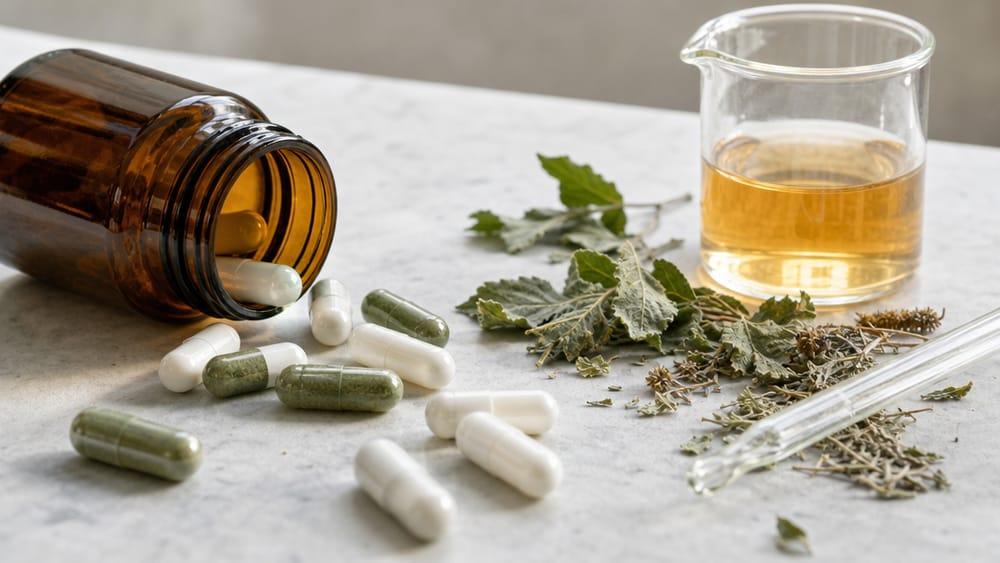
The biggest problem with herbal slimming products isn't that they don't work — it's that some of them "work" because there is a real pharmaceutical drug inside that was never printed on the box. When these products go through a laboratory, what comes out is not a disappointing list of inert herbs. It is a list of drugs: a substance pulled off the market for safety reasons, a laxative linked to cancer risk, and sometimes medicines with no connection to body weight at all. In Riyadh as anywhere else, the working rule is the same: the label is not the ingredient list. This article is educational only and is not a substitute for talking to your doctor or pharmacist before taking any supplement or weight-loss product.
Why isn't a supplement reviewed before it is sold, the way a drug is?
The difference most people miss is procedural, not chemical. A drug passes through a regulator before it reaches a shelf: its formulation, its dose and its safety are examined. A dietary supplement does not travel the same road. The Office of Dietary Supplements at the US National Institutes of Health states it plainly: "Unlike drugs, dietary supplements do not require premarket review or approval by FDA. Supplement manufacturers are responsible for determining that their products are safe." The US Food and Drug Administration says the same about itself — it "does not approve dietary supplements, vitamins or other non-drug products before they are sold."
So far this is only a procedural gap. The sentence that turns a gap into a doorway comes next, from the FDA's own page: "Some manufacturers intentionally do not disclose that their products contain drug ingredients to try to get around FDA's review." In other words, the drug does not always arrive in the capsule by accident. It is added precisely because it produces an effect the buyer can feel, and it is concealed precisely because naming it would turn the product into a medicine requiring approval.
The FDA also names the categories most prone to this: weight loss, energy, bodybuilding, sleep, pain relief and sexual enhancement. Notice what they share. Every one of them is a category where the buyer expects a fast, noticeable effect. That expectation is itself the commercial incentive to cheat.
What do laboratory analyses actually find in slimming products?
The clearest publicly documented example is a product sold across this region under the name AB Slim. FDA laboratories tested it, and the agency's public notification reads: "FDA laboratory analysis confirmed that AB Slim contains sibutramine, phenolphthalein and sildenafil" — three pharmaceutical substances in a capsule sold as a herbal slimming product.
What the agency says about each of them is worth reading slowly:
- Sibutramine is "a controlled substance that was removed from the market in October 2010 for safety reasons," and it "is known to substantially increase blood pressure and/or heart rate in some people and may present a significant risk for people with a history of coronary artery disease, congestive heart failure, arrhythmias, or stroke."
- Phenolphthalein is "a chemical that is not an active ingredient in any approved drug in the United States," and "studies have indicated that it presents a cancer-causing risk." It is, in origin, a laxative — meaning the "result" the user feels may be diarrhoea rather than fat loss.
- Sildenafil "may interact with nitrates found in some prescription drugs, such as nitroglycerin, and may lower blood pressure to dangerous levels."
Stop at the third one. Sildenafil has nothing whatsoever to do with body weight. Its presence in a slimming capsule is not a dosing error — it is evidence that whoever filled that capsule was not following an ingredient list at all. And if that is the level of discipline on the production line, then "are these herbs beneficial?" is the wrong first question. The first question is: is what the box says actually in the box?
How common is this? The closest published market data to us geographically comes from the Gulf. Jairoun AA, Al-Hemyari SS, Shahwan M and Zyoud SH (Molecules 2021;26(22):6903, doi:10.3390/molecules26226903) tested 137 weight-loss supplements sold in the United Arab Emirates and found that 17.5% (95% CI: 11.07–24) "contained significant concentrations of either sibutramine, phenolphthalein, or fluoxetine." Broken down: undeclared sibutramine in 15.3%, phenolphthalein in 13.9%, fluoxetine in 5.1%.
Honesty requires reporting how the authors themselves read their own result. Their verbatim conclusion was that "while weight loss herbal supplements offered for sale in the UAE have relatively low percentages of undeclared pharmaceuticals, many people take several different supplements daily and may face quite high levels of combined toxic exposure." Their worry, in other words, was not the odds inside one box. It was the accumulation of odds across several boxes taken on the same day.
Why are these substances so hard to catch? Because they often aren't the familiar drug
On 6 August 2026 the Saudi Food and Drug Authority warned against three ginseng products on the market — a ginseng coffee, a ginseng dark chocolate and a second ginseng coffee — after nortadalafil, a substance prohibited for use, was detected in them. The authority said the products "may pose health risks, particularly for individuals with chronic diseases," told consumers to stop using them immediately and dispose of any units safely, and confirmed that the products were being withdrawn and recalled while regulatory action proceeded against the importing companies.
The lesson is in the name itself. Nortadalafil is not the familiar tadalafil; it is a modified chemical analogue of it. That is the central trick: alter a drug molecule slightly so the pharmacological effect survives, while the compound becomes harder to pick up on routine screening and sits outside prohibited lists written by name. And notice the format. This was not a capsule in a supplement jar. It was coffee and chocolate.
This is also where a consumer's ability to protect themselves runs out. You cannot identify a modified drug analogue by taste, colour or smell, and you will not find it on the label — printing it is exactly what the manufacturer is trying to avoid. Nor can you judge from the herbs that are listed, because a list can be accurate and incomplete at the same time: accurate in what it names, incomplete in what it omits. So the only tool you actually have is not reading the ingredients. It is knowing who stands behind the product: a registered facility, an accountable company, and a registration number you can verify. The ingredient that should worry you is the unwritten one — and the only way to see it is through the party that put it there.
The most recent systematic review places this in its wider frame. Al-Saad N, Aljaal S, Alessa J and Santhosh ME (Frontiers in Sports and Active Living 2026;8:1740663, doi:10.3389/fspor.2026.1740663, published 13 March 2026) reviewed 44 studies covering 2010 to March 2025 and reported that "approximately 9–15% of commercially available supplements tested in empirical studies were contaminated with prohibited substances and unapproved pharmacological agents." Stimulants were the most frequent class, followed by anabolic-androgenic steroids. Their conclusion captures the direction of travel: the detection of selective androgen receptor modulators, peptide hormones and metabolic modulators "points to the increasing pharmacological complexity of supplement adulteration."
Their own stated limitation matters as much as their headline figure. The authors note that the evidence is "disproportionately concentrated in the Americas, the Asia-Pacific region, and Europe, while research from the Middle East, North Africa (MENA), and South Asia is largely absent," and that consequently "the true global prevalence of dietary supplement adulteration could be underestimated." So do not take a Saudi rate from this. Take a direction — and understand that missing regional data is not a certificate of safety.
Where does the consequence show up in clinic? Usually the liver
What reaches the doctor is rarely "my weight didn't move." It is a disturbed liver panel. LiverTox, the NIH reference on drug-induced liver injury (last updated 1 July 2025), records that herbal and dietary supplements were implicated in roughly 10% of cases in the US Drug Induced Liver Injury Network, "but this rate appears to be increasing and most recently was more than 16% of cases" — 145 of 899 cases enrolled between 2004 and 2012. Weight-loss and bodybuilding products dominate those cases.
More importantly, the same reference describes the mechanism in words that take us straight back to the label: "Reports exist of product contamination and unlabeled ingredients. Reported contaminants include heavy metals, pharmaceuticals, microbial products, and pesticides," and chemical analysis of implicated products "often reveals adulteration of the product and sometimes mislabeling and absence of the botanical listed on the label." So the risk is not only a harmful herb. It can also be the absence of the herb you paid for, with something else occupying its place.
And here the circle closes on the strangest fact in this whole file. On 22 January 2010 the European Medicines Agency's Committee for Medicinal Products for Human Use recommended suspending the marketing authorisations for sibutramine, after a trial that enrolled "nearly 10,000 patients for up to six years." The committee concluded that "the risks of these medicines are greater than their benefits" and that "the benefit of sibutramine as a weight-loss aid do not outweigh the cardiovascular risks." Doctors were told to stop prescribing it and pharmacists to stop dispensing it. The paradox is this: the substance that was taken away from the pharmacy — where it had a prescription, a dose and a doctor watching — came back to the market in a capsule with no prescription, no stated dose and no name on the label. The drug did not disappear. Only the supervision did.
And in Saudi Arabia? The warning is published on one channel, the decision is made on another
The Saudi Food and Drug Authority publishes warnings, recalls products and takes regulatory action — and that machinery works. The practical question is different: where does the buyer actually make the decision?
In a recent Saudi cross-sectional study (Alharbi EM, Cureus 2026;18(6):e111272, doi:10.7759/cureus.111272, data collected January to March 2024, 742 participants), 299 participants — 40.3% reported that medication-related social media posts "sometimes or frequently influenced their medication-use decisions," while 430 — 58.0% said they preferred visiting a doctor for medication information. For a large share of people, in other words, the channel of influence and the channel of trust are not the same channel.
This study needs reading with doubled caution, and we will say so openly. First, the author's own limitations: the cross-sectional design "prevents establishing causal relationships"; the self-reported data "may introduce recall and social desirability biases"; social-media-based convenience sampling "may also have introduced selection bias, as individuals who are more active on social media may have been more likely to participate"; women and residents of the central region were overrepresented; and no correction was applied for multiple comparisons. Second, at the level of the journal itself: in October 2025 Cureus was removed from Clarivate's Master Journal List, losing its Web of Science indexing and its impact factor over journal-quality criteria. We checked this particular paper's own page and found no correction or retraction notice on it — and we still say plainly that this figure is a signal of direction, not a national rate. A biased sample cannot carry an absolute rate, but it can carry an internal comparison. The comparison here is that the channel of influence arrived before the channel of trust.
For contrast, the NIH Office of Dietary Supplements (updated 2 October 2026) reports that fewer than one-third of Americans using weight-loss supplements discuss that use with a health professional, and that about 15% of adults have used them (21% of women, 10% of men). Those figures are American, not Saudi — but the behaviour they describe is familiar.
So what do you actually do tomorrow? Five steps, none of which require a doctor to begin:
- Look for the registration number, not the promise. A product registered with the Saudi Food and Drug Authority has an accountable company and a known facility behind it. A product sold only through a social account has neither.
- Treat speed of result as a warning sign, not a quality sign. "Visible loss in days" alongside "100% natural" is an internally contradictory claim — a fast effect usually has a pharmacological source.
- Keep the box and the blister strip. If something goes wrong, your doctor needs to see the product, not hear its name.
- Report it; don't just stop taking it. The warning you read today exists because somebody reported something.
- Tell your doctor and pharmacist everything you take — including what you think of as "just herbs," and especially before any surgery or alongside any long-term medication.
Who should ask a doctor first?
This section is educational and does not replace medical advice. Talk to your doctor or pharmacist before taking any weight-loss product if you:
- have high blood pressure, heart disease or a heart-rhythm disorder — the FDA's sibutramine warning is aimed at exactly this group;
- take nitrates such as nitroglycerin — an interaction with undeclared sildenafil can drop blood pressure to dangerous levels;
- take an SSRI antidepressant — undeclared fluoxetine means a doubled dose of unknown size;
- have liver disease, take medicines that stress the liver, or have diabetes;
- are pregnant or breastfeeding, or are considering giving the product to a child or teenager;
- have surgery or a medical procedure coming up.
Stop immediately and seek medical care if you develop yellowing of the eyes or skin, dark urine, pain in the upper right abdomen, unexplained nausea and severe fatigue, or palpitations or a clear rise in blood pressure after starting a product. If you took a product named in an official warning and have no symptoms, the task is to tell your doctor, not to panic: the useful information is what you took, when, and how much.
And us, at Bakery 8?
There is nothing on our shelf that will make you lose weight. And if weight loss specifically is your goal today, we will say the commercially uncomfortable thing: do not buy our chocolate truffles, our tiramisu or our cakes. Those are desserts — built to be a tastier, lower-sugar option at an occasion, not a weight-loss tool and not "a sweet that helps you burn fat." Here is a second uncomfortable thing: the most recent Saudi warning in this file was not about a capsule in a pharmacy. It was about a coffee and a chocolate — the very shelf categories we sell on. "Sugar-free," "keto" and "gluten-free" describe a formulation. They are not a registration certificate, and they do not replace your question about who stands behind anything you eat — ours or anyone else's.
So we commit to two things: we will never market any product of ours as a slimming or "fat-burning" product, and we will never use language implying a pharmacological effect that bread does not have. What we claim stays within its true limits — bread and desserts made to a low-carbohydrate, no-added-sugar formulation, suited to people following a keto or low-carb pattern or who need a gluten-free option, as in our bread and granola sections. "Healthy and delicious" describes what is in the loaf, not what it does to your scale.
If your question is about supplements and safety more broadly, our piece on omega-3 and what separates ALA from EPA and DHA covers dose thresholds and why you should tell your doctor what you take. And for a case where official advice was formally withdrawn and kept circulating anyway, see diverticular disease and the advice that quietly got reversed.
Frequently asked questions
Are all herbal slimming products adulterated?
No. The closest Gulf data tested 137 products and found undeclared drugs in 17.5% of them, and the researchers themselves called that rate "relatively low." The problem is that you cannot tell which box is that box — and someone taking several products a day is accumulating the odds, not spreading them.
If I feel a fast result, isn't that proof the product works?
It may be proof of the opposite. A fast effect usually needs a pharmacological substance, and the drugs covertly added to these products are precisely the ones that were withdrawn or that cause harm. With phenolphthalein, the "result" you feel may be a laxative effect rather than fat loss.
What about products sold in a pharmacy?
Buying from a licensed facility is far better than buying through an account in an app, but it does not replace checking that the product itself is registered with the Saudi Food and Drug Authority, or telling the pharmacist what other medicines you take.
I took a product that later appeared in a warning. What is the first step?
Stop using it, keep the box, tell your doctor what you took, when and how much, and report it to the authority. If yellowing, dark urine, upper-right abdominal pain or palpitations appear, seek medical care without delay.
Does "natural" mean "safe"?
No — and it does not mean "tested." LiverTox documents liver injury caused by herbal products, and notes that analysis of some implicated products revealed the absence of the very botanical named on the label. "Natural" is a marketing word, not a description of what is in the box.
References
- Office of Dietary Supplements, National Institutes of Health. Dietary Supplements for Weight Loss — Health Professional Fact Sheet. Updated 2 October 2026.
- Office of Dietary Supplements, National Institutes of Health. Weight-Loss Supplements — Consumer Fact Sheet. Updated 22 March 2021.
- U.S. Food and Drug Administration. Avoiding Products Contaminated with Hidden Ingredients. Updated 10 June 2025.
- U.S. Food and Drug Administration. Public Notification: AB Slim contains hidden drug ingredients. 20 June 2018.
- Saudi Food and Drug Authority. SFDA warns against certain ginseng coffee and chocolate products found to contain nortadalafil. 6 August 2026.
- European Medicines Agency, Committee for Medicinal Products for Human Use. European Medicines Agency recommends suspension of marketing authorisation for sibutramine. 22 January 2010.
- Jairoun AA, Al-Hemyari SS, Shahwan M, Zyoud SH. Adulteration of weight loss supplements by the illegal addition of synthetic pharmaceuticals. Molecules 2021;26(22):6903. doi:10.3390/molecules26226903.
- LiverTox: Clinical and Research Information on Drug-Induced Liver Injury. Herbal and Dietary Supplements. National Institute of Diabetes and Digestive and Kidney Diseases. NCBI Bookshelf NBK548441. Updated 1 July 2025.
- Al-Saad N, Aljaal S, Alessa J, Santhosh ME. Systematic review of undeclared prohibited substances and pharmacological adulterants in dietary supplements: prevalence, detection, and risks in sport. Frontiers in Sports and Active Living 2026;8:1740663. doi:10.3389/fspor.2026.1740663.
- Alharbi EM. Influence of social media on medication-related decision-making among adults in Saudi Arabia: a cross-sectional study. Cureus 2026;18(6):e111272. doi:10.7759/cureus.111272.
Related keywords: herbal slimming products, weight loss pills, sibutramine, adulterated dietary supplements, hidden drug ingredients, SFDA warnings, supplements and liver injury, verifying product registration.