

Osteoporosis is a silent disease: nothing hurts while bone density is being lost, and for many people the first symptom is the fracture itself. That is why the reflex answer is "more calcium" — when bone is in fact living tissue, constantly broken down and rebuilt, and it needs four things together rather than one: enough calcium, enough vitamin D to let that calcium be absorbed, mechanical load that gives bone a reason to stay strong, and time — because peak bone mass is built before about age 30. This article explains what a vitamin D test actually measures, why the newest Endocrine Society guideline suggests against ordering it routinely in healthy adults, why supplements alone failed to reduce fractures in one of the largest randomized trials ever run, and what did work.
Why is bone called "living tissue" rather than a storage tank?
Mayo Clinic describes bones as "living tissue that is constantly being broken down and replaced." That is not poetry — it is the whole problem. At every moment some cells are removing old bone and others are laying down new bone, and what you end up with is the difference between the two. Mayo also notes that peak bone mass is typically reached by about age 30, after which "bone mass is lost faster than it's created," with the rate of loss accelerating with age.
Why doesn't a routine blood panel show this? Because of bone's other job. The NIH Office of Dietary Supplements (ODS) states that "almost all calcium in the body (98%) is stored in the bones," and that the body "uses the bones as a reservoir for, and source of, calcium to maintain calcium homeostasis." In plainer terms: blood calcium is defended tightly, because heart, nerve and muscle function depend on it. If calcium does not arrive from food, it is withdrawn from bone.
The first practical key follows directly: a normal serum calcium result on a general panel can sit there while you are losing bone — it may even be normal because bone is paying the bill. That number does not reassure you about your skeleton, because it is not measuring your skeleton.
Why isn't sunshine enough in a sunny country?
Here is the paradox that confuses people: Saudi Arabia is among the sunniest countries on earth, and vitamin D deficiency is nonetheless common. In a retrospective study published in 2025 covering 22,335 people in the Sudair region of central Saudi Arabia between 2017 and 2021, 67.3% of results fell below 30 ng/mL — 28.1% insufficient, 35.9% deficient, and 3.3% severely deficient.
A more behaviourally detailed study, published in Scientific Reports in 2019 on 166 women aged 30–65 in Riyadh, found deficiency (below 20 ng/mL) in 60.2%, and severe deficiency (below 10 ng/mL) in 28.9%. The explanation sits in the same paper: 40.9% were "rarely or never exposed to sunlight," and 72.8% had less than 15 minutes of daily sun exposure.
The Saudi Osteoporosis Society's 2023 update reports that vitamin D insufficiency among adults over 40 fell from 86.2% in 2008 to 64.7% in 2017 — real progress, which still leaves two-thirds of that group short of target.
The reasons are both physiological and behavioural, and NIH ODS states the main ones without exaggeration:
- "UVB radiation does not penetrate glass, so exposure to sunshine indoors through a window does not produce vitamin D." Sitting by a sunny window is not exposure.
- Sunscreen at SPF 8 and above blocks the wavelengths responsible for synthesis.
- Greater melanin content in skin reduces the amount of vitamin D produced from the same amount of sun.
- An indoor life: home, office, car, mall — and in summer the peak-UV hours are also the hottest hours of the day.
The counter-intuitive conclusion: living in a sunny country is a geographic fact, not a physiological dose. Sunlight that never reaches your skin does not count.
When do you actually need a vitamin D test — and why isn't it for everyone?
This is where the recent evidence surprises people. The Endocrine Society guideline published in the Journal of Clinical Endocrinology & Metabolism in 2024, chaired by Dr. Marie Demay, is explicit: "In healthy adults, we suggest against routine screening for 25(OH)D levels," because, as the Society put it, "outcome-specific benefits based on these levels have not been identified."
The guideline did name specific groups for whom it suggested empiric supplementation — that is, without testing first:
- Children and adolescents aged 1–18, to prevent nutritional rickets and potentially lower the risk of respiratory tract infections.
- People aged 75 and older, for the potential to lower mortality risk, with daily lower-dose supplementation preferred over intermittent high doses.
- Pregnancy, given the potential to lower the risk of preeclampsia, preterm birth and neonatal complications.
- Adults with high-risk prediabetes, in addition to lifestyle modification and never in place of it.
For healthy adults under 75, the guideline suggested "against vitamin D supplements at doses beyond the reference dietary intakes recommended by the IOM."
Fairness requires putting the local picture beside that. The Saudi Osteoporosis Society's 2023 update recommends maintenance doses "starting from 1000 to 2000 IU/day once the target (>50 nmol/l) is achieved for the general population." That is less a contradiction than a difference in starting point: a population in which two-thirds of adults are below target is not the population most trials were run in. Which is exactly why this is a decision for your physician, not for a supplement aisle.
For context, these are the NIH ODS thresholds for serum 25(OH)D:
- Below 12 ng/mL (30 nmol/L): associated with vitamin D deficiency.
- 12 to below 20 ng/mL: generally considered inadequate for bone health.
- 20 ng/mL and above: "generally considered adequate for bone and overall health."
- Above 50 ng/mL (125 nmol/L): "linked to potential adverse effects."
Do supplements prevent fractures? What the largest trial found
This is the question that matters, because the goal is not a number on a lab report — it is a bone that does not break. In the fracture ancillary study of the VITAL trial, published in the New England Journal of Medicine in 2022 (LeBoff and colleagues), 25,871 participants — men aged 50 and older, women 55 and older — received either 2000 IU of vitamin D3 daily or placebo, with a median follow-up of 5.3 years. The results:
- Total fractures: hazard ratio 0.98 (95% CI, 0.89 to 1.08).
- Nonvertebral fractures: 0.97 (0.87 to 1.07).
- Hip fractures: 1.01 (0.70 to 1.47).
The investigators' own summary, as reported by Brigham and Harvard: "the results from this large clinical trial do not support the use of vitamin D supplements to reduce fractures in generally healthy U.S. men and women."
But read the caveat the authors themselves attached, because it is half the story: the findings "do not apply to adults with vitamin D deficiency or low bone mass or osteoporosis." Most participants were already replete — and a supplement corrects a deficit; it does not add benefit on top of sufficiency. This is not evidence that vitamin D is unimportant. It is evidence that giving it to people who are not short of it does nothing for fractures.
Pointing the same way, the U.S. Preventive Services Task Force gave a grade D recommendation "against daily supplementation with 400 IU or less of vitamin D and 1000 mg or less of calcium for the primary prevention of fractures in community-dwelling, postmenopausal women," and judged the evidence insufficient (grade I) for higher doses and for men and premenopausal women.
What actually raised bone density: the load, not the pill
Bone responds to what is asked of it. In the randomized LIFTMOR trial published in the Journal of Bone and Mineral Research (Watson and colleagues, 2018), 101 postmenopausal women with low bone mass (aged 65 ± 5 years) trained with high-intensity resistance and impact loading — two supervised sessions a week, 30 minutes each, for eight months — against a low-intensity home-based control program. The result:
- Lumbar spine: a 2.9% gain in the training group versus a 1.2% loss in controls (p < 0.001).
- Femoral neck: a 0.3% gain versus a 1.9% loss (p = 0.004).
The researchers reported that the training "was efficacious and induced no adverse events under highly supervised conditions," with one minor incident (a lower back spasm).
The comparison is worth sitting with: more than five years of a daily supplement did not move fractures in an already-replete population, while eight months of one hour a week, split over two sessions, moved density in the opposite direction from age. That does not cancel vitamin D — it places it correctly. Vitamin D is an enabling condition for calcium absorption, not a stimulus for bone building. The stimulus is load.
That said, do not start high-intensity resistance training on your own if you have established osteoporosis or previous fractures. The trial was run under supervision, and the difference between load that builds bone and load that breaks it is technique and progression.
Why more is not better: the safety ceilings
The common assumption is that a vitamin cannot hurt. It can. NIH ODS sets the Tolerable Upper Intake Level for adults at 100 mcg (4,000 IU) per day, and notes that toxicity typically occurs at blood levels above roughly 150 ng/mL, where it can cause hypercalcemia with complications including renal failure and cardiac arrhythmias.
The "one big dose is easier" logic has actually been tested. In a randomized trial published in JAMA in 2010 (Sanders and colleagues), 2,256 community-dwelling women aged 70 and over received a single annual dose of 500,000 IU of cholecalciferol; the vitamin D group recorded roughly 15% more falls and about 26% more fractures than placebo, with the excess concentrated in the three months after dosing. That is precisely why the 2024 guideline prefers daily lower-dose supplementation over intermittent high doses.
Calcium has ceilings too. In the Women's Health Initiative trial, which gave 1,000 mg of calcium carbonate plus 400 IU of vitamin D3 daily, the risk of urinary tract stones rose with a hazard ratio of 1.17 (95% CI, 1.02 to 1.34). Urology commentators note that observational data suggest dietary calcium may be protective in people prone to stones while supplements appear to do the opposite — a distinction that argues for food first, not against calcium.
Absorption itself resists big doses: NIH ODS notes absorption is highest at doses of 500 mg or less, and that the body absorbs about 36% of a 300 mg dose versus 28% of a 1,000 mg dose. Splitting the dose across two meals is not a cosmetic detail.
A practical plan: what is actually worth doing
Ordered from highest impact down, and all within what the sources above recommend:
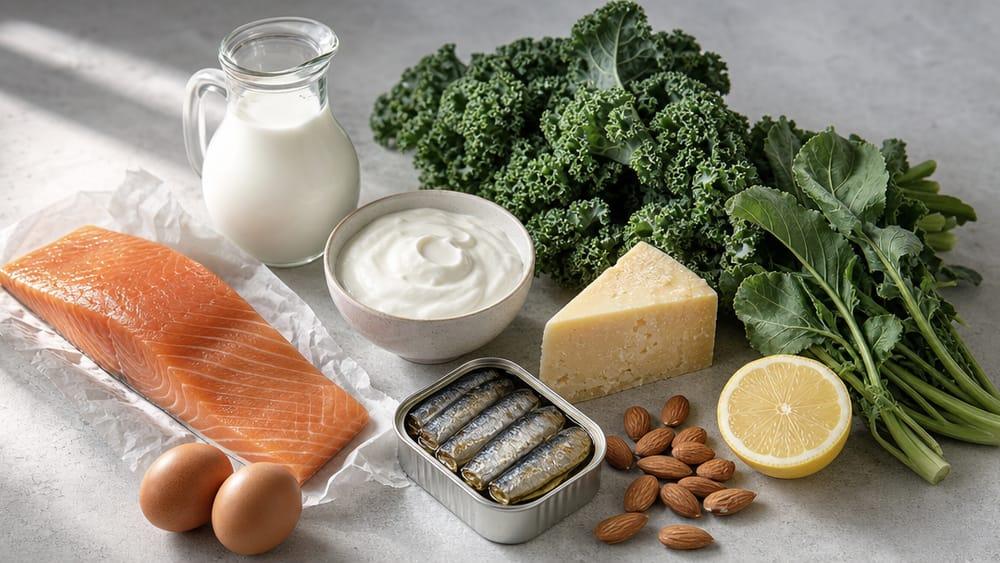
- Get calcium from food first. The Saudi Osteoporosis Society recommends a daily intake "between 800 and 1200mg which can be achieved through dietary sources." Per NIH ODS: yogurt (415 mg per serving), mozzarella (333), milk (276–299), canned sardines with bones (325), canned salmon with bones (181), calcium-fortified juice (349), turnip greens (99), kale (94).
- Know that plant calcium is not one thing. NIH ODS puts calcium bioavailability from spinach at roughly 5% because of its oxalates, versus about 27% from broccoli and kale. Spinach is an excellent food; it is not a reliable calcium source.
- Load your bones for real. Weight-bearing activity — walking, running, stair climbing, impact sports — affects mainly the bones of the legs, hips and lower spine, per Mayo Clinic; progressive resistance training adds what walking alone does not, as LIFTMOR showed.
- Take a sensible amount of vitamin D. The reference intake is 600 IU (15 mcg) daily for ages 1–70 and 800 IU (20 mcg) for those over 70, alongside moderate sun exposure outside peak hours.
- Ask about a DXA scan if a criterion applies to you. The Saudi Osteoporosis Society recommends bone density screening for all Saudi women and men aged 60 and above; women 40 and older with a history of fragility fracture; younger postmenopausal women with a prior fracture; premature menopause; long-term glucocorticoid therapy; primary hyperparathyroidism; and radiological evidence of fragility fracture or height loss. A Saudi-specific FRAX calculator has been available since 2022.
Why this deserves local attention: the same Society reports hip fracture incidence at 77.5 per 100,000 in women and 56.8 per 100,000 in men, with projections of a sevenfold increase by 2050 if nothing changes. And in a community-based study in Riyadh published in 2022 on 1,302 adults with a mean age of 68, osteoporosis was present in 11.8% at the lumbar spine and 8.2% at the femur — while osteopenia, the stage before it, was present in 41.2% and 50.2% respectively. The middle stage is the widest one, and it is exactly the stage where intervention still pays.
Bone health on a keto or gluten-free plan
A fair question that deserves a straight answer: a low-carbohydrate or gluten-free pattern does not harm bone in itself, but it can quietly drop foods that used to carry calcium in the previous diet — fortified products above all. The fix is not to abandon the plan but to build it deliberately: full-fat dairy for those who tolerate it, canned fish with the bones in, low-oxalate leafy greens, and nuts including almonds.
One caution is worth stating: undiagnosed celiac disease is a known cause of malabsorption that includes calcium and vitamin D — which means going gluten-free before celiac testing can hide the diagnosis. If you have chronic digestive symptoms, test first and then remove.
Who should pay closer attention?
- Postmenopausal women, and men and women over 60.
- Anyone who has broken a bone after age 40 from a minor fall — that is a signal, not an accident.
- Anyone on long-term corticosteroids, or with primary hyperparathyroidism.
- Anyone who has lost height or noticed increasing upper-back curvature.
- Anyone with a chronic digestive condition affecting absorption, or a history of bariatric surgery.
- Anyone who spends the entire day indoors with no sun exposure at all.
This article is educational and does not replace medical advice. Do not start a high-dose supplement, stop a prescribed medication, or interpret a lab result on your own — talk to your doctor, particularly if you have kidney disease, a history of stones, or take medications affected by calcium.
Where does Bakery 8 stand in all this?
No bread builds your bones. No baked product replaces a bone density scan, or the vitamin D dose your physician decides on, or the resistance training that trials show moves density. Those limits belong at the top, before any sentence about a product.
Only one honest claim remains: bone health is a long-horizon project that lives inside a sustainable way of eating, and anyone following a low-carb or gluten-free pattern needs options that do not force them out of it. Our bread range is made from almond flour with no added sugar — a base for a meal that can actually carry the eggs, cheese or salmon where the calcium and vitamin D really are. Our granola and crackers lean on nuts and seeds instead of refined flour. Bakery 8 / مخبز ثمانية — Riyadh, Saudi Arabia — sells bread, not treatment.
For more lab-literacy reading: see Iron Deficiency: Why a Hemoglobin Test Isn't Enough and Muscle and Blood Sugar: What Actually Receives the Glucose.
Frequently asked questions
Do I need a vitamin D test every year?
Not necessarily. The 2024 Endocrine Society guideline suggests against routine 25(OH)D screening in healthy adults, because benefits tied to a specific numeric result have not been identified. If you have a risk factor — osteoporosis, malabsorption, kidney disease, interacting medications — the decision belongs to your physician rather than to a generic panel.
Is dietary calcium better than a supplement?
The Saudi Osteoporosis Society recommends 800–1,200 mg daily, achievable through food. In the WHI trial, calcium plus vitamin D supplementation raised urinary stone risk with a hazard ratio of 1.17. So food stays the first option, with a supplement added when there is a genuine gap and under medical supervision.
Can one large monthly dose replace a daily one?
The evidence does not encourage it. The 2024 guideline prefers daily lower-dose supplementation to intermittent high doses, and the 2010 JAMA trial found that a single annual 500,000 IU dose was associated with more falls and fractures — not fewer — in women over 70.
Is walking enough to maintain bone density?
Walking helps and Mayo Clinic classifies it among weight-bearing exercises affecting the legs, hips and lower spine, but it is not equivalent to progressive loading. In LIFTMOR, lumbar spine density rose 2.9% with supervised high-intensity resistance training versus a 1.2% decline in controls.
Does a normal blood calcium result mean my bones are fine?
No. About 98% of body calcium is stored in bone, and the body draws on that store to keep blood calcium stable. Blood calcium can therefore stay normal while bone density falls. Bone density itself is measured by DXA, when there is an indication for it.
Isn't the sun in Saudi Arabia enough on its own?
It is not a guarantee. Despite abundant sunshine, deficiency reached 67.3% in a study of 22,335 people in Sudair, and 60.2% among Riyadh women, 72.8% of whom had under 15 minutes of daily sun exposure. UVB radiation also does not penetrate glass, so sitting behind a window produces no vitamin D.
The bottom line
Bone health is not a calcium equation. It is a four-part one: food that supplies calcium, vitamin D that lets it be absorbed within safe limits, mechanical load that gives bone a reason to stay, and medical follow-up that knows when a test is indicated and when it is not. The practical message is simple: do not wait for a fracture to tell you, and do not treat anxiety with a bigger dose. Browse Bakery 8's products if you want options that support how you already eat — and leave bone treatment to your doctor.
References
- Demay MB, et al. "Vitamin D for the Prevention of Disease: An Endocrine Society Clinical Practice Guideline." Journal of Clinical Endocrinology & Metabolism, 2024.
- Endocrine Society. Clinical practice guideline announcement on vitamin D, 2024.
- NIH Office of Dietary Supplements. "Vitamin D — Fact Sheet for Health Professionals."
- NIH Office of Dietary Supplements. "Calcium — Fact Sheet for Health Professionals."
- LeBoff MS, et al. "Supplemental Vitamin D and Incident Fractures in Midlife and Older Adults." New England Journal of Medicine, 2022 (the VITAL trial).
- Watson SL, et al. "High-Intensity Resistance and Impact Training Improves Bone Mineral Density and Physical Function in Postmenopausal Women With Osteopenia and Osteoporosis: The LIFTMOR Randomized Controlled Trial." Journal of Bone and Mineral Research, 2018.
- Sanders KM, et al. "Annual High-Dose Oral Vitamin D and Falls and Fractures in Older Women: A Randomized Controlled Trial." JAMA, 2010.
- Jackson RD, et al. "Calcium plus Vitamin D Supplementation and the Risk of Fractures." New England Journal of Medicine, 2006 (Women's Health Initiative).
- U.S. Preventive Services Task Force. "Vitamin D, Calcium, or Combined Supplementation for the Primary Prevention of Fractures in Community-Dwelling Adults," 2018.
- Mayo Clinic. "Osteoporosis — Symptoms and causes."
- Al-Daghri NM, et al. "Diagnosis and management of osteoporosis in Saudi Arabia: 2023 key updates from the Saudi Osteoporosis Society." Archives of Osteoporosis, 2023.
- "Prevalence and trends of vitamin D deficiency in a Saudi Arabian population: a five-year retrospective study from 2017 to 2021," 2025 (Sudair region, 22,335 participants).
- "Vitamin D Deficiency and Associated Risk Factors in Women from Riyadh, Saudi Arabia." Scientific Reports, 2019.
- "The Prevalence of Osteoporosis and Osteopenia Among Older Adults in a Community-Based Setting in Riyadh, Saudi Arabia." Cureus, 2022.
Related keywords: vitamin D and bone health, vitamin D deficiency in Saudi Arabia, osteoporosis, daily calcium intake, 25(OH)D test, DXA scan, resistance training and bone density, peak bone mass.