

Zinc is an essential mineral your body cannot make, and it is a requirement for your immune system to work — not a booster that makes it work harder. That distinction decides everything: correcting a shortage restores a function that was failing, while adding more to a body that already has enough adds nothing. The strongest evidence available today, the 2024 Cochrane systematic review, found that zinc does essentially nothing to prevent colds, and may shorten one by about two days — but with "low certainty" and more non-serious side effects. Meanwhile zinc has a hard ceiling: 40 mg a day for adults, and exceeding it long-term depletes copper, lowers HDL cholesterol, and can weaken the very immunity the supplement was bought to strengthen.
This article pulls together what the established medical sources actually say about zinc and immunity: what it does, what the numbers show for the common cold, why no simple blood test can tell you that you are deficient, and where the harm begins. In the middle sits a trial published in August 2026 that compresses the whole argument into a single line.
What does zinc actually do, and why does immunity feel it first? 🔬
Zinc is not an "immunity vitamin" in the advertising sense. According to the Micronutrient Information Center at Oregon State University's Linus Pauling Institute, zinc enables the function of more than fifty different enzymes, and "over 3,000 proteins in humans have functional zinc-binding sites." Many of those are zinc-finger motifs — small structures that hold a protein in the right shape so it can bind DNA and switch genes on or off. In other words, zinc is not fuel you pour in. It is a structural component the system does not run without.
And because immune tissue is among the fastest-dividing tissue in the body, it pays the price of a shortage first. That covers innate immunity (neutrophils, macrophages, natural killer cells) and adaptive immunity (B and T lymphocytes). The Linus Pauling Institute puts the effect plainly: zinc deficiency "diminishes the capacity of the body to combat pathogens."
What does zinc deficiency actually look like?
The StatPearls chapter maintained through the US National Library of Medicine lists the clinical signs, including:
- Increased susceptibility to infections, from impaired immune cells and function.
- Impaired taste (hypogeusia) and impaired smell (hyposmia).
- Delayed wound healing.
- Skin changes such as angular cheilitis and scaly plaques over friction areas like elbows and knees.
- Hair changes: thinning, brittleness and breakage.
- Growth retardation in deficient children.
Read that list carefully, because the framing is the point. These are signs of a deficiency. They are not promises that going above sufficiency will sharpen your sense of smell or speed up healing in an already well-nourished body. The gap between "correcting a shortage" and "improving on normal" is the spine of everything that follows.
Globally the shortage is real: StatPearls estimates that "an estimated 17.3% of the global population is at risk of inadequate zinc intake," with higher rates in South Asia and sub-Saharan Africa. That is a problem of intake — not a reason for every individual to reach for a pill.
Does zinc prevent colds? What the strongest review actually found 🤧
This is the question that sells more zinc than any other. The best available answer is the updated 2024 Cochrane systematic review, "Zinc for the prevention and treatment of the common cold," which pooled 34 studies with 8,526 participants. Its findings split cleanly into two very different halves.
Prevention: essentially nothing
For prevention, the review analysed 9 studies with 1,449 participants and concluded that "there may be little or no reduction in the risk of developing a cold with zinc supplements compared to placebo," at low certainty. It also found no meaningful benefit for the number of colds per year or for symptom severity.
That single finding undercuts the most common way zinc is used: taken every day through the winter so that you "don't get sick."
Duration: two days — and a confidence interval worth looking at
For treatment, the review analysed 8 studies with 972 participants and found that zinc "may reduce the length of time that symptoms are present, by approximately two days, when compared with placebo" — a mean difference of 2.37 days, with a 95% confidence interval running from 4.21 days all the way down to 0.53 days.
Stop at that interval for a moment, because it is telling you something. The true effect could be four full days, or it could be half a day. Cochrane did not dress this up. The review states outright that "we have little confidence in the evidence supporting this conclusion," and rates the certainty as low. When the range is that wide, "two days" is not a promise. It is a fragile average.
And the cost? More side effects
Against that, the review concluded that "there is probably an increase in the risk of non-serious adverse events when zinc is used for cold treatment" — most commonly taste irregularities, stomach upset and nausea — with no serious harms recorded. One of the review's authors summed up the position honestly: it is ultimately up to the individual to decide whether the risk of unpleasant side effects is worth possibly shortening the illness by a few days.
"I tried zinc and it did nothing" — why?
Three details explain most of the variation between people's experiences, and all three are documented:
- Timing. Mayo Clinic ties the benefit to starting within 24 hours: "if zinc syrup or lozenges are taken within 24 hours after cold symptoms start, zinc can help shorten the length of a cold." Starting on day three is not the same experiment.
- Form and dose. The NIH Office of Dietary Supplements notes that the benefit was seen with lozenges or syrup at doses ranging from 45 to 300 mg daily for up to two weeks — short therapeutic courses, not a permanent daily tablet.
- Added ingredients. The Linus Pauling Institute warns that many over-the-counter zinc formulations "contain additives... that either cancel out the benefit of zinc or worsen cold symptoms." The box you tried may never have delivered free zinc at all.
Why is there no simple test that tells you that you're low on zinc? 🧪
This is the most surprising point, and the most practical. The Linus Pauling Institute states it directly: "there is not a sensitive and specific biomarker to detect zinc deficiency in humans." Plasma or serum zinc — the test most people are given — comes with limitations spelled out in the same source: "lack of sensitivity to detect marginal zinc deficiency, diurnal variations, and confounding by inflammation, stress, and hormones."
The NIH fact sheet agrees: serum zinc levels shift with age, sex, time of day, infection and hormonal state, and do not always track dietary intake. StatPearls adds that serum zinc "may be unreliable in mild cases," and that a "normal" level can coexist with clinical deficiency.
The practical conclusion is blunt but useful: a test drawn while you are sick or inflamed is the worst possible moment to decide whether you need zinc, because the inflammation itself pushes the number down. Which means the supplement decision belongs to a conversation with your doctor about your clinical and dietary context — not to a single number you read yourself. (We applied a similar logic, with entirely different thresholds, in our article on iron deficiency and why a hemoglobin test isn't enough.)
New in August 2026: what the ZIPS-2 trial actually proves 🆕
On 19 August 2026, JAMA published ZIPS-2: a randomized, double-blind, placebo-controlled trial run at Jinja Regional Referral Hospital in Uganda between February and November 2025, enrolling 100 children aged one to five years with sickle cell anemia. Half received 20 mg of zinc sulfate daily for six months.
The result: 80 infections in the zinc group versus 124 in the placebo group, an adjusted incidence rate ratio of 0.62 (95% CI, 0.45 to 0.86) — roughly a 38% lower rate of all-cause infection, with no serious adverse events in either arm. The researchers noted that at volume pricing, daily zinc could cost under three dollars per child per year.
But read precisely what this trial proves, because that is the whole point:
- It is a small pilot: 100 children, one hospital, one country, six months. The investigators themselves said the findings "need to be validated in larger multi-site studies."
- It was run in a high-risk population: young children with a chronic disease that raises infection burden, in a setting where zinc deficiency is common.
- It is therefore not evidence that a healthy, well-fed adult in Riyadh will get sick less often by adding a daily zinc tablet.
In fact ZIPS-2 is the cleanest possible demonstration of this article's central idea: zinc works where there is a shortage and a burden. The closer a body is to sufficiency, the less the pill has left to add.
There is a Saudi angle here. Sickle cell disease is not a distant condition locally: a review in Annals of Saudi Medicine reports that the Saudi Premarital Screening Program estimated sickle cell trait at about 4.2% and sickle cell disease at about 0.26% among adults nationally, with the highest rates in the Eastern Province (roughly 17% trait and 1.2% disease). The right conclusion from that is not to start giving an affected child zinc on your own — it is to make it an explicit question at the next appointment with the treating physician.
The 40 mg ceiling: how an "immune support" supplement turns on your immunity ⚠️
Here is the part the advertising leaves out. The tolerable upper intake level for zinc from all sources, for adults 19 and older, is 40 mg per day, per both the NIH and Mayo Clinic. That number is not decorative.
The mechanism is well described by the Linus Pauling Institute: "High intake of zinc induces the intestinal synthesis of a copper-binding protein called metallothionein," and that protein "traps copper within intestinal cells and prevents its systemic absorption." Excess zinc is not simply stored — it crowds out another mineral you also need.
What follows from that? The NIH consumer fact sheet says it without hedging: "If you take too much zinc for a long time, you could have problems such as lower immunity, low levels of high-density lipoprotein (HDL) (good) cholesterol, and low copper levels." Read the first item again: lower immunity — precisely the outcome the supplement was purchased to buy.
In severe chronic cases it goes beyond lab values. Medical sources document copper deficiency and neurological disease — including myelopathy and sensory ataxia — in people who used very large amounts of zinc-containing denture cream over long periods. Mayo Clinic notes that long-term high doses can produce copper deficiency showing up as "numbness and weakness in the arms and legs."
Three practical warning signs
- Do not put zinc in your nose. Mayo Clinic states that intranasal zinc "has been linked to loss of the sense of smell," and that "sometimes, the loss of smell may last for a long time." This is not a cosmetic caution — smell is not something you can buy back.
- Short therapeutic doses are not a daily habit. The cold-trial doses (45–300 mg for a day or a few days) deliberately exceed the daily upper limit; that is exactly why they are a short supervised course rather than a permanent routine.
- Watch drug interactions. Zinc reduces the effectiveness of quinolone and tetracycline antibiotics; the standard advice is to take the antibiotic two hours before zinc or four to six hours after. Thiazide diuretics increase urinary zinc loss.
Where does zinc actually come from? 🍽️
Before any talk of a supplement, this is the dietary picture using NIH figures (roughly, per serving):
- Oysters: 28–32 mg — far ahead of everything else.
- Beef: about 3.8 mg.
- Pumpkin seeds: about 2.2 mg.
- Lentils: about 1.3 mg.
- One egg: about 0.6 mg.
The recommended dietary allowance for adults is 11 mg for men and 8 mg for women. Note how reachable that is from food for anyone eating animal protein, nuts and seeds regularly.
But the milligrams alone do not tell the whole story, because of a second factor: phytate. The NIH notes that phytates "bind some minerals such as zinc in the intestine and form an insoluble complex that inhibits zinc absorption." That is why absorption ranges from roughly 5% to 50% depending on the dietary pattern, and why zinc from animal foods is more bioavailable. Practically, preparation methods that lower phytate — soaking, sprouting and fermentation — reduce that inhibition.
Who should pay attention, and when should you see a doctor? 🩺
The medical sources identify groups at higher risk of inadequate zinc, including:
- People with gastrointestinal disorders or a history of bariatric surgery (impaired absorption).
- Vegetarians and vegans (patterns higher in phytate).
- Pregnant and breastfeeding women (requirements roughly double).
- Exclusively breastfed infants after six months.
- Children with sickle cell disease.
- People with alcohol use disorder.
In the Saudi context, a study published in the journal Healthcare in 2022 surveyed 3,432 adults across all thirteen administrative regions between March 2019 and November 2021 and found that zinc deficiency "was higher in women than in men (14.5% vs. 8.9%, p < 0.001)," using a 60–130 μg/dL reference range. So the issue is not theoretical locally — but it is also not a universal epidemic.
See your doctor if you have unexplained recurrent infections, a persistent change in taste or smell, wounds that will not heal, noticeable hair loss, chronic diarrhea — or if you are simply considering taking zinc daily, especially alongside long-term medication. This article is educational and does not replace medical diagnosis or treatment; the decision to supplement, and at what dose and for how long, is a medical one.
Zinc and a low-carb pattern: where does your plate stand? 🥗
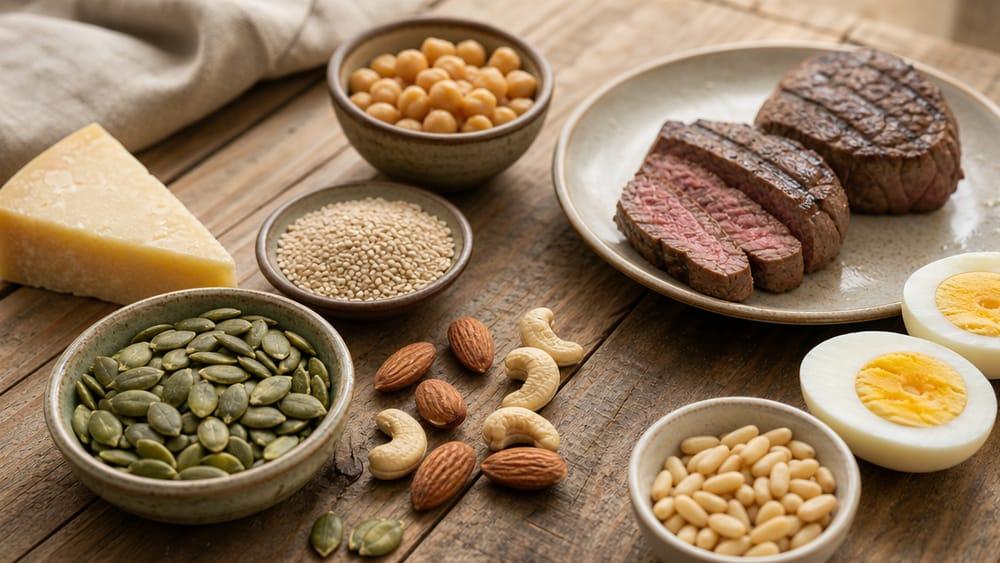
A low-carb pattern is not usually a low-zinc pattern — often the opposite, since it leans on meat, eggs, fish, dairy, nuts and seeds, which are the densest and most bioavailable zinc sources there are. The problem appears when the pattern quietly becomes a "products diet": processed snacks, not much real protein, and few nuts or seeds.
No bread treats a zinc deficiency, and no product replaces a visit to your doctor. But there is a real difference between a snack built on refined starch and one built on nuts and seeds. At Bakery 8 (مخبز ثمانية) in Riyadh, our products are made primarily from almond flour with no added sugar — which means what you eat between meals comes from the same nuts and seeds that carry the zinc in the table above:
- Keto granola — a base of nuts and seeds instead of sweetened cereal.
- Crackers and manakish — a practical alternative to starchy snacks.
- Samoli and cloud bread — everyday bread built on almond flour.
The idea is simple: let zinc come from your plate first, then discuss a supplement with your doctor if a need remains. If you are following the nutrient series on our blog, our article on vitamin D and bone health applies the same logic to a different nutrient.
Frequently asked questions ❓
Does zinc prevent colds?
Probably not. The 2024 Cochrane review analysed nine studies with 1,449 participants and concluded there may be little or no reduction in the risk of developing a cold compared with placebo, at low certainty. It also found no benefit for the number of colds per year or symptom severity. Taking zinc daily all winter for prevention is not supported by current evidence.
How much zinc do I need daily, and what is the limit?
The recommended dietary allowance for adults is 11 mg for men and 8 mg for women, per the NIH. The tolerable upper intake level from all sources combined is 40 mg per day for anyone 19 and older. Regularly exceeding that ceiling is what is linked to copper deficiency and lower HDL cholesterol.
Can a blood test tell me whether I'm zinc deficient?
Not conclusively. The Linus Pauling Institute states there is no sensitive and specific biomarker for zinc deficiency in humans, and serum zinc is confounded by inflammation, stress, hormones and time of day. A reading can look "normal" alongside real deficiency, or read low simply because you are ill. The decision belongs to your doctor and your full context, not one number.
Are zinc lozenges worth it if I start early?
They may shorten a cold by about two days per Cochrane 2024, but with a wide confidence interval (4.21 down to 0.53 days) and low certainty, plus a probable increase in non-serious side effects like taste disturbance and nausea. Mayo Clinic ties any benefit to starting within 24 hours of symptom onset. It is a personal call, best discussed with your pharmacist or doctor.
What about zinc nasal sprays?
Avoid them. Mayo Clinic states that intranasal zinc has been linked to loss of the sense of smell, and that the loss may last for a long time. The risk is out of proportion to any possible benefit.
Can I take zinc with an antibiotic?
Only with a time gap. Zinc reduces the absorption and effectiveness of quinolone and tetracycline antibiotics; the usual advice is to take the antibiotic two hours before zinc or four to six hours after. Check with your pharmacist in every case, particularly with long-term medications.
The bottom line
Zinc is a textbook case of a real nutrient marketed the wrong way. It genuinely is required for immune function, deficiency genuinely does harm, and correcting it in the people who need it produces a measurable difference — as ZIPS-2 showed in August 2026. None of that means a daily tablet adds immunity to someone whose diet already covers it, and none of it makes "more" mean "better." The 40 mg ceiling exists for a reason.
Start with the plate: enough protein, nuts and seeds regularly, and snacks that earn their place. If you are looking for sugar-free, almond-flour options in Riyadh, browse Bakery 8's range — healthy and delicious — and take any supplement question to your doctor.
References
- NIH Office of Dietary Supplements — "Zinc: Fact Sheet for Health Professionals."
- NIH Office of Dietary Supplements — "Zinc: Fact Sheet for Consumers."
- Nault D et al. — "Zinc for prevention and treatment of the common cold," Cochrane Database of Systematic Reviews, 2024 (CD014914).
- Namazzi R, Mellencamp KA, Bagala I, et al. — "Daily Zinc Supplementation for Infection Prevention in Children With Sickle Cell Anemia: The ZIPS-2 Randomized Clinical Trial," JAMA, 19 August 2026 (trial registration NCT06561061).
- Linus Pauling Institute, Oregon State University — Micronutrient Information Center, "Zinc."
- StatPearls, US National Library of Medicine — "Zinc Deficiency."
- Mayo Clinic — "Zinc" (Drugs and Supplements).
- Albalawi AS et al. — "The Prevalence of Vitamin and Mineral Deficiencies and High Levels of Non-Essential Heavy Metals in Saudi Arabian Adults," Healthcare, 2022.
- Jastaniah W — "Epidemiology of sickle cell disease in Saudi Arabia," Annals of Saudi Medicine, 2011.
- Center for Infectious Disease Research and Policy (CIDRAP), University of Minnesota — report on the 2024 Cochrane zinc review.
Related keywords: zinc and immunity, zinc deficiency, zinc deficiency symptoms, zinc supplements, daily zinc dosage, zinc for colds, zinc lozenges, zinc and copper, dietary sources of zinc, zinc upper limit.