

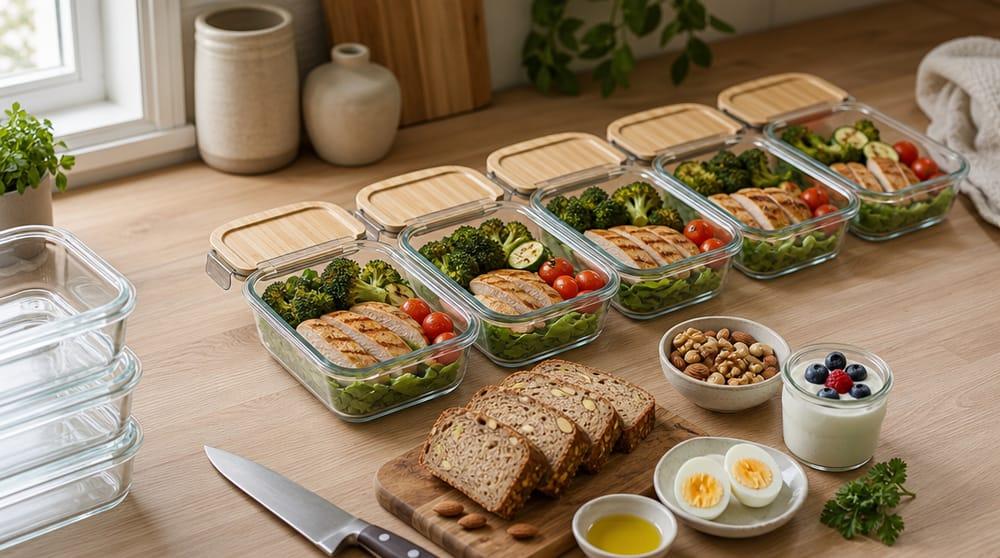
Weekly meal prep means setting aside one block of time each week — 90 minutes is usually enough — to plan, shop, cook, and portion most of your meals in advance, instead of deciding what to eat while you are hungry and tired. The idea is simple, but the effect is large: when a healthy meal is already sitting in the fridge, it becomes the easy option rather than the one that requires willpower. In a large French study of 40,554 adults, meal planning was associated with greater food variety, better diet quality, and lower odds of obesity. In this guide from Bakery 8 (مخبز ثمانية) in Riyadh, Saudi Arabia, you will find a practical four-step plan, a 90-minute prep timetable, the food-safety numbers worth memorising, and how to keep your week low-carb without living in the kitchen. 🥗
What exactly is weekly meal prep?
Meal prep is not a diet. It is an operating system for your kitchen. Its core idea is to move the food decision away from the moment of hunger — when it is at its worst — to a calm moment when you can think clearly. It also comes in more than one form. Harvard T.H. Chan School of Public Health describes meal prep as flexible and tailored to your schedule, cooking ability, and personal goals. The common variations are:
- Full meal prep: complete meals portioned into individual containers that you simply take out and reheat. Best for workday lunches.
- Ingredient prep: instead of finished meals, you prepare the building blocks — sliced grilled chicken, roasted vegetables, hard-boiled eggs, washed greens — and assemble a different meal in five minutes each day.
- Batch cooking: cook one recipe in double or triple quantity, eat part of it and freeze the rest in portions.
- Partial prep: prepare only one meal a day — breakfast, for example — and leave the rest flexible. An excellent starting point if the whole idea feels overwhelming.
There is no single "correct" method. The best one is the one you will actually repeat next week.
Why does the healthy week usually fall apart?
Most dietary slips do not happen because of missing knowledge. They happen in the gap moment: it is 8 p.m., you have just got home, the fridge holds raw ingredients that need 40 minutes, and the delivery app needs 40 seconds. The outcome writes itself.
This is not just a personal problem. A 2024 study in Frontiers in Public Health on dietary trends and obesity in Saudi Arabia reported that 61% of participants ate restaurant food weekly and 15% ate it daily, while only 4% never ate from restaurants. The study also noted a shift in Saudi eating habits toward a Western dietary pattern high in fat, salt, and sugar.
Why does that matter? Because a U.S. Department of Agriculture Economic Research Service report (Todd, Mancino & Lin, ERR-90, 2010) found that food away from home increases daily calorie intake and reduces diet quality for the average adult: breakfast away from home lowered whole-grain and dairy servings per 1,000 calories while raising saturated fat and added sugar, and dinner away from home reduced vegetable servings.
Meal prep does not fix weak willpower — it removes the need for it. When you open the fridge and a balanced meal is already there, there is no decision left to make.
What does the research say about meal planning?
The clearest available evidence comes from the French NutriNet-Santé cohort, published in the International Journal of Behavioral Nutrition and Physical Activity in 2017, which analysed data from 40,554 adults. Fifty-seven per cent reported planning their meals at least occasionally. After adjustment, meal planning was associated with:
- Greater food variety (odds ratio 1.25 for the highest versus lowest quartile).
- Better adherence to national nutritional guidelines (odds ratio 1.13).
- Lower odds of obesity: 0.79 in women (and 0.92 for overweight); 0.81 in men.
This is an observational study, so it shows association rather than proven causation — people who plan meals may already be more health-conscious. But the direction is consistent with everyday experience: what is already cooked in your home decides what you eat far more reliably than your intentions do.
The four-step plan: how to start
Step 1: pick one fixed day
Choose a single day each week for planning, shopping, and cooking — Friday or Saturday usually works best in Saudi Arabia. Put it in the calendar as a real appointment. Harvard recommends starting that day by setting the week's menu first, then shopping against it, not the other way round. Shopping without a list is the fastest route to a fridge full of ingredients that never become a meal.
Step 2: build a plate template, not a complicated menu
You do not need 21 different recipes. You need one template you keep reassembling. The Diabetes Plate Method used by the American Diabetes Association (ADA) is the simplest reliable template: fill half the plate with non-starchy vegetables, a quarter with a protein source, and the final quarter with a carbohydrate source — and for anyone following a low-carb pattern, that last quarter is swapped for a low-carb option such as almond-flour bread or more fibre-rich vegetables.
Then change only the variables: the protein (chicken, beef, fish, eggs), the vegetables (broccoli, courgette, peppers, spinach), and the flavour profile (lemon and herbs; cumin and coriander; smoked paprika). One template × three variables = a full week with no boredom and no complexity.
Step 3: batch cook in a smart order
Sequencing saves half the time. The rule from Harvard's guide: start with whatever takes longest. Get the oven going first for proteins and roasted vegetables, and while they cook, wash the greens, chop the vegetables, and boil the eggs. Never stand and wait.
- Heat the oven and put in the protein tray (chicken or beef) and the roasting-vegetable tray.
- Put the eggs on to boil.
- Meanwhile: wash and thoroughly dry the greens, chop cucumbers, peppers, and tomatoes.
- Make one multi-purpose dressing (olive oil, lemon, garlic, herbs).
- Take the trays out, let them cool briefly, then portion.
Step 4: portion, store, and label the date
Portion food into shallow containers — this is not a styling detail but an explicit food-safety recommendation from FoodSafety.gov, because shallow containers cool food far faster than deep ones and therefore shorten the time food spends in the danger zone. Use single-serve containers for meals you will take with you, and family-sized ones for what goes on the table.
Then write the date on every container. Harvard recommends freezing extra portions with clear labels and dates — because "when was this cooked?" is a question that should never be answered by guessing or sniffing.
A 90-minute prep timetable
A realistic single session that covers most of the week:
- 0–10 minutes: heat the oven, season the protein, put the eggs on.
- 10–20 minutes: chop vegetables, spread them on trays, get everything into the oven.
- 20–45 minutes: wash and dry greens, make the dressing, assemble the week's breakfasts (unsweetened Greek yoghurt with nuts, or eggs).
- 45–65 minutes: take out the trays, peel the eggs, cool everything quickly on the counter.
- 65–85 minutes: portion into shallow containers and write the dates.
- 85–90 minutes: organise the fridge — what will be eaten within 3 days at the front, and whatever is destined for the freezer goes in immediately.
The food-safety numbers worth memorising
This is the part most often skipped, and the most important — especially in a Riyadh summer. The following figures come from the USDA Food Safety and Inspection Service and the U.S. government's FoodSafety.gov:
- Refrigerator temperature: 4°C (40°F) or below.
- Freezer temperature: −18°C (0°F) or below.
- The danger zone: 4°C to 60°C (40–140°F) — bacteria multiply rapidly in this range.
- The two-hour rule: refrigerate perishable food within two hours of cooking. If the ambient temperature is above 32°C (90°F) — that is most of our summer — the window is one hour only.
- How long leftovers keep in the fridge: 3 to 4 days (cooked meat and poultry, soups and stews).
- Reheating: to an internal temperature of 74°C (165°F).
- Cooling: in small, shallow containers.
For the freezer, useful figures from the FoodSafety.gov cold storage charts and Harvard's guide: soups, stews, and cooked beans 2–3 months; cooked meat and poultry 2–6 months; cooked ground meat 3–6 months; blanched vegetables 8–12 months. Properly frozen food stays safe for a long time, but its quality declines over time.
One practical note: do not rely on smell or appearance to judge leftovers. The bacteria that cause foodborne illness may not change the smell or taste at all. The date written on the container is more honest than your nose.
Does freezing destroy nutrients?
This is the objection that stops most people from prepping ahead, and the answer is reassuring. In a study published in the Journal of Agricultural and Food Chemistry in 2015 (Bouzari and colleagues), researchers compared levels of ascorbic acid (vitamin C), riboflavin, alpha-tocopherol, and beta-carotene across eight items — corn, carrots, broccoli, spinach, peas, green beans, strawberries, and blueberries — under refrigerated versus frozen storage. Frozen foods often had comparable, and occasionally higher, vitamin content than refrigerated fresh produce, across the majority of vitamins analysed.
The reason makes sense: the "fresh" vegetables in your fridge are not really fresh — they may have been picked days ago. Freezing stops the clock. The idea that frozen is nutritionally inferior is an inaccurate oversimplification.
A useful finding: freezing then toasting lowers bread's blood-sugar response
In a small but striking study published in the European Journal of Clinical Nutrition (Burton and Lightowler), 10 healthy participants had their glucose response measured after eating white bread prepared in different ways. The results (incremental area under the curve, mmol·min/L) for homemade bread were:
- Fresh: 259
- Frozen then defrosted: 179
- Toasted: 193
- Frozen, defrosted, then toasted: 157
All three treatments lowered the glucose response compared with fresh bread, and freezing followed by toasting was the strongest. The likely explanation is the formation of resistant starch through retrogradation during cooling — a starch that resists rapid digestion.
It is important to keep this in proportion: the study was small (10 people) and used white bread, and it does not make white bread a suitable choice for anyone watching their blood sugar — the difference is relative, within a food that is high in carbohydrate to begin with. But it does support a practical habit: freezing low-carb bread and toasting it at serving time is not just a storage trick, it is a sensible practice. If you want to go deeper on how food affects blood sugar, see our article on prediabetes and how to reverse it.
A weekly low-carb shopping list
A workable list from the Saudi supermarket, organised by its role on the plate:
- Protein: chicken breasts, lean minced beef, fish (hammour or salmon), eggs, tuna canned in water, a whole roasting chicken.
- Non-starchy vegetables: broccoli, cauliflower, courgette, mixed peppers, cucumber, tomatoes, spinach, rocket, mushrooms, aubergine.
- Healthy fats: extra virgin olive oil, avocado, almonds, walnuts, chia seeds, unsweetened tahini.
- Dairy: unsweetened Greek yoghurt, labneh, natural full-fat cheeses.
- Starches (for non-keto eaters): lentils, chickpeas, unsweetened steel-cut oats.
- Low-carb baked goods: almond-flour bread, low-carb toast, savoury crackers for snacking.
- Storage: shallow glass containers with tight lids, freezer bags, labels, and a marker.
A practical tip: count your needs in meals, not in items. "10 lunches and 7 breakfasts" is far clearer than "some chicken and vegetables".
Five common meal-prep mistakes
- Starting too ambitiously: 21 meals in week one is a reliable recipe for quitting. Start with five lunches only.
- Ignoring variety: the same dish seven days running kills adherence. Change the marinade and the sauce, not the whole recipe.
- Storing everything in the fridge: anything beyond 3–4 days should go into the freezer on day one, not sit waiting until it is close to spoiling.
- Deep, hot containers: they slow cooling and keep food in the danger zone longer. Choose shallow, and portion before chilling.
- Forgetting snacks: most slips happen between meals, not at them. Keep a protein snack or low-carb crackers within reach. See also our article on protein and satiety.
Who should take extra care?
Meal prep is safe and practical for most people, but some situations need tailoring:
- People with diabetes using insulin or glucose-lowering medication: suddenly changing the carbohydrate content of your meals may require a dose adjustment. Plan the change with your doctor or dietitian and monitor your readings closely in the first days.
- People with kidney disease or high blood pressure: watch the salt in large-batch marinades — one salty batch repeats itself in every meal of the week.
- Pregnant and breastfeeding women, older adults, and the immunocompromised: these groups are more vulnerable to complications from foodborne illness; apply the two-hour rule (one hour in heat) and the 3–4 day limit more strictly.
- Coeliac disease and wheat sensitivity: dedicate separate chopping boards and utensils to avoid cross-contamination with gluten. For more, see our article on non-celiac gluten sensitivity.
This article is for nutritional education and awareness only and is not a substitute for medical advice. If you take medication or have a chronic condition, consult your doctor or dietitian before making substantial changes to your diet.
How Bakery 8 removes half the prep day
The hardest part of meal prep is baked goods: kneading and baking take longer than everything above put together. This is where Bakery 8 fits into your plan as a ready-made step rather than an afterthought:
- Samoli bread, cloud bread, and toast — baked with almond flour and no added sugar, and they freeze beautifully. Freeze the loaves already portioned, take out what you need, and toast at serving time — which is precisely what the bread study above points to.
- Keto granola — solves breakfast in 60 seconds over unsweetened Greek yoghurt, with no added sugar.
- Manakish and crackers — a ready snack you can pre-portion into small bags, closing the between-meals gap that derails most plans.
- Sugar-free desserts — a pre-planned weekly portion beats a spur-of-the-moment decision in front of the dessert shelf.
Every Bakery 8 product is free from added sugar and wheat flour, which aligns with the World Health Organization recommendation to reduce free sugars to less than 10% of total daily energy, with additional health benefit below 5%.
Frequently asked questions
How many days does prepped food keep in the fridge?
According to the USDA, most cooked leftovers — meat, poultry, soups, and stews — stay safe in the refrigerator for 3 to 4 days at 4°C or below. Anything you plan to eat after day four should be frozen on day one rather than left in the fridge until its window is nearly closed.
Does meal prep actually help with weight loss?
The evidence is observational rather than conclusive. In the NutriNet-Santé study of 40,554 adults, meal planning was associated with lower odds of obesity (0.79 in women and 0.81 in men). Planning does not burn calories by itself, but it improves food quality, controls portions, and reduces reliance on ready-made meals — and those are the mechanisms through which it works.
What is the best meal-prep day in Saudi Arabia?
Friday or Saturday for most people, because they sit right before the working week, so meals are at their freshest on the busiest days. If you prefer to split the effort, use two short sessions — one at the weekend and one mid-week — instead of a single long one.
Does freezing reduce the nutritional value of food?
Not in the way people assume. In a 2015 study in the Journal of Agricultural and Food Chemistry covering eight fruits and vegetables, vitamin content in frozen items was comparable — and sometimes higher — than in fresh produce stored in the refrigerator. Freezing halts the nutrient decline that continues day after day in "fresh" produce.
How do I prep low-carb meals without getting bored?
Fix the template and change the flavour. Keep the same plate structure — half non-starchy vegetables, a quarter protein, a quarter low-carb option — and rotate the marinades weekly: lemon and herbs, then cumin and coriander, then smoked paprika. Changing the spices creates a sense of variety at almost no extra effort.
Do I need special equipment?
No. You need two oven trays, a good knife, a chopping board, a set of shallow glass containers with tight lids, and a marker and labels for dates. Glass containers are practical because they go in the oven and microwave and show their contents, so less food is forgotten at the back of the fridge.
Conclusion
Weekly meal prep is not a luxury for people with spare time. It is the lowest-effort way to make the healthy choice the automatic one. Ninety minutes on a single day, one fixed plate template, and seven food-safety numbers — that is all that stands between you and a week that does not require heroic willpower at 8 p.m.
And when you reach the part that needs an oven and dough, let Bakery 8 handle it: almond-flour baked goods, no added sugar, no wheat flour — ready to freeze and toast whenever you need them. Healthy and delicious. 🌿
References
- Ducrot P, et al. Meal planning is associated with food variety, diet quality and body weight status in a large sample of French adults. International Journal of Behavioral Nutrition and Physical Activity, 2017.
- Burton P, Lightowler HJ. The impact of freezing and toasting on the glycaemic response of white bread. European Journal of Clinical Nutrition, 2008.
- Bouzari A, Holstege D, Barrett DM. Vitamin Retention in Eight Fruits and Vegetables: A Comparison of Refrigerated and Frozen Storage. Journal of Agricultural and Food Chemistry, 2015.
- U.S. Department of Agriculture, Food Safety and Inspection Service (FSIS). Leftovers and Food Safety; Danger Zone (40°F–140°F).
- FoodSafety.gov (USDA/FDA/CDC). Cold Food Storage Charts; Leftovers guidance.
- Harvard T.H. Chan School of Public Health, The Nutrition Source. Meal Prep Guide.
- Todd JE, Mancino L, Lin B-H. The Impact of Food Away From Home on Adult Diet Quality. USDA Economic Research Service, Report ERR-90, 2010.
- Dietary trends and obesity in Saudi Arabia. Frontiers in Public Health, 2024.
- American Diabetes Association (ADA). The Diabetes Plate Method.
- World Health Organization. Guideline: Sugars intake for adults and children, 2015.
Related keywords: weekly meal prep, meal planning, batch cooking, keto meal prep, low-carb meal prep, food storage safety, freezing bread, healthy work lunches, almond flour bread, leftovers safety.