

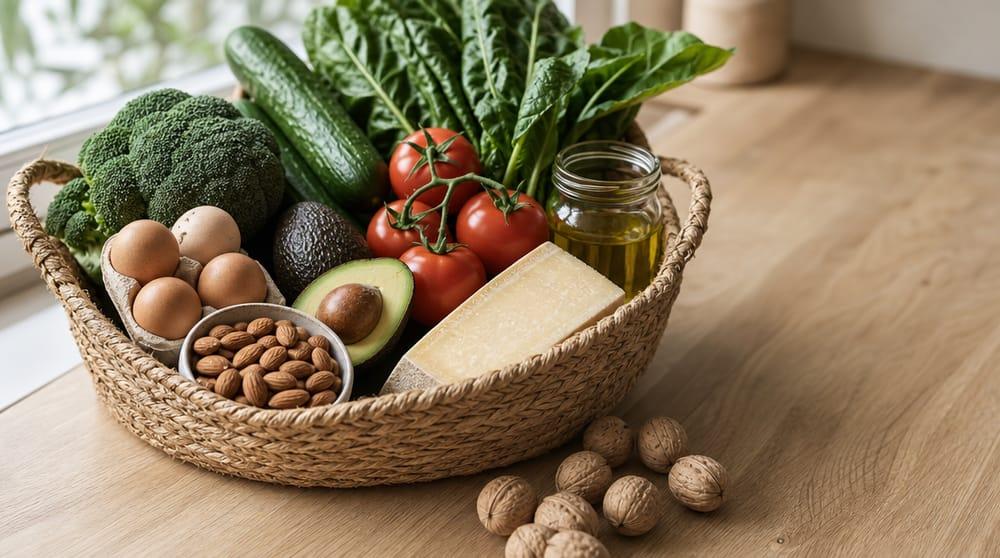
Smart grocery shopping means settling your food decisions before you walk into the store, rather than fighting them in front of the shelves. The evidence available today says something both reassuring and uncomfortable: what changes the contents of your cart is not your willpower in the moment, but how food is arranged around you — what is available, what is within reach, what size the package is, and what is on offer today. In this article we take apart the most famous shopping rule of all — “never shop hungry” — and discover that the study behind it was formally retracted. Then we replace it with what the research actually supports, and turn that into a practical plan for a household in Riyadh.
This is not an article about reading nutrition labels; we already published a full guide to that. This one is about what happens before you ever pick the package up: about the store as an environment, your kitchen as an environment, and the handful of decisions that determine what your family eats over the next twenty-one meals.
🛒 Why “never shop hungry” isn’t enough
You have probably heard it dozens of times: don’t enter the supermarket on an empty stomach. The rule sounds sensible, it is comfortable, and it appears in almost every article about shopping. Its scientific footing, however, is far weaker than most people assume.
The most-cited source for the rule is a 2013 paper in JAMA Internal Medicine titled “Fattening Fasting: Hungry Grocery Shoppers Buy More Calories, Not More Food.” On 19 September 2018, the journal itself retracted that paper, as part of a series of retractions affecting the same researcher’s work, preceded by an Expression of Concern in April of the same year. Put plainly: the number the advice was built on no longer exists in the scientific literature.
What does that mean in practice? It does not mean hunger has no effect — it is entirely plausible that a depleted person decides differently. It means we do not have the strong evidence we thought we had, and that building an entire shopping strategy on “eat something before you leave” is building on soft ground. More importantly, the rule places the whole burden on your personal discipline in a single moment, while the stronger evidence says the real levers are structural — in the design of the place, not the design of your character.
That is actually a liberating message. If much of the choosing happens by arrangement rather than by resolve, you are not a “weak-willed” person because you walked out with things you had not planned. You simply shopped inside an environment that was very well designed to sell.
📊 What actually changes your cart: four evidence-backed factors
Set the folk rules aside and look at the systematic reviews and field experiments, and four factors keep reappearing. All of them are about distance, size, price and placement — none of them is about intention.
1) Availability and proximity: the shorter the distance, the higher the intake
A Cochrane systematic review (Hollands and colleagues, 2019) examined how altering the availability and proximity of products changes their selection and consumption, including 24 studies. For availability, exposure to fewer options produced a large reduction in selection (standardised mean difference −1.13, 95% CI −1.90 to −0.37, across 154 participants). For proximity, placing food farther away produced a moderate reduction in consumption (SMD −0.60, 95% CI −0.84 to −0.36, across 15 comparisons from 12 studies and 1,098 participants).
The authors rate the certainty of this evidence as low, and that honesty deserves to be passed on intact. But the direction is consistent: food that is nearer gets eaten more, food that is farther gets eaten less. That is precisely the language store design speaks — front-of-store displays, aisle end-caps, eye level.
2) The checkout zone: our strongest field evidence
The best natural experiment here comes from the UK. In a study by Ejlerskov and colleagues, published in PLOS Medicine in 2018, researchers tracked supermarket chains that introduced policies removing less-healthy foods from checkouts (sugary confectionery, chocolate, crisps), using purchase data from roughly 30,000 households.
The result: an immediate 17.3% reduction in purchases of those items, still at 15.5% twelve months later — so not a passing novelty effect. In the cross-sectional analysis of “on-the-go” purchasing, annual purchases of these items were 76.4% lower (95% CI 48.6% to 89.1%) at supermarkets with checkout policies compared with those without.
An evidence brief from the MRC Epidemiology Unit at the University of Cambridge shows how large the difference in display itself was: in stores with strong policies, 35% of foods displayed at checkouts were less healthy; that rose to 57% where policies were weak, and to 90% where there was no policy at all. Likewise, 72% of checkouts had no food whatsoever in the first group, versus only 38–39% elsewhere.
Notice what those numbers say. Nobody’s awareness changed. Nobody attended a nutrition class. Only the location of the sweets changed.
3) Package size: the nudge you carry home yourself
This is one of the strongest and most overlooked pieces of evidence. A Cochrane review (Hollands and colleagues, 2015) examined the effect of portion, package and tableware size on consumption across 72 randomised trials and 6,603 participants. Exposure to larger sizes increased consumption with a standardised mean difference of 0.38 (95% CI 0.29 to 0.46), at moderate certainty — higher than much of the evidence in this field.
The authors estimated that eliminating exposure to larger sizes across the whole diet could reduce average daily energy intake by roughly 144 to 228 calories among UK adults and children (8.5% to 13.5% of a 1,689-calorie baseline).
The practical takeaway is counter-intuitive but powerful: the size of the package you buy today is a decision about how much you will eat all week. The giant family bag of crisps is not only a saving; it is also an implicit instruction to eat more.
4) Price promotions: why discounts tilt toward the less healthy
Nakamura and colleagues, writing in the American Journal of Clinical Nutrition in 2015, analysed purchase data from around 27,000 British households, covering more than 11,000 products across 135 food categories. The central finding: price promotions lift sales of less healthy foods considerably more than they lift sales of healthier ones — an increase of roughly 35% versus about 20% for healthier foods at a comparable increase in promotion.
Fairness requires adding what the study also found: overall, less-healthy items were not promoted more often than healthier ones, with exceptions in some categories. In other words, the problem is not necessarily that discounts are “targeting” you; it is that your response to a discount is stronger when the product is less healthy. That distinction matters, because it means the answer is not to avoid promotions altogether, but to have a clear rule for handling them — we will set one out shortly.
🇸🇦 Half of shoppers never even pick the product up: the Saudi data
In a national observational study published in Nutrition and Health in 2022 (Almutairi and colleagues), researchers observed 12,675 shoppers in real stores across all thirteen administrative regions of Saudi Arabia. The findings are worth sitting with:
- 52.2% did not interact with the product at all before putting it in the cart — they did not turn it over or look at anything on it.
- The most frequently checked item was the production date (66.6%), followed by the expiry date (51%).
- Nutrition facts were examined by only 29%.
- The researchers concluded there was a low level of dietary knowledge and a moderate level of belief in package and media claims.
That first number — more than half of purchases made without touching the product — is the key to this whole article. If the decision takes one second and is made by eye alone, then betting on “I’ll read the label in the aisle” is a weak bet. The stronger bet is to settle the decision in your kitchen, on paper, before you start the car.
🏠 The most powerful shelf you control isn’t in the store — it’s in your kitchen
Here is the central idea we hope you take away: the same physics the store uses on you, you can use for yourself at home. The availability-and-proximity principle documented by Cochrane does not know the difference between a supermarket shelf and a fridge shelf. The only difference is that at home you are the merchandiser, not the customer.
That reframes the shopping trip itself. You are not buying “groceries” — you are configuring the food environment your family will live in for seven days. Every item you put in the cart is an option that will be available at eleven at night when someone opens the fridge. Every item you don’t, simply won’t be.
A “re-merchandise the kitchen” checklist for after every shop
- Fridge eye level for the things you want eaten more: washed and cut vegetables in a clear container, boiled eggs, plain yoghurt, cheese.
- Top or back shelf for what you want eaten less — not as deprivation, but to add one step between you and it.
- The kitchen counter is not storage; it is an aisle end-cap inside your home. Whatever sits on it gets eaten. Put there what you mean to eat.
- Clear container versus opaque bag: what you see gets consumed more. Use that for vegetables and nuts, not for sweets.
- Break down large packages the moment you get home into small portions in bags or boxes. This is the direct application of the 2015 Cochrane finding — and it is cheaper and easier than buying expensive single-serve packs.
📝 The three-list method: plan the week before you enter the store
Most people write one list — the shopping list — and they write it from memory while standing at the door. The predictable result: half of it is missing, and half of it duplicates what is already in the cupboard. The alternative is three short lists, in order, taking no more than fifteen minutes in total:
- The inventory list: open the fridge, freezer and cupboard and write down what you actually have, and what is close to expiring. Harvard Health suggests a practical trick: photograph the inside of your fridge and pantry with your phone before you leave, so you can check in the aisle instead of guessing.
- The meals list: write out the week’s meals — not elaborate recipes, just meal names. Mayo Clinic advises deciding first which nights you will genuinely cook and which nights you will only reheat leftovers, then building around that. Plan the plate with a simple rule: half vegetables and fruit, a quarter protein, and the last quarter grains — preferably whole grains.
- The shopping list: which is simply (the meals list) minus (the inventory list). Sort it by store section rather than by stream of thought, so you are not circling the aisles for a single item — every extra lap is extra exposure.
Mayo Clinic and Harvard Health agree on one point here: a written list makes it easier to resist impulse purchases and reduces unplanned trips for forgotten items. This is not a moral lesson about discipline; it is a tool for reducing the number of decisions you will have to make inside an environment engineered to sell. If you want to extend the idea into the kitchen itself, we covered it in detail in our weekly meal prep guide.
🗺️ A route map: shopping the store in a smarter order
The order of your route is not cosmetic; it applies the availability-and-proximity principle to yourself. The practical suggestion, which Harvard Health also recommends:
- Start with the perimeter: produce, proteins, dairy. These sections fill the cart with staples first.
- Enter the centre aisles with a specific list and a specific purpose, not to browse. An aisle with nothing on your list does not need a visit.
- Treat end-caps and the checkout zone as advertising, not as sections. What is placed there is placed there for a commercial reason, not because it is what you need.
- Avoid shopping with hungry children where possible — note that parents in the Cambridge review described brightly coloured packaging placed at a child’s eye height as the hardest problem of all. If it is unavoidable, give the child a job from the list (find the cucumbers, pick the vegetables) rather than letting them browse.
- Make fewer trips: every extra visit is extra exposure to everything above.
📦 The package rule: small for what you want less of, large for what you want more of
This is the simplest rule in the article and the most effective — it takes the 2015 Cochrane finding and turns it around in your favour:
- For anything you wish you ate less of (sweets, crisps, sugary drinks): buy the smallest package available — even if the unit price is higher. The price difference is usually far smaller than the difference in how much you will eat.
- For anything you wish you ate more of (vegetables, pulses, eggs, unsweetened nuts): buy the largest package you can realistically finish before it spoils.
- If the promotion only exists on the large package of something you want less of, portion it out immediately at home before it goes in the cupboard. A large, open package is the worst-case scenario.
🏷️ The promotion test: three questions before it goes in the cart
Since our response to discounts is stronger for less-healthy foods (Nakamura 2015), the answer is not to refuse promotions — a deal on lentils, eggs or frozen vegetables is a genuine gift to the budget. The answer is a three-question rule:
- Would I have bought this at full price this week? If the answer is no, you are not saving money; you are spending money you were not going to spend.
- Do I have a realistic plan to use it before it spoils? Food that gets thrown away is a total loss, not a discount.
- Is this a staple or a treat? Stock up without hesitation on shelf-stable staples; apply the small-package rule to treats.
♻️ Bulk buying and waste: when saving becomes losing
According to the United Nations Environment Programme (UNEP) Food Waste Index Report 2024, the world generated 1.05 billion tonnes of food waste in 2022, with households responsible for 60% of it, averaging roughly 132 kilograms per person per year — close to one-fifth of all food available to consumers.
The report notes an observation that concerns us directly: hotter countries appear to generate more household food waste per capita, likely reflecting greater consumption of fresh foods with substantial inedible parts, along with cold-chain challenges. In Riyadh’s climate specifically, that changes the economics of buying large quantities of fresh produce: the deal that looks like a saving on the shelf can be a net loss by the end of the week.
The working rule: buy fresh food to the size of your plan, and buy the larger quantity of things that store well — frozen items, dried pulses, canned goods with no added sugar, and anything you can freeze the moment you get home.
🤔 Do “clever nudges” always work? An honest reading of the evidence
It is easy for talk of “environment design” to turn into an oversold promise, so the other side deserves airtime. In a large randomised trial published in BMC Medicine in 2022 (Stuber and colleagues), nudges were tested inside a real online supermarket with 11,775 shoppers across four arms (control, information nudges, position nudges, and both combined).
The overall result: no meaningful effect. In the detailed analysis, the healthiness of purchases improved by just 2.4% (95% CI 0.8 to 4.0) among shoppers from deprived areas in the information-nudge arm, while it actually decreased among shoppers from non-deprived areas (−1.6% and −2.1%).
There is a double lesson here. First, do not believe anyone selling you a single psychological trick that solves everything; what works in a lab may not work in a real shopping basket. Second, notice the difference between what worked and what didn’t: big, permanent structural changes (removing sweets from checkouts entirely) produced a clear effect that lasted a full year, while light hints did nothing. The same applies at home: the purchase decision — whether an item enters your house at all — is far more powerful than any reminder note on the fridge.
✅ Quick tips to apply on your next shop
- Write the three lists, even on a scrap of paper; fifteen minutes in the kitchen saves an hour in the store.
- Photograph the inside of your fridge and cupboard before you leave.
- Sort your list by store section, and start with the perimeter.
- Apply the package rule: small for what you want less of, large for what you want more of.
- Run every promotion through the three questions.
- Break large packages into portions as soon as you get home — before you sit down.
- Wash and cut vegetables the same day and put them in a clear container at eye level.
- Don’t let the counter become sweet storage; make it the display for what you want eaten.
- Reduce the number of weekly store trips rather than increasing them.
- Check the nutrition facts, not the front-of-pack claims — especially given that only 29% look at them.
⚠️ Who should take extra care, and when to see a professional
This article is general education and does not replace individual medical advice. Some situations need tailoring that no article can provide:
- People with diabetes and anyone using insulin: a substantial change in what you buy and eat may require reviewing doses with your doctor. Never adjust medication on your own.
- People with celiac disease: your purchasing decisions are a medical necessity, not a dietary preference, and include watching for possible cross-contamination in products not explicitly labelled gluten-free.
- People with food allergies: the ingredient list remains the reference, and no general rule in this article replaces it.
- Anyone with anxiety or a difficult relationship with food: if rules and lists increase stress rather than reduce it, stop and speak to a dietitian or mental health professional. Organisation is meant to bring relief, not a new burden.
- Pregnant women, older adults, and people with kidney or heart conditions: protein, sodium and fluid needs can differ substantially and should be set with a doctor or dietitian.
🥖 Where does Bakery 8 fit into all this?
Let’s be honest: no product buys you a habit. The list, the planning and the kitchen layout are what make the difference, and no loaf substitutes for them. But the logic we have laid out — that what goes in the cart today is what will be available at home all week — makes the choice of “default staples” worth thinking about. That is where Bakery 8 / مخبز ثمانية in Riyadh, Saudi Arabia can help:
- Bread and toast: the sandwich base is the item that recurs in your kitchen almost daily. Almond-flour samoli, cloud bread and toast with no added sugar make the default option in your freezer one you actually chose — and they freeze well, which serves the waste rule above.
- Keto granola: a direct swap for the sweetened breakfast cereal that usually occupies eye level in the cupboard. If breakfast is decided by eye in the morning, let what the eye sees be pre-selected.
- Crackers and manaqish: the savoury option that takes the crisp packet’s place on the counter or in the work bag — exactly the spot the research shows matters most.
- Sugar-free chocolate and desserts: if an evening sweet is an established habit, applying the small-package rule with a sugar-free alternative is more realistic than deciding to “stop entirely.”
And as we always say: apply the same rule to our products that we are asking you to apply to everyone else’s — turn the package over, read the nutrition facts, and decide for yourself.
❓ Frequently asked questions
Is it true that shopping hungry makes me buy more?
The best-known study behind that rule (JAMA Internal Medicine, 2013) was formally retracted by the journal in September 2018, so it cannot be relied on. It is plausible that severe hunger affects decisions, but stronger evidence points to store layout, package size and promotions as the bigger influences. You are better off relying on a written list than on how full you feel.
What’s the single most important step if I have no time for all this?
Write a list before you leave, and sort it by store section. Mayo Clinic and Harvard Health both recommend the list specifically because it reduces impulse buying and repeat trips. If you add a second step, make it portioning out large packages as soon as you get home.
Is buying the large package really a saving?
It depends on the item. For shelf-stable goods (pulses, frozen items, canned foods with no added sugar) usually yes. For anything you want to eat less of, the 2015 Cochrane review found larger sizes increase consumption (SMD 0.38), so the “bargain” turns into extra calories. For fresh produce, factor in the probability of waste first.
Does kitchen arrangement really matter, or is it just motivational talk?
The 2019 Cochrane review found that placing food farther away reduced consumption (SMD −0.60) and that fewer options reduced selection, though the certainty of that evidence is low. The direction is consistent and the cost is zero: moving a bowl from one shelf to another costs you nothing even if the effect is modest.
How often should I shop each week?
There is no proven ideal number. But the logic of the evidence favours fewer trips with better planning, because every visit is extra exposure to displays and checkout zones. One planned weekly shop, plus a short top-up for fresh items if needed, is practical for most families.
My child asks for sweets at the checkout every time — what can I do?
This is not purely a parenting problem. According to the Cambridge review, up to 90% of foods displayed at checkouts are less healthy in stores with no policy, and parents described packaging placed at a child’s eye height as the hardest issue. Practically: prefer stores with food-free checkout lanes, give your child a task from the list, and settle the decision before you join the queue rather than while standing in it.
🎯 The bottom line
Smart grocery shopping is not a test of your willpower; it is a design task. The popular rule “never shop hungry” lost its scientific footing when its study was retracted, while stronger evidence points to four factors you can handle deliberately: availability and proximity, placement, package size, and price promotions. The good news is that the most powerful of these tools — arranging the environment — is entirely in your hands the moment you get back to your kitchen.
Start with one trip: three lists, a route that begins at the perimeter, a clear package rule, and ten minutes of rearranging after you get home. And if you want the staples in your freezer and cupboard to be options you chose deliberately from the start, you can browse Bakery 8’s range — almond-flour breads and desserts with no added sugar. صحي ولذيذ — healthy and delicious.
📚 References
- Tal A, Wansink B. “Fattening Fasting: Hungry Grocery Shoppers Buy More Calories, Not More Food.” JAMA Internal Medicine. 2013;173(12):1146–1148 — RETRACTED; retraction notice issued by JAMA Internal Medicine on 19 September 2018, preceded by an Expression of Concern on 13 April 2018.
- Hollands GJ, et al. “Altering the availability or proximity of food, alcohol, and tobacco products to change their selection and consumption.” Cochrane Database of Systematic Reviews. 2019; CD012573.
- Hollands GJ, Shemilt I, Marteau TM, et al. “Portion, package or tableware size for changing selection and consumption of food, alcohol and tobacco.” Cochrane Database of Systematic Reviews. 2015; CD011045.
- Ejlerskov KT, Sharp SJ, Stead M, Adamson AJ, White M, Adams J. “Supermarket policies on less-healthy food at checkouts: Natural experimental evaluation using interrupted time series analyses of purchases.” PLOS Medicine. 2018;15(12):e1002712.
- MRC Epidemiology Unit, University of Cambridge. “Checking out checkout food” — Evidence Brief.
- Nakamura R, et al. “Price promotions on healthier compared with less healthy foods: a hierarchical regression analysis of the impact on sales and social patterning of responses to promotions in Great Britain.” American Journal of Clinical Nutrition. 2015;101(4):808–816.
- Stuber JM, Lakerveld J, Kievitsbosch LW, Mackenbach JD, Beulens JWJ. “Nudging customers towards healthier food and beverage purchases in a real-life online supermarket: a multi-arm randomized controlled trial.” BMC Medicine. 2022;20:10.
- Almutairi LA, Althumiri NA, Aljadani RH, et al. “Consumer behavior at supermarkets during grocery shopping in Saudi Arabia: A national observational study.” Nutrition and Health. 2022;28(1):19–23.
- United Nations Environment Programme (UNEP). “Food Waste Index Report 2024.”
- Harvard Health Publishing, Harvard Medical School. “Eating better: 3 keys to healthy grocery shopping.”
- Mayo Clinic. “Menu planning: 5 steps to healthy eating.”
Related keywords: smart grocery shopping, healthy grocery list, impulse buying at the supermarket, supermarket promotions, package size and consumption, fridge organisation, weekly meal planning, household food waste, grocery shopping with diabetes, sugar-free bread.