

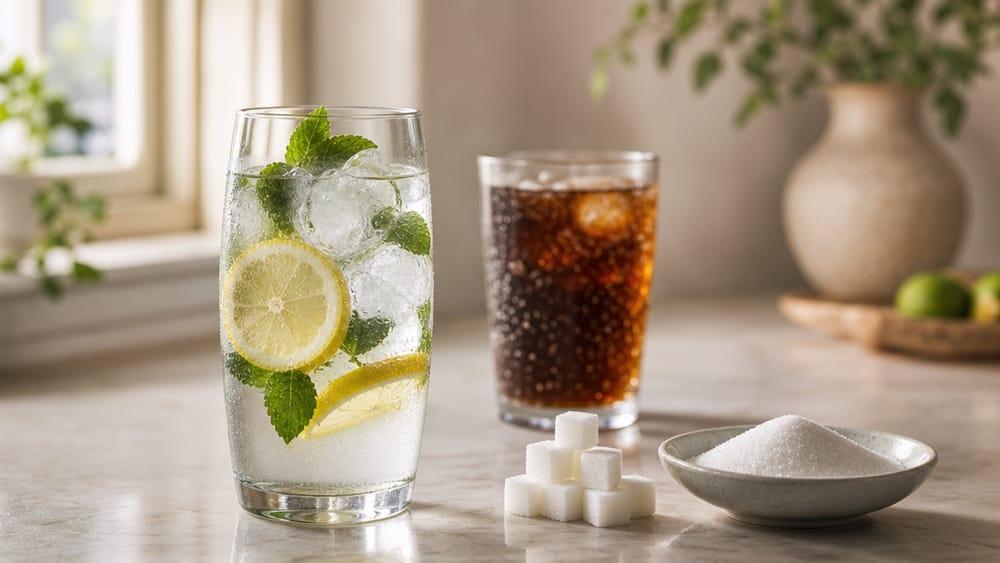
Sugary drinks are the single largest source of added sugar in many diets worldwide, and their real danger is not simply the calorie count — it is that your body does not treat them like food. The calories you drink do not make you feel full, so they get added on top of what you eat rather than replacing any of it. This article explains what actually happens when you drink a can of soda, an energy drink or a glass of juice; why Saudi Arabia placed an excise tax on these products; what the official figures and clinical trials show; and how to cut back with steps you can start today — without lecturing, and without overpromising.
We at Bakery 8 (مخبز ثمانية) in Riyadh, Saudi Arabia write this awareness series because a large share of metabolic health is decided entirely off the plate: in the glass sitting next to it.
Why doesn't your body "register" what you drink?
When you eat a date or a slice of bread, a whole cascade of signals fires: chewing, stomach stretch, slower gastric emptying, satiety hormones. That cascade is what tells your brain you have eaten. A sugary drink bypasses most of those stations — it moves fast, with no chewing and no fiber to slow it down.
Harvard T.H. Chan School of Public Health's Nutrition Source states the idea plainly: fluids don't provide the same feeling of fullness or satisfaction as solid foods, because the body doesn't "register" liquid calories the way it registers calories from solid food (drawing on a 2011 review by Pan and Hu). The practical consequence of that short sentence is enormous: you do not eat less to make up for what you drank.
What is the difference between a calorie eaten and a calorie sipped?
The difference is not in the calorie itself — a calorie is a calorie — but in what your body does afterwards. In short:
- Solid food: chewing, gastric stretch, slower emptying and stronger satiety signals, so the next meal shrinks automatically.
- Sugary drink: rapid absorption, weak satiety signals, so the next meal stays exactly the same size.
- Cumulative effect: calories that sit on top of your daily requirement rather than inside it.
To give that a real-world scale: the Nutrition Source notes that the average can of sugar-sweetened soda or fruit punch provides about 150 calories, almost all of them from sugar — the equivalent of about 10 teaspoons of table sugar. Picture stirring ten teaspoons of sugar into a cup of tea and drinking it in one go. That is what passes through in a can; the acidity and the carbonation simply mask how shocking the sweetness would otherwise taste.
Is this just observational, or are there actual trials?
Both — and that distinction matters, because observational studies alone cannot prove causation. On the long-follow-up side, a 20-year study of roughly 120,000 men and women found that people who increased their sugary drink intake by one 12-ounce serving per day gained more weight over time — on average about an extra pound every four years (Mozaffarian and colleagues, New England Journal of Medicine, 2011).
On the randomized side — methodologically the strongest evidence — de Ruyter and colleagues ran an 18-month trial in 641 children, published in the New England Journal of Medicine in 2012, which found that replacing sugar-containing beverages with non-caloric beverages reduced weight gain and fat accumulation. So this is not merely a statistical association: a direct intervention changed the outcome.
What is the link between sugary drinks, diabetes and metabolic syndrome?
Here the discussion needs precision, and it should be stated honestly. In a meta-analysis published in Diabetes Care in 2010 (Malik and colleagues), eight cohort studies of type 2 diabetes covering 310,819 participants and 15,043 diabetes cases were pooled, along with three studies of metabolic syndrome covering 19,431 participants and 5,803 cases. Compared with people who drank none or less than one serving per month, those in the highest intake category (most often 1–2 servings per day) had:
- A relative risk of type 2 diabetes of 1.26 (95% CI 1.12–1.41) — roughly a 26% higher risk.
- A relative risk of metabolic syndrome of 1.20 (95% CI 1.02–1.42) — roughly a 20% higher risk.
The methodological brake: these are observational studies, and a relative risk is not a verdict on any individual person. It does not mean everyone who drinks a daily can will develop diabetes. But when the same signal repeats across hundreds of thousands of participants, and a randomized trial supports the weight side of the story in children, it stops being reasonable to treat a sugary drink as a small detail.
Saudi Arabia ran the experiment nationally: what did the tax do?
This is one of the clearest natural experiments in the region, and it is rarely noticed: the Kingdom did not stop at giving advice — it changed the price.
A review published in the Eastern Mediterranean Health Journal of the World Health Organization (Al-Jawaldeh and colleagues, 2024) on sugar-sweetened beverage taxation in Saudi Arabia summarizes the regulatory path: a 50% excise tax on carbonated drinks and a 100% excise tax on energy drinks, followed in 2019 by a unified 50% selective excise tax on sweetened beverages administered by the Zakat, Tax and Customs Authority, on top of value-added tax.
As for the measured effect, the review reports some striking figures:
- Prices of carbonated drinks rose by about 67% after implementation.
- Carbonated drink sales volume declined by about 35% post-tax.
- Soft drink consumption fell by about 19% after taxation.
The review places those numbers in local health context: diabetes prevalence among Saudi adults reached 18.7% in 2021, and among children and adolescents aged 5–19, overweight reached 41.4% and obesity 18.1% in 2022.
The personal lesson inside a public policy: what changed behaviour across an entire country was not new information — everyone already knows soda is sugar — it was friction. It became slightly harder to obtain. The household version of that idea is simple: what is not in your fridge is not what you drink at eleven at night.
Who drinks the most in Saudi Arabia?
In a nationally representative survey published in Nutrients in 2025 (Alqahtani and colleagues) covering 4,385 participants across all 13 administrative regions, with data collected between April 2022 and December 2023, sugar-sweetened beverage intake was clearly highest in younger groups: an odds ratio of 4.0 (95% CI 2.6–6.3) for ages 18–29 and 2.8 (1.8–4.3) for ages 30–44, compared with older groups. Intake was also higher in men (OR 1.6), while higher education was associated with less sugary drink intake and more water.
The practical takeaway: this is not only a "children's problem." It peaks among adults in their twenties and thirties — exactly the age at which diabetes risk is built quietly, long before any symptom appears.
Energy drinks: why does Saudi law require the words "this product has no health benefit" on the can?
Few people realize that the verdict on energy drinks in Saudi Arabia is written literally on the packaging, by force of regulation. Under Council of Ministers Decision No. 176 dated 2/5/1435H, energy drink packaging must carry clear, prominent warning statements, among them the phrase "This product has no health benefit", a warning that consuming more than two cans a day may harm health, and a warning directed at specific groups: pregnant and breastfeeding women, people under 16 years of age, people with heart disease, high blood pressure or diabetes, people sensitive to caffeine, and athletes while exercising. The decision also prohibited advertising and promotional campaigns for these drinks through any media channel.
Pause on that for a moment: this is a food product whose manufacturer is legally required to state that it confers no health benefit. That level of warning is not applied to milk, water, or bread.
What happens in the first four hours after a large energy drink?
In a randomized trial published in the Journal of the American Heart Association in 2019 (Shah and colleagues), 34 healthy volunteers aged 18–40 drank 32 fluid ounces (about 950 ml) of an energy drink within 60 minutes, containing 304–320 mg of caffeine, with ECG and blood pressure measured every 30 minutes for four hours. The results:
- Corrected QT interval was 6.0 and 7.7 milliseconds longer at four hours (depending on the drink) compared with placebo.
- Systolic and diastolic blood pressure rose by about 4 to 5 mm Hg.
How should those numbers be read honestly? These are small changes in healthy people, and they do not mean that anyone who drinks an energy drink faces immediate cardiac danger. But the QT interval is precisely the measure physicians watch in people with arrhythmias or those already taking QT-prolonging medications — which is exactly why "people with heart disease" appears in the warning list on the can. Note too that the trial dose (304–320 mg of caffeine) is close to the usual adult daily ceiling of 400 mg, but it was consumed inside a single hour.
An energy drink is not a sports drink
Confusing the two is extremely common, and the difference is fundamental: a sports drink aims to replace fluid and electrolytes, while an energy drink is a stimulant product built around caffeine and other ingredients. According to Mayo Clinic Health System, most energy drinks contain 100 to 300 milligrams of caffeine per serving, and one 16-ounce can of a popular product supplies 210 calories and 47 grams of added sugar — roughly 12 teaspoons, which is close to the entire suggested daily added-sugar allowance on a 2,000-calorie diet, in one can.
The same source notes that the safe caffeine ceiling for adults is up to 400 mg per day and 200 mg for pregnant or breastfeeding women, while no safe limits have been set for children, and that the American Academy of Pediatrics discourages caffeine and other stimulants for children and adolescents. Symptoms of excess include headache, insomnia, nervousness, irritability, fast heartbeat, palpitations, tremors, agitation and gastrointestinal upset.
Is "diet" the final answer?
The honest answer: it is a step down in sugar, not necessarily a step up in health. In a guideline released in 2023, the World Health Organization recommended against the use of non-sugar sweeteners to control body weight or reduce the risk of noncommunicable diseases, covering sweeteners such as aspartame, sucralose, saccharin, stevia and others. The recommendation was classified as conditional under WHO's guideline processes, and it does not apply to people with pre-existing diabetes. Francesco Branca, WHO Director for Nutrition and Food Safety, said that people should reduce the sweetness of the diet altogether, starting early in life, to improve their health.
How do we translate that practically, without dogma? If you drink four cans of soda a day, moving to a sugar-free version is not a mistake — it is an immediate, real cut in free sugar. But the end goal is for water to become the default drink again, and for sweetness to become an occasional event rather than the permanent background of your day. We have written a full article on sugar substitutes: stevia, monk fruit and erythritol for anyone who wants the detail on that specific point.
And what about 100% natural juice?
This is the point that surprises people most. In the World Health Organization's 2015 guideline on sugars intake, "free sugars" are defined as monosaccharides and disaccharides added to foods and beverages by the manufacturer, cook or consumer, plus sugars naturally present in honey, syrups, fruit juices and fruit juice concentrates. In other words, freshly squeezed orange juice with no added sugar counts — from the guideline's standpoint — as free sugars, not as fruit.
WHO recommends reducing free sugars to less than 10% of total energy intake (a strong recommendation) and suggests a further reduction to below 5% (a conditional recommendation). The difference between an orange and a glass of orange juice is not the type of sugar, but everything around it: the fiber, the volume, and the time it takes to eat. It is hard to eat four oranges in one sitting; it is very easy to drink them in a minute.
This does not make juice forbidden. It means its correct category is "a naturally sweetened beverage," not "a serving of fruit" — and it should be counted that way, especially by anyone with diabetes or prediabetes.
A practical two-week plan to cut sugary drinks
Change that lasts does not begin with a heroic decision; it begins with rearranging your environment. Try this sequence:
- Count before you decide. For three days only, write down every non-water drink you consume, by count. Most people are startled by the number, and the number alone is usually enough to start the change.
- Change the stock, not your willpower. Don't bring the cans into the house. A drink that requires a trip to the shop is consumed far less than one three steps from the sofa.
- Make water ready and pleasant. A cold bottle in the fridge, with lemon slices, mint or cucumber. The competition is not between water and soda; it is between "ready" and "not ready."
- Taper instead of banning abruptly. Four cans down to two for a week, then one, then occasions only. Your palate adjusts gradually to less sweetness.
- Don't drink your calories with your meal. Make the mealtime drink water or unsweetened tea. If you want something sweet, let it be eaten rather than sipped — because eaten food satiates.
- Watch sweetened tea and coffee. In the Saudi national survey mentioned above, sweetened tea was among the highest contributors to daily energy from beverages. Sometimes the problem is not the soda at all.
- Set your energy-drink rule before you need it. Decide in advance that they are not part of your daily routine — not during exams, not on night shifts, not before training.
- Change the house, not the child. Children drink what they find. Make water and milk the default in the fridge and half the battle disappears.
Who should be especially careful?
- People with diabetes or prediabetes: sugary drinks raise blood glucose very quickly because there is no fiber or fat to slow absorption.
- People with high blood pressure, heart disease or arrhythmias: energy drinks are named explicitly in the regulatory warning list for these groups.
- Pregnant and breastfeeding women: the caffeine ceiling is lower (200 mg per day per Mayo Clinic), and energy drinks appear among the prohibited categories in the Saudi decision.
- Anyone under 16: named specifically in the regulatory warning, and no safe caffeine limits have been established for children.
- People with anxiety, insomnia or palpitations: caffeine can amplify symptoms without their realizing the source.
Important note: this article is general education and is not a substitute for medical advice. If you have diabetes, heart disease or hypertension, take regular medications, or feel palpitations or dizziness after stimulants, discuss it with your physician or treating dietitian before making any major change — and especially before relying on any stimulant drink daily.
Where does Bakery 8 stand in all this?
No bread cancels the effect of a sugary drink. We say it plainly because honesty matters more than selling: if you drink two cans of soda a day, no loaf, whatever its formulation, will fix that. The drink decision is entirely separate from the plate decision, and it has to be made on its own terms.
What we can say honestly is one thing: when you decide to cut sugar from your drinks, it makes sense not to let it back in through the other door — through the bread, the sweets and the crackers that accompany them. That is why our products were designed from the outset with no added sugar and built on almond flour, for keto followers, people with diabetes and those avoiding gluten:
- Bread — including samoli and cloud bread, a daily option with no added sugar.
- Desserts — for the moment you crave something sweet, so you eat it rather than drink it.
- Granola — for a breakfast that doesn't open with a sharp glucose rise.
- Crackers — for anyone looking for satisfying chew instead of a quick sip.
For the bigger picture, read our article on insulin resistance: symptoms, causes and how to reverse it.
Frequently asked questions
Is one can of soda a day really harmful?
In long-term follow-up, each additional daily serving was associated with greater weight gain over time — about an extra pound every four years in a 20-year study of 120,000 people. The figure looks small annually, but it is cumulative, and it arrives with no satiety in return. One can is not a catastrophe, but it is not zero either.
Are sugar-free drinks safe?
Regulators consider approved sweeteners safe within permitted limits, but in 2023 the World Health Organization recommended against using them as a means of weight control or reducing noncommunicable disease risk — a conditional recommendation that does not apply to people with pre-existing diabetes. In short: useful as a bridge, unsuitable as a destination.
Is an energy drink better than a coffee before training?
Nothing makes it better. The Saudi regulatory decision explicitly warns athletes against consuming energy drinks while exercising, and the American Heart Association trial showed QT prolongation and a rise in blood pressure after a large dose. Add to that the added sugar, which can reach 47 grams in a single can.
My son drinks energy drinks — what should I do?
Saudi regulation explicitly warns against consumption by anyone under 16, no safe caffeine limits exist for children, and the American Academy of Pediatrics discourages stimulants for this age group. Start by changing what is in the house rather than by confrontation, explain the reason in the language of numbers rather than prohibition, and consult a paediatrician if intake is daily or accompanied by palpitations or insomnia.
Is fresh juice a healthy replacement for soda?
It is better nutritionally, but it is not neutral: WHO counts the sugars in fruit juice as "free sugars." Whole fruit with its fiber is the better choice, with juice kept for occasions and in small amounts.
What is the fastest change with a noticeable effect?
Removing sugary drinks from the fridge entirely for two weeks, with a cold bottle of water always ready. Most people notice a drop in sweet cravings themselves within that window, because the daily sweetness ceiling falls.
The bottom line
A sugary drink is not "a small food." It is calories that arrive without a satiety signal, sugar that lands fast with no fiber to brake it, and a daily habit built quietly. The numbers are clear: an association with weight gain in long-term follow-up, a higher risk of diabetes and metabolic syndrome in meta-analysis, and a real national shift in consumption when the price changed. Start with the smallest possible step today: decide what your default drink is going to be.
And if you want your plate to match that decision, browse the Bakery 8 store — no added sugar, almond-flour based, healthy and delicious, delivered to your door in Riyadh.
References
- World Health Organization — Guideline: Sugars Intake for Adults and Children, 2015.
- Al-Jawaldeh et al. — "A review of sugar-sweetened beverages taxation in Saudi Arabia," Eastern Mediterranean Health Journal (WHO), Vol. 30, No. 11, 2024.
- Malik VS et al. — "Sugar-Sweetened Beverages and Risk of Metabolic Syndrome and Type 2 Diabetes: A meta-analysis," Diabetes Care, Vol. 33, No. 11, 2010.
- Harvard T.H. Chan School of Public Health — The Nutrition Source: Sugary Drinks.
- Pan A, Hu FB — "Effects of carbohydrates on satiety: differences between liquid and solid food," Current Opinion in Clinical Nutrition and Metabolic Care, 2011.
- Mozaffarian D et al. — "Changes in Diet and Lifestyle and Long-Term Weight Gain in Women and Men," New England Journal of Medicine, 2011.
- de Ruyter JC et al. — "A Trial of Sugar-free or Sugar-Sweetened Beverages and Body Weight in Children," New England Journal of Medicine, 2012.
- Shah SA et al. — "Impact of High Volume Energy Drink Consumption on Electrocardiographic and Blood Pressure Parameters: A Randomized Trial," Journal of the American Heart Association, 2019.
- Saudi Press Agency (SPA) — Council of Ministers Decision No. 176 dated 2/5/1435H on warning statements for energy drinks and the ban on advertising them.
- Mayo Clinic Health System — The buzz on energy drinks (caffeine and sugar content, intake limits, adverse effects).
- World Health Organization — Use of non-sugar sweeteners: WHO guideline, 15 May 2023.
- Alqahtani et al. — "Patterns of Beverage Consumption Among Saudi Residents and Associated Demographic Factors: A Nationwide Survey," Nutrients, 2025.
- Centers for Disease Control and Prevention (CDC) — Get the Facts: Added Sugars.
Related keywords: sugary drinks, energy drinks, hidden sugar in beverages, Saudi sugary drink tax, liquid calories, soda alternatives, free sugars, fruit juice and sugar, caffeine and blood pressure, metabolic health.