

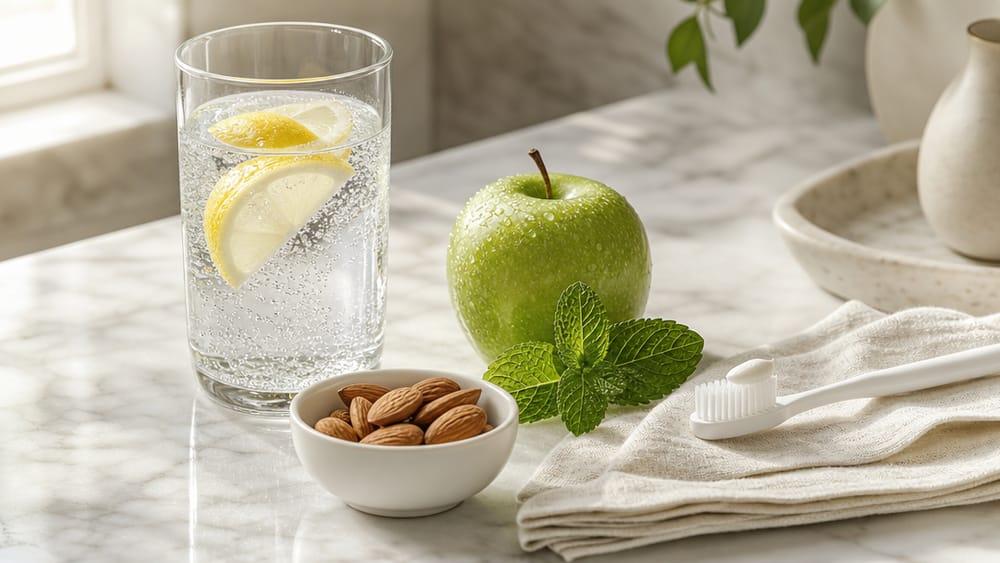
Tooth decay is not a single event. It is a balance that shifts dozens of times a day between minerals leaving the tooth surface and minerals returning to it. And the unit your mouth actually "counts" is not grams of sugar — it is how many times, and for how long, the tooth surface sits in an acidic environment. That is why a person who eats a little something sweet spread across the whole day can decay faster than someone who ate more of it in one sitting. It is also exactly where the advice "cut down on sugar," on its own, goes wrong.
This article walks through that balance as the scientific sources describe it: why fluoride changes the weight sugar itself carries in the equation, why "sugar-free" does not automatically mean "safe for teeth," and what the Saudi figures say — because two of them, read together, say something neither says alone.
What is actually happening inside your mouth? A balance, not an accident
The US National Institute of Dental and Craniofacial Research (NIDCR) puts the mechanism plainly: bacteria in the mouth meet sugars and starches and "they form an acid. This acid can attack the tooth's enamel, causing it to lose minerals."
But the second half of that story is the half usually dropped from popular advice. Enamel, the same source says, "can repair itself by using minerals from saliva and fluoride from toothpaste." The tooth does not only lose — it also regains. Decay is the net result of loss against repair over weeks and months, not the consequence of one biscuit.
Which is why there is a stage almost nobody knows about: the white spot. NIDCR notes that early decay appears as "a white spot… where minerals have been lost," and then says it directly: "Tooth decay can be stopped or reversed at this point." If it progresses, "the enamel weakens and eventually breaks down, forming a cavity" — and a cavity is not reversed. It is treated.
Saliva is not water; it is the repair system
Saliva dilutes acid, returns calcium and phosphate to the surface, and carries fluoride to where it is needed. So anything that reduces saliva tips the balance silently — and it is the factor nobody gets asked about. We will come back to it.
Amount or frequency? The answer is less settled than you would expect
This is the most over-simplified point in the whole subject. The best-known review of the question is by van Loveren in Caries Research (2019), and its title is the question itself: "Sugar restriction for caries prevention: amount and frequency. Which is more important?"
What the review found is genuinely two-sided:
- In Finnish adults (Bernabé and colleagues, 2016), the DMFT decay index rose by 0.15 units for each additional sugar-consumption occasion, and by 0.10 for each additional 10 g of sugar.
- But when both were adjusted for each other, "only the amount of sugars intake remained significantly associated with DMFT levels although the coefficient reduced to 0.09" — it was amount, not frequency, that survived statistically.
- Against that, the review cites the classic Vipeholm study: "300 g additional sugar during the mean meals did not increase caries risk, while the addition of sugary snacks between meals did so significantly."
The review's own conclusion is careful, and worth quoting exactly: "A model where frequency is more important fits better in the biological knowledge of the caries process," and reducing amount without reducing frequency "does not seem to be an effective caries preventive approach."
And its own stated limitation: "The high correlation between amount and frequency hampers the decision related to which of both is of more importance." It also notes that no high-quality randomised trials directly examine the sugar–caries relationship. So the honest summary is not "frequency is everything." It is: the biology favours frequency, the statistics cannot cleanly separate the two, and in real life they move together.
The number that changes everything: fluoride changes sugar's coefficient
The most interesting figures in that review are not in the overall average — they are in the split. Among frequent fluoride users, the coefficients were 0.08 for amount versus 0.12 for frequency. Among infrequent fluoride users, they rose to 0.26 and 0.43.
Read that again: the effect of frequency itself is roughly three and a half times larger in people who do not use fluoride regularly. Sugar is not an independent variable in this equation — fluoride changes sugar's coefficient. The same diet does not produce the same outcome in two different mouths.
The World Health Organization stated the mirror image of that sentence in its 2015 free-sugars guideline: fluoride "does not completely prevent dental caries, and dental caries still progresses in populations exposed to fluoride." The guideline's recommendations themselves: reduce free sugars to less than 10% of total energy intake — a strong recommendation "based on moderate quality evidence from observational studies of dental caries" — with a conditional suggestion of a further reduction to below 5%, resting on "very low quality evidence from ecological studies." We carry the certainty grades because they are part of the recommendation, not a footnote to it.
"Sugar-free" does not mean "safe for teeth": two different routes to the same surface
This is the biggest gap in public understanding — and it is a gap that implicates us before anyone else. What dissolves a tooth surface is not "sugar." It is acid. And acid arrives by two completely different routes:
- Caries: acid manufactured by bacteria from sugars and starches.
- Erosion: acid that arrives ready-made from food, drink, or stomach reflux — needing no bacteria and no sugar at all.
The chemistry makes this concrete. In a 2022 study in Frontiers in Dental Medicine, the critical pH for enamel dissolution is 5.5, and for dentine it is higher still at 6.3. But the study's more important finding is that "pH alone does not predict erosive potential": acid concentration and buffering capacity (titratable acidity) matter too, and a solution buffered to pH 3.8 still caused erosion.
In a laboratory study published in JADA Foundational Science in 2022 on human dentine specimens, pH was measured for drinks most people treat as harmless: a sugar-free stevia-sweetened cherry cola at 2.68, lemon seltzer at 3.71, cranberry-raspberry seltzer at 3.84, against still waters between 5.03 and 5.22. The deepest erosion belonged to the sugar-free cola (about 37.56 μm).
Honesty requires shipping the brakes with the result: this was an in vitro study on dentine rather than enamel, with continuous 24-hour exposure that resembles no real mouth with real saliva in it. The authors themselves wrote that carbonated beverages "have greater potential to cause dentinal erosion," and that "the low total acidity of the noncarbonated waters makes them more likely to be buffered in the oral environment." So the lesson is not "sparkling water ruins your teeth." It is narrower and more useful: acid does not ask the name of the sweetener.
Which is also why Mayo Clinic lists "snacking or sipping a lot" among its risk factors. A sip is not a dose of sugar — it is an extension of acid time. An acidic drink finished in five minutes is not the same drink sipped across two hours.
What actually works, ranked by strength of evidence rather than strength of advertising
1) Fluoride toothpaste — the strongest thing we have, at high certainty
A Cochrane review from 2019 (Walsh and colleagues) pooled 96 studies. Its headline result: toothpaste at 1000–1250 ppm versus non-fluoride toothpaste in children and adolescents gave a standardised mean difference of −0.28 (95% CI −0.32 to −0.25) at high certainty — a grade that is rare in nutrition and prevention literature.
By contrast, the difference between 1450–1500 ppm and 1000–1250 ppm was small: −0.08 (−0.14 to −0.01) at moderate certainty. The practical reading is clear: the big gap is between having fluoride and not having it, not between a high concentration and a slightly higher one. WHO recommends encouraging "twice-daily tooth brushing with fluoride-containing toothpaste (1000 to 1500 ppm)."
One small, practical detail: the American Dental Association advises those who prefer to rinse after brushing to "rinse lightly with a small amount of water such as a sip from the hand or delay the rinse by about 20 minutes" — so the fluoride you just applied is not immediately washed away.
2) The honest brake: water fluoridation is not what it was
A 2024 Cochrane review (Iheozor-Ejiofor and colleagues) compared fluoridated and non-fluoridated communities across 157 studies. In studies from 1975 or earlier (5,708 children), fluoridation reduced decayed baby teeth by an average of 2.1 per child. In studies conducted after 1975 (2,908 children), the difference fell to 0.24 teeth — and it comes "with uncertainty, meaning it's possible that the more recent schemes have no benefit."
Author Anne-Marie Glenny explains why, verbatim: "Most of the studies on water fluoridation are over 50 years old, before the availability of fluoride toothpaste." This is not an argument against fluoride. It is precisely the opposite: the spread of topical fluoride is what shrank the added benefit of fluoride in water. The practical message is that today's protection is built on what you do twice a day, not on what your water supply does.
3) Sugar-free chewing gum — what was actually approved, and at what dose
This one has to be quoted precisely, because advertising abbreviates it. The European Food Safety Authority (EFSA) did conclude that "a cause and effect relationship has been established" between sugar-free chewing gum and reduced tooth demineralisation. But it set highly specific conditions of use: "2–3 g of sugar-free chewing gum should be chewed for 20 minutes at least three times per day after meals."
Notice what those conditions imply. The approved claim has a dose and a timing, and it is about gum after a meal — not a general claim about anything labelled "sugar-free."
4) Dry mouth — the factor nobody asks about
According to the ADA's dry-mouth topic page (last updated 4 March 2026), xerostomia has an estimated prevalence of about 22% globally and around 30% of people over 65. Medications are "the most frequent cause of hyposalivation," and a systematic review identified 106 medications with strong to moderate evidence of association with salivary gland dysfunction — from antihistamines, antihypertensives and decongestants to pain medications, diuretics and muscle relaxants. Reduced saliva, the page states, "can also increase the chance of developing dental caries, demineralization of teeth, tooth sensitivity, and/or oral infections."
Which means two people eating identical food can be on entirely different slopes — because one of them has lost half the balance: the repair system.
The Saudi picture: a near-universal disease, and a window that closes before the first appointment
Two figures. Read together, they say something neither says alone.
Figure one — the size of the problem. A retrospective cross-sectional study published in the Journal of Clinical Pediatric Dentistry in 2025 examined 8,215 schoolchildren across 66 public schools in Jeddah. Caries prevalence in primary and permanent teeth was 91.2%. Untreated decay was present in 86.1% of the children, and was higher among elementary students (87.1%; p < 0.0001). Mean dmft in primary teeth was 4.22 ± 4.00 in girls versus 4.02 ± 3.89 in boys (p = 0.04). This is one city and a cross-sectional design — a strong indicator, not a national survey.
Figure two — why people come. A Saudi systematic review published in Patient Preference and Adherence in 2025 pooled 10 cross-sectional studies and at least 5,099 participants on the reason for the first dental visit: pain or emergency 19.8–71.5%, dental caries 17.9–45.2%, against a routine check-up in only 10.5–27.3%. The authors concluded that initial dental attendance in Saudi Arabia is "predominantly symptom-driven… while preventive motives are comparatively infrequent." Their own limitations: the evidence "was restricted to cross-sectional studies," was "dominated by moderate-risk articles," relied mostly on self-administered questionnaires "raising concerns about recall and reporting bias," and two studies did not report their sample size.
Now lay the two figures on top of each other. The one stage at which the process can be reversed — the white-spot stage — is the one stage that sends no signal at all: no pain, no sensitivity, no visible hole. And pain is the leading reason for the first visit. Which means the system usually meets the patient after the reversible window has already closed, silently. The gap here is not knowledge about brushing, and not the availability of treatment. It is the timing of the appointment.
For global context, WHO's oral health fact sheet (last updated 17 March 2025) states that oral diseases "affect nearly 3.7 billion people," that untreated caries in permanent teeth is "the most common health condition according to the Global Burden of Disease 2021," and that oral diseases "disproportionately affect the poor and socially disadvantaged members of society."
What to do tomorrow morning: six steps in order
- Twice a day with 1000–1500 ppm fluoride toothpaste. This is the high-certainty step, and it is not the least important simply because it is the cheapest.
- Rinse lightly, or delay rinsing about 20 minutes after brushing, as the ADA advises.
- Reduce the number of occasions before you reduce the quantity: keep sweet things inside a meal rather than between meals — the clearest practical lesson from the Vipeholm data.
- Do not sip acidic drinks across an hour. Plain water between meals; if you drink something acidic, give it a defined end.
- If your mouth is dry, ask your doctor about your medications — not to stop them, but so the issue is assessed and managed.
- Make the appointment preventive, not analgesic. If you cannot remember your last routine check-up, that single step will change your trajectory more than any dietary adjustment.
Who should be more careful, and when to see a dentist
See a dentist — and per Mayo Clinic, "if you have a toothache or mouth pain, see your dentist as soon as possible" — for any of the following:
- Toothache or mouth pain, or pain when you bite down.
- Sensitivity, or mild to sharp pain when eating or drinking something sweet, hot or cold.
- Visible holes or pits in a tooth.
- Brown, black or white staining on any tooth surface.
Groups who need closer attention: anyone with dry mouth or taking several medications; anyone with reflux or heartburn (which Mayo Clinic lists among risk factors because the acid can "wear away the enamel"); children, especially where bedtime feeding involves sugar-containing liquids; older adults with receding gums and exposed tooth roots; and anyone with worn fillings or dental devices.
And remember that the absence of pain does not rule decay out. Mayo Clinic says it plainly: "You may not be aware that a cavity is forming."
This article is educational. It does not replace your dentist or your doctor, and it is not a basis for diagnosis or treatment. Do not start or stop any medication because of an article.
From Bakery 8: what we are not claiming
There is no bread — not ours, not anyone's — that prevents or reverses tooth decay. And the three things in this article that actually protect your teeth — fluoride, fewer exposure occasions, and a preventive dental appointment — are not sold in a bakery.
More honestly still, here is the part that concerns us specifically. "Sugar-free" on our label answers one side of the balance, not the balance. Decay is counted in occasions and in the acidity that accompanies eating, not in sugar alone. Which means that a product with no added sugar, if it is added between meals as an extra snack, has added a fresh exposure occasion to your day — even though it added no sugar.
And further: the "healthy snacking" pattern that the entire healthy-baking category profits from — us included — pushes toward eating more often across the day, which is precisely the variable that the Caries Research review said the biology favours. We say this although it does not serve us, just as we previously noted that sugar alcohols in sugar-free products can cause diarrhoea in our article on chronic diarrhea, and just as we disowned "guilt-free" marketing language in our article on diabetes distress.
What we do claim is narrow and specific: if bread or something sweet is going to be inside your meal anyway, choosing a version with no added sugar reduces one side of the balance — and does nothing at all for the other side. On that basis only, you might look at our bread or our desserts within a meal, not between meals. That is all we claim — and nothing more than that.
Frequently asked questions
Can tooth decay really be reversed?
Only at one stage: the white-spot stage, before a cavity forms. NIDCR states that "tooth decay can be stopped or reversed at this point," with help from fluoride and minerals in saliva. Once enamel breaks down and an actual cavity forms, it is no longer reversed — it is treated by a dentist.
Are sugar-free drinks safe for my teeth?
Sugar-free does not mean acid-free. In 2022 measurements in JADA Foundational Science, a sugar-free cola registered pH 2.68 and flavoured sparkling waters 3.71–3.84 — all below enamel's critical pH of 5.5. The risk there is erosion rather than decay, and it grows the longer you sip.
Which matters more, how much sugar or how often?
The evidence is not decisive: in mutually adjusted data only amount stayed statistically significant, yet the 2019 Caries Research review concluded that a frequency model "fits better in the biological knowledge," and that cutting amount without cutting frequency "does not seem to be an effective" approach. Practically: reduce both, starting with frequency.
Is a pricier toothpaste with more fluoride enough?
The decisive gap is between having fluoride and not having it, not between a high concentration and a higher one. In the 2019 Cochrane review the difference between 1450–1500 ppm and 1000–1250 ppm was small (−0.08; −0.14 to −0.01), while the difference against non-fluoride toothpaste was large and at high certainty.
My child has never seen a dentist and has no complaints — should we wait?
No complaint is not evidence of health, because the reversible stage is completely silent. In the 2025 Saudi review, a routine check-up was the reason for the first visit in only 10.5–27.3% of cases, against pain in up to 71.5%. Make the appointment preventive, and ask about fluoride and sealants.
References
- National Institute of Dental and Craniofacial Research (NIDCR). Tooth Decay. nidcr.nih.gov.
- Mayo Clinic. Cavities/tooth decay — Symptoms & causes. mayoclinic.org.
- World Health Organization. Oral health — fact sheet (last updated 17 March 2025).
- World Health Organization. Guideline: Sugars Intake for Adults and Children. Geneva: WHO, 2015 (NCBI Bookshelf NBK285525).
- van Loveren C. Sugar restriction for caries prevention: amount and frequency. Which is more important? Caries Research 2019;53(2):168–175. doi:10.1159/000489571.
- Walsh T, Worthington HV, Glenny A-M, Marinho VCC, Jeroncic A. Fluoride toothpastes of different concentrations for preventing dental caries. Cochrane Database of Systematic Reviews 2019, Issue 3, Art. No.: CD007868. doi:10.1002/14651858.CD007868.pub3.
- Iheozor-Ejiofor Z, Walsh T, Lewis SR, Riley P, Boyers D, Clarkson JE, Worthington HV, Glenny A-M, O'Malley L. Water fluoridation for the prevention of dental caries. Cochrane Database of Systematic Reviews 2024, Art. No.: CD010856. doi:10.1002/14651858.CD010856.pub3.
- Cochrane. Water fluoridation less effective now than in past (news release, 2024).
- Pattem J, Field J, Waterhouse PJ, German MJ. The dynamic interplay of dietary acid pH and concentration during early-stage human enamel and dentine erosion. Frontiers in Dental Medicine 2022;3:1040565. doi:10.3389/fdmed.2022.1040565.
- The erosive potential of sugar-free waters on cervical dentin. JADA Foundational Science 2022;1:100009.
- EFSA Panel on Dietetic Products, Nutrition and Allergies. Scientific Opinion on the substantiation of a health claim related to sugar-free chewing gum and reduction of tooth demineralisation which reduces the risk of dental caries. EFSA Journal 2010;8(10):1775.
- Meisha D, Bahanan L, Ashi H, Alwafi A, Farsi N, Kabbarah A, et al. Prevalence of dental caries among children in public schools in Jeddah, Saudi Arabia. Journal of Clinical Pediatric Dentistry 2025;49(6):102–110. doi:10.22514/jocpd.2025.131.
- Aljohani K, Alqarni A, Alshammari AF, et al. Reasons for first dental visit in Saudi Arabia: a systematic review. Patient Preference and Adherence 2025;19:4207–4217. doi:10.2147/PPA.S559984.
- American Dental Association. Xerostomia (dry mouth) — Oral Health Topics (last updated 4 March 2026); and Should you rinse after brushing? ADA News.
Related keywords: tooth decay, enamel erosion, fluoride toothpaste, free sugars, critical pH, dry mouth, oral health in Saudi Arabia, reversing early decay, acid attack, sugar frequency.