

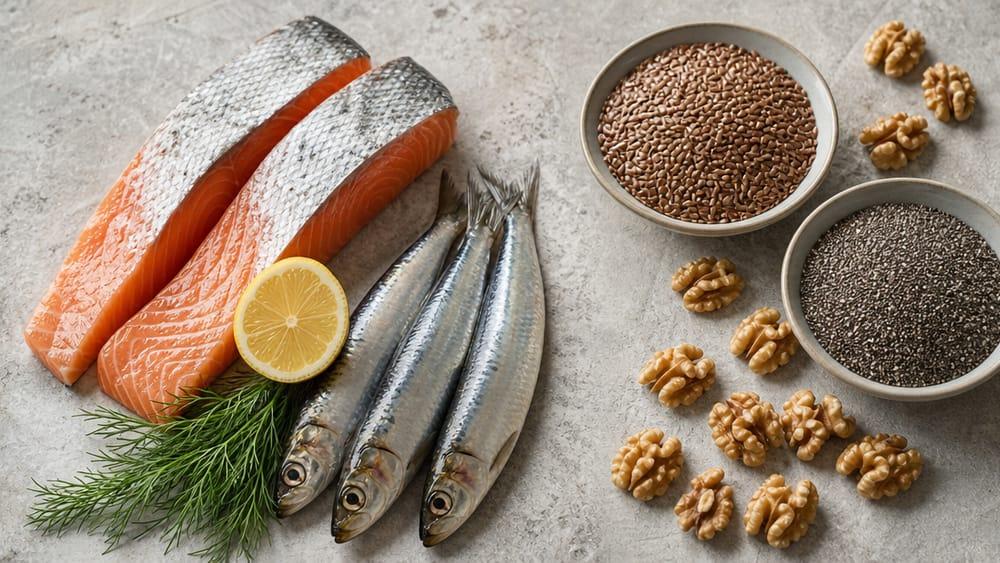
Omega-3 is not one nutrient. It is three different molecules sold under a single name. One is a plant omega-3 (ALA), found in flaxseed, chia and walnuts. Two are marine omega-3s (EPA and DHA), and those are the ones research links most directly to heart, brain and eye health. The catch is that your body does not swap freely between them: the conversion from plant to marine form is very limited, at reported rates of less than 15%, according to the Office of Dietary Supplements at the US National Institutes of Health. This article explains what that means in practice — why a spoonful of ground flaxseed is not a substitute for a tin of sardines, why the famous "omega-6 to omega-3 ratio" is a question you cannot act on, and what the most recent evidence, up to 2026, actually says about fish-oil capsules. This is general health education and does not replace advice from your own doctor.
Three molecules, one name 🧬
When you read "omega-3" on a label, you are reading the name of a family of fatty acids, not a single substance. Three members of that family matter to you:
- ALA (alpha-linolenic acid) — the plant form. The Office of Dietary Supplements (ODS) describes it as present in "plant oils, such as flaxseed, soybean, and canola oils," adding that "chia seeds and walnuts also contain ALA."
- EPA (eicosapentaenoic acid) — a marine form. Cleveland Clinic puts it plainly: "EPA is a marine omega-3 because it's found in fish."
- DHA (docosahexaenoic acid) — also marine, and the dominant structural fatty acid in the membranes of brain and retinal cells.
In nature, EPA and DHA come from essentially one place: "cold-water fatty fish, such as salmon, mackerel, tuna, herring, and sardines," as ODS lists them. So a single word on a label covers one thing you eat from a plant and two things you eat from the sea — and the research does not treat them as interchangeable.
How much plant omega-3 actually becomes the kind your heart uses? 🔑
This is the hinge of the whole article. Your body can convert ALA into EPA and then into DHA — but the factory has a small output. ODS states it directly: "ALA can be converted into EPA and then to DHA, but the conversion (which occurs primarily in the liver) is very limited, with reported rates of less than 15%." Cleveland Clinic says the same thing in patient language: "When you get ALA from food, your body is able to turn some of the ALA into EPA and subsequently to DHA. However, this process provides just a small amount of EPA and DHA."
Note the wording: "less than 15%" is a ceiling, not an average. The practical consequence is that a large plant intake becomes a small marine intake. Which is why the numbers are more useful here than the intentions:
- The Adequate Intake for ALA, per ODS, is 1.6 g/day for adult men and 1.1 g/day for adult women.
- Average US intake of ALA already exceeds that: "2.06 g in males" and "1.59 g in females."
- But average intake of EPA plus DHA combined is, in the sheet's own words, "about 90 mg in adults."
Set that against what the European Food Safety Authority considers a meaningful amount. In its review of dietary reference values (26 March 2010) the Panel on Dietetic Products, Nutrition and Allergies concluded that "a daily intake of 250 mg of long-chain omega-3 fatty acids for adults may reduce the risk of heart disease." The gap, in other words, is not a gap in awareness or intention. It is a gap in substance, and it has a number attached: a generous intake of the form that doesn't count, and a thin intake of the form that does.
The difference is not only chemical — it shows up in the trials themselves. In the major Cochrane systematic review (Abdelhamid AS, Brown TJ, Brainard JS, et al., Cochrane Database of Systematic Reviews 2020, Issue 3, CD003177) — 86 randomised trials and 162,796 participants — the two were analysed as separate entities, and they behaved differently. Long-chain omega-3 (EPA/DHA) slightly reduced coronary heart disease events (RR 0.91, 95% CI 0.85–0.97, low certainty) and reduced triglycerides by about 15% (high certainty), while making no difference to all-cause mortality (RR 0.97, 0.93–1.01, high certainty). Plant ALA was neutral for mortality (RR 1.01, 0.84–1.20), with a slight reduction in arrhythmia (RR 0.73, 0.55–0.97, moderate certainty).
The honest reading is not "plant omega-3 is worthless" — it isn't, and it has effects of its own. It is this: the two are not interchangeable, not in your body and not in the evidence.
Why the omega-6 to omega-3 ratio is a question you can't act on ⚖️
Over the past two decades a popular idea took hold: that the problem is not a shortage of omega-3 but the ratio between omega-6 and omega-3, and that the fix is to cut omega-6 oils. It is an elegant idea. Scientific bodies have not adopted it.
ODS states: "Some researchers propose that the relative intakes of omega-6s and omega-3s — the omega-6/omega-3 ratio — may have important implications for the pathogenesis of many chronic diseases, such as cardiovascular disease (CVD) and cancer, but the optimal ratio — if any — has not been defined."
The American Heart Association went further in a science advisory devoted to the question (Harris WS, Mozaffarian D, Rimm E, Kris-Etherton P, Rudel LL, Appel LJ, Engler MM, Engler MB, Sacks F. Circulation 2009;119(6):902–907, doi:10.1161/CIRCULATIONAHA.108.191627). The commentary published on the association's professional platform sums the position up bluntly: "Despite theoretical concerns regarding omega-6 PUFA and inflammation and oxidative stress, there are no compelling epidemiologic or clinical trial data to suggest that omega-6 PUFA are proatherogenic," adding that "when compared with saturated fatty acids, omega-6 PUFA confer a lower risk of cardiovascular events." The AHA does not advise cutting omega-6; it advises getting 5% to 10% of daily calories from it — roughly 11 to 22 grams on a 2,000-calorie diet, as Harvard Health explains.
And here is the sentence that converts all of this into behaviour, from Harvard directly. Yes, most people eat roughly ten times more omega-6 than omega-3 — but "don't do this by cutting back on healthy omega-6 fats. Instead, add some extra omega-3s."
Put simply: the ratio is a fraction, and the mistake is attacking its denominator. The numerator is what you are short of. That distinction has real consequences, because attacking the denominator means deleting useful foods for no proven return, while raising the numerator means adding a fish meal.
So what about fish-oil capsules? A real alarm, currently being renegotiated 💊
You need three stops here, in order, because any one of them read alone gives a misleading impression.
2021: the alarm
A systematic review and meta-analysis (Gencer B, et al.; Albert CM, corresponding author; Circulation 2021;144(25):1981–1990, doi:10.1161/CIRCULATIONAHA.121.055654) pooled 7 randomised trials and 81,210 patients (mean age 65) and found an increased risk of atrial fibrillation with marine omega-3 supplements: hazard ratio 1.25 (95% CI 1.07–1.46). Crucially, the effect looked dose-dependent: 1.49 (1.04–2.15) above one gram per day, 1.12 (1.03–1.22) at one gram or less, and roughly an 11% increase per additional gram.
2023: the regulator moves
In a Direct Healthcare Professional Communication agreed on 11 October 2023, the European Medicines Agency stated that "systematic reviews and meta-analyses of randomized controlled trials highlighted a dose-dependent increased risk of atrial fibrillation in patients with established cardiovascular diseases or cardiovascular risk factors treated with omega-3-acid ethyl ester medicines compared to placebo," that the observed risk "was found to be highest with a dose of 4 g/day," and that "if atrial fibrillation develops treatment with these medicines should be permanently discontinued."
Notice exactly what that text is about: prescription medicines at pharmacological doses — not a spoon of fish oil and not a salmon dinner.
2026: the renegotiation — and who is making it
On 30 July 2026, Circulation: Arrhythmia and Electrophysiology (doi:10.1161/CIRCEP.125.014785) published a far larger meta-analysis: 35 randomised trials and 114,592 participants. Its conclusion was that nutritional doses — below roughly 1,500 mg/day of EPA plus DHA — showed no increased atrial fibrillation risk, with the increase appearing only at high therapeutic doses. The corresponding author's words: "Our findings show that the relationship between omega-3s and atrial fibrillation is much more nuanced than previous headlines suggested."
And we should say who that author is: William S. Harris, president of the Fatty Acid Research Institute (FARI) — the institute that conducted the analysis, and therefore a party with a direct scientific and institutional interest in this field. That does not invalidate the work. It does mean that a reassuring result from an interested party does not cancel a drug regulator's warning; it puts it in proportion. The reading that holds all three together without exaggerating in either direction is this: the alarm is real at pharmacological doses, weak or absent at nutritional ones, and the decision about high doses belongs to a doctor, not to a pharmacy shelf.
Above all of it sits a modest ceiling from Cochrane: the supplement made no difference to all-cause mortality, at high certainty. It is not a shield. As for the safety limit, the US Food and Drug Administration sets it: "FDA has concluded that dietary supplements providing no more than 5 g/day EPA and DHA are safe when used as recommended."
What actually translates into behaviour — and its brakes 🐟
Food first, in an amount that has a number. The American Heart Association recommendation, as Cleveland Clinic reports it: "The American Heart Association recommends people without a history of heart disease eat at least two servings of fish per week (6 ounces to 8 ounces total)." Sardines, mackerel and tuna — including tinned — count, and in the Saudi market they are among the cheapest things you can buy.
But fish comes with one brake that deserves to be stated honestly: mercury. In their joint advice, revised in October 2021, the FDA and the US Environmental Protection Agency direct pregnant and breastfeeding people and children in particular toward "between 8 and 12 ounces per week of a variety of seafood from choices that are lower in mercury," and place a named set of species in a "Choices to Avoid" list: king mackerel, marlin, orange roughy, shark, swordfish, tilefish (Gulf of Mexico) and bigeye tuna. The advice, in other words, is not "eat more fish" without qualification. It is "eat more of these fish."
The Saudi picture: knowledge that exists — and changes nothing 🇸🇦
Here is the strangest finding in this article, and it comes from a recent Saudi survey: Alruwaili NW, Mashraqi A, Alafif N, Frontiers in Public Health 2026;14:1886816, doi:10.3389/fpubh.2026.1886816 (published 20 July 2026), covering 1,021 adults across all thirteen administrative regions.
The findings: "regular seafood consumption was reported by 47.4% of participants," most commonly tuna (54.9%), shrimp (48.5%), greasy grouper (44.9%) and Spanish mackerel (44.6%). Against that, "only 19.7% identified mercury as a health concern" — with higher awareness among women (23.6% vs 16.5%, p=0.005).
The central result is this. Food-safety knowledge strongly predicted mercury awareness (OR 4.000, 95% CI 3.350–4.777) but was not associated with consumption behaviour at all (OR 0.997, p=0.950) — a dissociation the researchers found "robust across all five sensitivity specifications," making it structural rather than informational. Their conclusion, verbatim: "Over half the respondents met species-based criteria for high-risk consumption; fewer than one in five recognized mercury as a health concern; and the food-safety knowledge that reliably predicted awareness had essentially no influence on dietary choice."
That is a kind of gap this blog has not met before. We are used to gaps of access (an appointment never booked), of timing, of supply, of missing awareness. Here the knowledge exists, is correct, and is measurable — and does nothing. Which is why the researchers called for "species-named advisories embedded in coastal fish retail environments" rather than general knowledge campaigns: the decision is made at the chiller cabinet, not in the lecture hall.
A second Saudi survey from the same research group completes the picture: Alruwaili NW, Aljarallah B, Bin Zarah A, Alafif N, BMC Public Health 2026;26:2614, doi:10.1186/s12889-026-28384-z (9 July 2026, n=321). It reports that "the prevalence of n-3 FA supplement ever-use was 39.3%," while 46.0% of ever-users did not disclose their supplement use to their healthcare provider — precisely the group whose doctor needs to know, because of interactions with blood thinners and before any surgery.
A methodological note, stated honestly: both surveys used online convenience sampling and both say so. In the first, 74.5% of the sample were university graduates against a national figure of roughly 22–25%; nationality was not collected; and awareness was measured with a single yes/no item. The second had no a priori sample-size calculation and collected no omega-3 biomarker. So we do not use either to estimate a national rate. What they can carry is the comparison inside the same sample — 47.4% who eat it against 19.7% who notice, and 39.3% who take it against 46.0% who don't tell their doctor — because the bias cuts both sides of that comparison equally.
Who should ask a doctor first? ⚠️
This section is educational and does not replace medical advice. Speak to your doctor before starting an omega-3 supplement if you:
- take blood thinners, anticoagulants or antiplatelet drugs — Cleveland Clinic warns that supplements may "raise your risk of bleeding" in this situation, and may interfere with some prescription medicines;
- have surgery or a bleeding-risk procedure coming up (tell the team about every supplement you take);
- have established cardiovascular disease or risk factors, especially at a high dose — the European Medicines Agency's warning is aimed at exactly this group;
- have known atrial fibrillation, or new palpitations — a reason to see your doctor, not to decide alone;
- are pregnant, breastfeeding or feeding a child — here the mercury rules and the specific fish amounts above apply, and choosing the species comes before choosing the quantity;
- take 3 grams or more of omega-3 a day — Cleveland Clinic explicitly asks you to talk to your provider at that threshold;
- have a fish or shellfish allergy — a clear reason to discuss alternatives with a specialist before buying any marine supplement.
Where Bakery 8 stands in all this 🥖
Frankly, not in our favour: no bread — not ours, not anyone's — gives you EPA or DHA. It does not improve your liver's conversion efficiency, it does not fix your omega-3 index, and it does not stand in for a fish meal.
Further than that: our shelf is built, at its core, on almond flour. Almonds are an excellent food for many reasons, but look at the Office of Dietary Supplements' own list of ALA-rich foods — flaxseed, chia, walnuts — and almonds are not on it. Most of their fat belongs to the omega-6 family which, as explained above, is neither an enemy nor something to delete, but is also not the numerator you are short of. Which means the low-carbohydrate pattern our products serve adds nothing to the marine side of the equation, and can make it easy for weeks to pass without a single fish meal.
And the most honest line of all is one a bakery is not supposed to write: the cheapest source of omega-3 in the Saudi market is not a supplement, and it is not anything on our shelf — it is a tin of sardines. We say that knowing it sells us nothing.
What we commit to: never marketing any product of ours as a source of omega-3, and never using the phrase "healthy fats" in a way that implies EPA or DHA. Our role is simpler and clearer — that the loaf or the granola you put beside your fish is sugar-free and low in carbohydrate, not that it replaces the fish. You can browse our bread on exactly that basis.
The principle that having a nutrient in your food is not the same as getting it into your cells is one we have covered before, in our article on vitamin B12; and the reason a "normal" lab value can still hide a shortfall is the subject of our piece on magnesium.
Frequently asked questions ❓
Can flaxseed and walnuts replace fish?
Not fully. Flaxseed and walnuts are excellent sources of plant ALA, but the Office of Dietary Supplements notes that conversion of ALA to EPA and then DHA is very limited, "with reported rates of less than 15%." They are a good addition to your diet rather than a substitute for the marine source.
How much omega-3 do I actually need?
For plant ALA there is a defined Adequate Intake: 1.6 g/day for men and 1.1 g/day for women. For EPA and DHA, no specific intake recommendation was set by the US Institute of Medicine, but the European Food Safety Authority pointed to 250 mg/day of long-chain omega-3 as an amount that may reduce heart disease risk.
Do fish-oil capsules raise the risk of atrial fibrillation?
The picture is dose-dependent. A 2021 meta-analysis found an increase (hazard ratio 1.25), and the European Medicines Agency warned of a dose-dependent risk peaking at 4 g/day in prescription medicines. A much larger 2026 analysis found no increase at low nutritional doses. If you are on a high dose, that is a conversation with your doctor.
Should I cut omega-6 oils to improve my ratio?
No, according to the scientific bodies. The Office of Dietary Supplements says the optimal ratio "has not been defined," and the American Heart Association recommends getting 5% to 10% of calories from omega-6 rather than reducing it. Harvard's practical advice is explicit: improve the balance by adding omega-3, not by deleting omega-6.
Does tinned fish count, and what about mercury?
Yes — tinned tuna and sardines are genuine sources of EPA and DHA, and among the cheapest options available. Mercury is a question of species as much as quantity: the FDA and EPA advice places specific fish in a "Choices to Avoid" list, including shark, swordfish, king mackerel and bigeye tuna, especially for pregnant people and children.
In summary
Omega-3 is one name on three molecules, and your body barely swaps between them. If you take a single step from this article, make it this: move your attention from the ratio to the numerator, and from the capsule to the plate — two servings of fish a week from the lower-mercury species, and if you add a capsule, tell your doctor about it. Our own role is what goes beside that fish: sugar-free, low-carbohydrate bread and granola from Bakery 8 in Riyadh, Saudi Arabia — healthy and delicious, and claiming nothing more than that.
References
- Office of Dietary Supplements, National Institutes of Health. Omega-3 Fatty Acids — Fact Sheet for Health Professionals. ods.od.nih.gov.
- Office of Dietary Supplements, National Institutes of Health. ALA Content of Selected Foods (USDA National Nutrient Database for Standard Reference, Release 28).
- Cleveland Clinic. Omega-3 Fatty Acids. my.clevelandclinic.org.
- Abdelhamid AS, Brown TJ, Brainard JS, et al. Omega-3 fatty acids for the primary and secondary prevention of cardiovascular disease. Cochrane Database of Systematic Reviews 2020, Issue 3. Art. No.: CD003177.
- European Food Safety Authority, Panel on Dietetic Products, Nutrition and Allergies. Dietary reference values for fats and carbohydrates — news release, 26 March 2010. efsa.europa.eu.
- Harris WS, Mozaffarian D, Rimm E, Kris-Etherton P, Rudel LL, Appel LJ, Engler MM, Engler MB, Sacks F. Omega-6 fatty acids and risk for cardiovascular disease: a science advisory from the American Heart Association. Circulation 2009;119(6):902–907. doi:10.1161/CIRCULATIONAHA.108.191627.
- American Heart Association, Professional Heart Daily. Commentary: Omega-6 Fatty Acids in the Hierarchy of Cardiovascular Protection. professional.heart.org.
- Harvard Health Publishing. No need to avoid healthy omega-6 fats. health.harvard.edu.
- Gencer B, et al.; Albert CM (corresponding author). Effect of long-term marine omega-3 fatty acids supplementation on the risk of atrial fibrillation in randomized controlled trials of cardiovascular outcomes: a systematic review and meta-analysis. Circulation 2021;144(25):1981–1990. doi:10.1161/CIRCULATIONAHA.121.055654.
- European Medicines Agency / CMDh. Direct Healthcare Professional Communication: Omega-3-acid ethyl ester medicines — dose-dependent increased risk of atrial fibrillation. Agreed 11 October 2023.
- Fatty Acid Research Institute (Harris WS, corresponding author). Effects of omega-3 fatty acid treatment on risk for atrial fibrillation: an updated meta-analysis of 35 trials. Circulation: Arrhythmia and Electrophysiology 2026. doi:10.1161/CIRCEP.125.014785. Published 30 July 2026.
- U.S. Food and Drug Administration and U.S. Environmental Protection Agency. Advice About Eating Fish. Revised October 2021. fda.gov.
- Alruwaili NW, Mashraqi A, Alafif N. Seafood consumption patterns and methylmercury risk awareness among Saudi adults: a nationwide cross-sectional survey documenting a structural knowledge–behavior gap. Frontiers in Public Health 2026;14:1886816. doi:10.3389/fpubh.2026.1886816.
- Alruwaili NW, Aljarallah B, Bin Zarah A, Alafif N. Omega-3 fatty acid supplement use among Saudi adults: prevalence, independent associations, and knowledge assessment — a cross-sectional survey. BMC Public Health 2026;26:2614. doi:10.1186/s12889-026-28384-z.
Related keywords: omega-3, EPA and DHA, alpha-linolenic acid ALA, fish oil supplements, flaxseed omega-3, omega-6 to omega-3 ratio, two servings of fish per week, mercury in fish, atrial fibrillation and fish oil.