

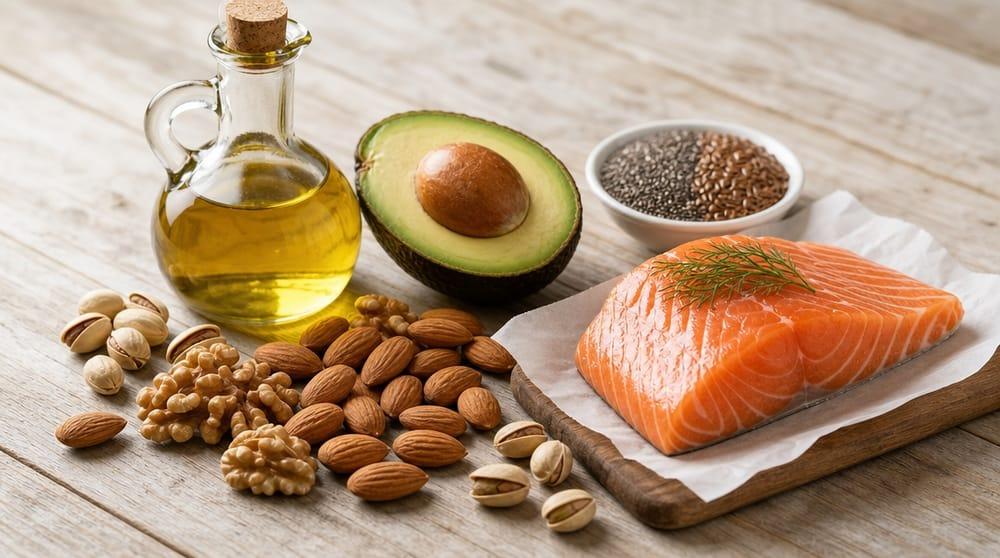
Not all fat is your heart's enemy. Some fats raise your "bad" cholesterol and damage your arteries, while others actually lower it and protect your heart. The goal isn't to avoid fat altogether — it's to know the type of fat on your plate: cut back on trans and excess saturated fats, and lean into the monounsaturated and polyunsaturated fats in olive oil, nuts, and fish. In this guide we explain — in practical terms grounded in trusted medical sources — how to tell healthy fats from harmful ones, how they affect cholesterol, and why sugar and refined flour can be more dangerous for your heart than the fat itself.
This matters for everyone, but especially in Saudi Arabia, where high cholesterol and disordered blood lipids are among the most common cardiovascular risk factors in adults. The good news: small, repeated choices on your daily table can make a real difference.
Why do we need fat at all?
Before we talk about "bad" fats, it's only fair to remember that fat is an essential nutrient the body can't do without. Fat is a concentrated energy source; it's needed to absorb the fat-soluble vitamins (A, D, E, K), to build cell walls, to produce key hormones, and to protect organs. So the goal is never "zero fat" — it's the right fats in the right amounts.
Sources like Mayo Clinic and the American Heart Association stress that what happens to your heart is driven less by total fat and more by its type — and by what you replace it with when you cut it. That single idea is the key to this whole article.
What are the types of dietary fat?
The fats in our food fall into four main groups — two generally beneficial, two to be careful with:
1) Monounsaturated fats (beneficial)
Found in extra-virgin olive oil, avocado, almonds, hazelnuts, pistachios, and canola oil. These fats are linked to lower "bad" LDL cholesterol and better heart health, and they are the cornerstone of the Mediterranean diet.
2) Polyunsaturated fats (beneficial)
These include two important families: omega-3 (in oily fish like salmon and sardines, and in flaxseed, chia, and walnuts) and omega-6 (in many vegetable oils, nuts, and seeds). They help lower LDL cholesterol, and omega-3 in particular is known for lowering blood triglycerides.
3) Saturated fats (in moderation)
Found in fatty meats, butter and ghee, full-fat dairy, and coconut and palm oils. Saturated fat raises LDL cholesterol in many people, so moderation is advised. But — and this is important — the sharper point isn't "avoid it at all costs," it's what you replace it with, as we'll see shortly.
4) Trans fats (avoid as much as possible)
These are the worst of all. Industrial trans fats are created by partially "hydrogenating" oils, and historically appeared in some commercial baked goods, fast food, and hard margarine. Their double harm is that they raise LDL cholesterol and lower HDL cholesterol at the same time.
The World Health Organization estimates that industrial trans-fat intake causes more than 500,000 deaths a year from cardiovascular disease, and recommends keeping it below 1% of total energy (less than about 2.2 grams a day on a 2,000-calorie diet). That's why WHO launched a global campaign (REPLACE) to eliminate industrial trans fats from the food supply. The practical rule: if a label says "partially hydrogenated oils," put it back.
What's the difference between "bad" and "good" cholesterol?
Cholesterol is a waxy substance the body needs, but it travels in the blood inside different carriers. Three numbers matter most:
- LDL ("bad") cholesterol: called "bad" because a high level contributes to plaque building up inside artery walls and narrowing them. Lowering it is the first goal in protecting your heart.
- HDL ("good") cholesterol: helps pull excess cholesterol out of the arteries and return it to the liver, so a relatively higher level is helpful.
- Triglycerides: a type of blood fat that rises especially with excess sugar, refined carbohydrates, alcohol, and surplus calories.
In short: we want LDL low, HDL in good shape, and triglycerides low. And the type of fat you eat influences all three of these numbers.
Is dietary cholesterol what raises blood cholesterol?
This is one of the ideas that has shifted most in modern science. For decades people assumed dietary cholesterol (such as in eggs) was the main driver of high blood cholesterol. But recent evidence shows that saturated and trans fats raise blood cholesterol in most people more than dietary cholesterol itself does. That's why the 2015–2020 U.S. Dietary Guidelines removed the old upper limit on dietary cholesterol (300 mg a day).
This doesn't mean "eat unlimited cholesterol." Some people are "hyper-responders" who react more, and those with diabetes or an inherited lipid disorder need closer monitoring. But the core message is clear: focus on the quality of your fats and on cutting trans and excess saturated fat far more than on counting the milligrams of cholesterol in an egg.
The biggest trap: swapping fat for sugar and refined flour
Here lies the most important idea in this article. When people are told to cut fat, many reach for "low-fat" products loaded with sugar and refined white flour — and the result can be worse, not better.
The American Heart Association's 2017 Presidential Advisory concluded that replacing saturated fat with polyunsaturated fat lowers cardiovascular disease by about 30% — a reduction comparable to what statin drugs achieve. By contrast, when saturated fat was replaced with refined carbohydrates, risk didn't improve — coronary heart disease actually rose by about 1% — while replacing it with whole grains lowered it by about 9%.
In other words: refined carbs and sugar raise triglycerides and lower HDL. So dropping good fats in favor of sugar and white flour isn't a win for your heart — it's a step backward. The winning equation is: better fats + fewer refined, lower-sugar carbohydrates.
What does the science say about healthy fats and the heart?
The Mediterranean diet and the PREDIMED trial
In the large Spanish PREDIMED trial (republished in the New England Journal of Medicine in 2018), about 7,447 people at high cardiovascular risk followed one of three diets: a Mediterranean diet supplemented with extra-virgin olive oil, a Mediterranean diet supplemented with mixed nuts, or a low-fat control diet. Over roughly five years of follow-up, major cardiovascular events (heart attacks, strokes, cardiovascular deaths) fell by about 30% in the two Mediterranean groups versus control. What those groups had in common was an abundance of monounsaturated and unsaturated fats from olive oil and nuts.
Almonds and cholesterol
A meta-analysis of 18 randomized controlled trials (837 participants) examined almond intake and blood lipids. It found that almonds lowered total cholesterol by about 5.9 mg/dL and LDL cholesterol by about 4.8 mg/dL on average, with a larger effect at higher intakes and in people whose baseline cholesterol was elevated. Almonds are rich in monounsaturated fat, fiber, and vitamin E — one of the best heart-friendly snacks.
Omega-3 and triglycerides
The American Heart Association notes that omega-3 fatty acids (EPA and DHA) from oily fish help lower triglycerides, and generally recommends eating two servings of fish per week. In cases of severely high triglycerides, a doctor may prescribe high-dose omega-3.
Fats in the Saudi kitchen: a practical view
Many of our beloved dishes rely on ghee, deep frying, and rich sweets full of white flour and sugar. We're not here to ask you to give up the flavor of our tables — just to make smart swaps that keep the taste and lighten the load on your heart:
- Replace some of the ghee with olive oil: where the dish allows, olive oil gives you monounsaturated fat instead of more saturated fat.
- Cut back on repeated deep frying: prefer grilling, the oven, or air frying — reusing oil at high heat generates unwanted compounds.
- Make raw or unsalted roasted nuts your snack instead of processed fried crisps.
- Watch ready-made sweets and commercial baked goods: some contain partially hydrogenated oils (trans fats) alongside sugar and refined flour — the worst combination for the heart.
Small, repeated swaps beat harsh short-term diets, because the heart responds to what you eat on most days, not what you eat once.
A quick comparison of common fat sources
To simplify choosing, here is a practical ranking of fat sources from best to worst for heart health, with examples:
Best (unsaturated fats): extra-virgin olive oil, avocado, almonds, walnuts, pistachios, chia and flaxseeds, oily fish.
In moderation (saturated fats): butter and ghee, fatty meats, full-fat dairy, coconut and palm oils.
Avoid where possible (industrial trans fats): partially hydrogenated oils, some hard margarines, part of commercial baked goods and fast food.
The idea isn't "more fat or less fat," but gradually moving up this list and away from the bottom — while cutting sugar and refined flour at the same time.
How to choose healthy fats in practice: simple steps
- Make extra-virgin olive oil your default for light cooking and salad dressing instead of hard fats.
- Add a source of good fat to almost every meal: a handful of almonds or walnuts, avocado slices, chia or flaxseeds.
- Eat oily fish twice a week (salmon, sardines, mackerel) for omega-3.
- Read the label: avoid "partially hydrogenated oils," and watch added sugars — not just fat.
- Cut sugar and refined white flour as much as you mind the type of fat — the two battles are linked.
- Keep saturated fat moderate (ghee, butter, fatty meat) rather than eliminating it entirely, and swap part of it for unsaturated fat.
Who should pay extra attention?
Most of the advice above is general and safe, but some situations need individual medical follow-up: people with inherited (familial) high cholesterol, known heart disease, diabetes, or very high triglycerides. These may need specific medical and dietary targets. Also, following a low-carb or keto pattern raises the share of fat in the diet, which makes choosing the type of fat (favoring unsaturated, minimizing trans) more important, not less.
This information is general education and is not a substitute for consulting your doctor or dietitian, especially if you take cholesterol medication or have a chronic condition. Check with a professional before any major change to your diet.
Where does Bakery 8 fit into all this?
The idea behind Bakery 8 (مخبز ثمانية) aligns perfectly with everything above: we replace refined white flour with almond flour — itself a source of the monounsaturated fats and fiber that support heart health — and we make our baked goods sugar-free. In other words, we work both levers at once: better fats, and fewer refined carbs and less sugar.
If you're looking for a healthy alternative to daily bread, try our almond-flour samoli and cloud bread. For a heart-friendly snack rich in nuts and seeds, see our keto granola and crackers. And for a sugar-free treat that fits a heart-friendly pattern, browse our sugar-free chocolate. For more of the science, read our articles on net carbs and insulin resistance.
Frequently asked questions
Does fat always cause weight gain?
Not fat itself, but a calorie surplus from any source. Fat is calorie-dense but filling, and including moderate amounts of good fat within a balanced diet helps control hunger — it doesn't automatically mean weight gain.
Is olive oil okay for frying?
Extra-virgin olive oil is fine for medium-heat home cooking and salad dressing, and is a healthy choice overall. For very high-heat frying some prefer oils with a higher smoke point, but always avoid partially hydrogenated oils.
Which is better: cutting fat or cutting sugar?
Recent evidence favors cutting sugar and refined flour while improving the type of fat (not just the amount) as the better approach for heart health. The two are linked, but replacing good fats with sugar is a common mistake.
Are eggs bad for cholesterol?
For most healthy people, eggs have a limited effect on blood cholesterol compared with saturated and trans fats. Anyone with diabetes or high cholesterol should ask their doctor about the right amount for them.
Are fish oil supplements necessary?
For healthy people, eating oily fish twice a week is often enough. High-dose omega-3 supplements are usually used under prescription for high triglycerides; consult your doctor before starting.
Conclusion
Heart health isn't built on "avoiding fat" — it's built on choosing the right fats and cutting sugar and refined flour together. Favor olive oil, nuts, avocado, and fish; steer clear of trans fats; keep saturated fat moderate; and don't swap it for sugar. Small, consistent choices on your daily table are the strongest long-term investment you can make in your heart.
At Bakery 8, we build our baked goods on that same principle: almond flour instead of refined flour, and no sugar — so your everyday choices can be delicious and heart-friendly at once. Browse our products and start with one small step today.
References
- Sacks FM, et al. Dietary Fats and Cardiovascular Disease: A Presidential Advisory From the American Heart Association. Circulation. 2017.
- Estruch R, et al. (PREDIMED). Primary Prevention of Cardiovascular Disease with a Mediterranean Diet Supplemented with Extra-Virgin Olive Oil or Nuts. New England Journal of Medicine. 2018.
- World Health Organization. WHO plan to eliminate industrially produced trans-fatty acids from global food supply (REPLACE). 2018.
- Musa-Veloso K, et al. The effects of almond consumption on fasting blood lipid levels: a systematic review and meta-analysis of randomised controlled trials. Journal of Nutritional Science. 2016.
- Skulas-Ray AC, et al. Omega-3 Fatty Acids for the Management of Hypertriglyceridemia: A Science Advisory From the American Heart Association. Circulation. 2019.
- Mayo Clinic. Dietary fat: Know which to choose.
- Harvard T.H. Chan School of Public Health — The Nutrition Source. Fats and Cholesterol.
- American Heart Association. Dietary Fats (Saturated, Trans, Polyunsaturated, Monounsaturated). heart.org.
- U.S. Department of Health and Human Services and U.S. Department of Agriculture. 2015–2020 Dietary Guidelines for Americans.
Related keywords: healthy fats, types of fat, LDL cholesterol, HDL cholesterol, trans fats, saturated fat, omega-3, triglycerides, Mediterranean diet, almond flour, heart health.