

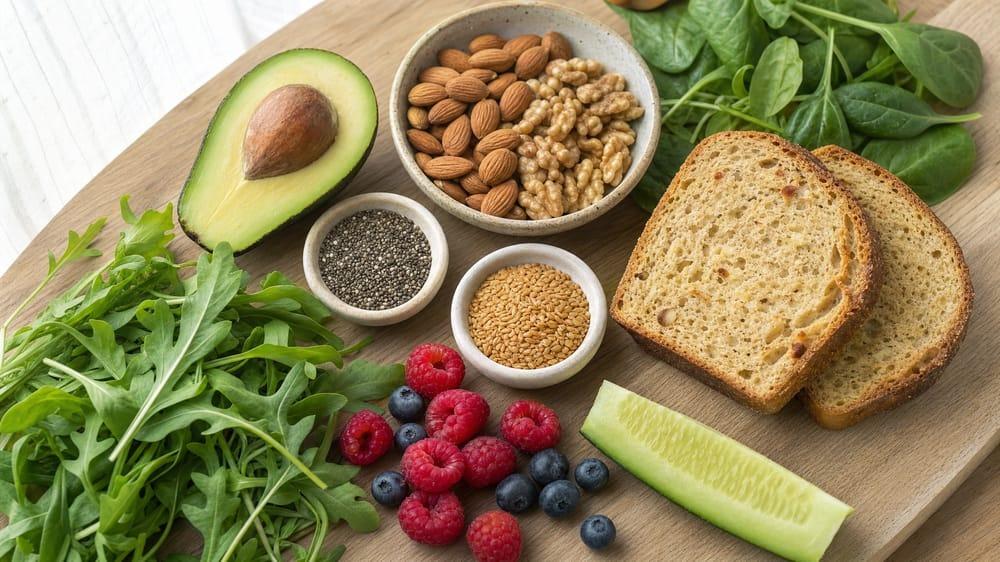
Net carbs are the portion of carbohydrate in a food that your body actually absorbs and that can raise your blood sugar. You estimate them by subtracting dietary fiber (and, in processed foods, sugar alcohols) from the total carbohydrate on the label. In other words, not every gram of carbohydrate on your plate "counts" the same way, because fiber passes through the digestive tract largely undigested — unlike starch and sugar. Understanding this helps people with diabetes, keto dieters, and anyone watching their weight choose foods that satisfy without spiking glucose.
In this guide from Bakery 8 we explain exactly what net carbs are, how to calculate them step by step in whole foods and in packaged products, why fiber and some sweeteners are subtracted while others are not, and when to be cautious — along with an important note about the limits of this concept.
What are net carbs?
Carbohydrates on a nutrition label fall into three main types: sugars, starches, and fiber. Starches and sugars are what turn into glucose and raise blood sugar; fiber is classified as a carbohydrate on paper but is not digested or absorbed the same way. The U.S. Centers for Disease Control and Prevention (CDC) sums it up in one line: "sugars and starches raise your blood sugar, but fiber doesn't."
That is where the idea of "net carbs" comes from: an attempt to estimate the carbohydrates that actually affect glucose, after excluding components that aren't absorbed or don't meaningfully raise blood sugar. The basic formula for whole foods is simple:
Net carbs = total carbohydrates − dietary fiber
In processed products that contain sugar-alcohol sweeteners (such as erythritol), those sugar alcohols are also subtracted — fully or partially depending on the type, as we'll explain.
Why is fiber subtracted?
Dietary fiber is the part of a plant that our digestive enzymes can't break down into simple sugar that enters the blood. So fiber doesn't raise blood sugar the way starch or sugar does; in fact it can slow the absorption of the other carbohydrates in the same meal. The American Diabetes Association (ADA) notes that higher-fiber foods can help improve blood-sugar management and digestion and reduce heart-disease risk.
This is why high-fiber foods — leafy greens, nuts, seeds, avocado — are "cheap" in net carbs even when they look high in total carbs. Avocado is a classic example: a medium fruit has about 17 g of total carbohydrate, but roughly 13.5 g of that is fiber, leaving only about 3.6 g of net carbs.
How much fiber do we need daily?
The Dietary Guidelines for Americans recommend at least 14 g of fiber per 1,000 calories — roughly 25 to 38 g a day for most adults. The ADA emphasizes that people with diabetes need at least the same amount of fiber recommended for everyone else. Increasing fiber gradually, with enough water, supports satiety, steadier blood sugar, and gut health.
How to calculate net carbs, step by step
The calculation differs slightly between whole foods (vegetables, fruit, nuts) and processed products (bars, sugar-free desserts). Here are both methods:
In whole foods
- Read the total carbohydrate for the serving.
- Subtract the grams of dietary fiber.
- The result is the approximate net carbs.
Example: 100 g of raw spinach has about 3.6 g of carbohydrate and 2.2 g of fiber, so net carbs are only about 1.4 g.
In processed products
- Start from total carbohydrate.
- Subtract dietary fiber.
- Subtract sugar alcohols according to type: erythritol is subtracted in full because it has virtually no effect on blood sugar, while other sugar alcohols (such as maltitol) are subtracted by only about half, because they raise blood sugar partially.
The common rule of thumb is "subtract half of the sugar alcohols" in processed products, with erythritol as the exception you can subtract in full when it's the only sugar alcohol. This distinction matters: a bar labeled "3 g net carbs" may really contain more if it relies on maltitol instead of erythritol.
Sugar alcohols: not all the same
Sugar alcohols are sweeteners that deliver sweetness with fewer calories and less blood-sugar impact than sugar — but they vary widely:
- Erythritol: glycemic index near zero and very few calories (about 0.2 kcal per gram); subtracted from net carbs in full. It's the preferred choice in keto- and diabetes-friendly products.
- Maltitol: a much higher glycemic index (about 35), meaning it noticeably raises blood sugar, so it shouldn't be subtracted in full.
- Others (sorbitol, xylitol): moderate impact, and can cause digestive upset in excess.
So reading the ingredient list — not just the "net carbs" number on the front — is what reveals a product's true quality. We covered this in depth in Sugar Substitutes: Stevia, Erythritol & Monk Fruit Guide.
A worked example: how to read a nutrition label
Imagine a "sugar-free" candy bar whose panel lists, per piece: total carbohydrate 24 g, of which fiber 9 g and sugar alcohols 10 g. To calculate net carbs honestly, first check which sugar alcohol appears in the ingredient list:
- If the sweetener is erythritol: subtract fiber in full and the sugar alcohol in full: 24 − 9 − 10 = 5 g net.
- If the sweetener is maltitol: subtract fiber in full but only half the sugar alcohol: 24 − 9 − 5 = 10 g net — roughly double.
Notice how the number doubles when the sweetener changes, even though the front of pack may promise the same figure. That is the real value of reading the ingredient list: one label, two very different numbers depending on ingredient quality.
Low-net-carb, high-fiber foods
The best way to lower net carbs without deprivation is to build on whole foods that combine few impactful carbs with plenty of fiber and healthy fat. Standouts include:
- Avocado: about 3.6 g net per medium fruit, rich in fiber and monounsaturated fat.
- Leafy greens (spinach, lettuce, rocket): often under 2 g net per serving, plus vitamins and minerals.
- Nuts (almonds, walnuts, pecans): high in fiber, healthy fat and protein, with low net carbs at moderate portions.
- Seeds (chia, flax): most of their carbohydrate is fiber, so net carbs are close to zero.
- Berries (strawberries, blueberries): lower-sugar, relatively higher-fiber fruit compared with others.
- Almond flour: a low-carb, high-fiber, healthy-fat alternative to white flour — the base of many of our products.
Common mistakes when counting net carbs
Even with the formula understood, people make errors that make the math misleading. The most common:
- Subtracting all sugar alcohols indiscriminately: maltitol really does raise blood sugar, and subtracting it in full shows a number lower than reality.
- Trusting the front-of-pack number alone: "net carbs" on the wrapper isn't a regulator; the truth is in the nutrition panel and ingredient list.
- Ignoring serving size: figures are per stated serving; doubling the amount doubles the net carbs.
- Forgetting calories: a low-net-carb product can be high in calories from fat; moderation still matters.
- Assuming a uniform response: your body may react to a food differently than someone else's; personal testing is the judge.
Net carbs, satiety and weight management
Lowering net carbs doesn't only steady blood sugar — it also helps with satiety and weight management. Fiber slows stomach emptying and prolongs fullness, which reduces the urge to eat more between meals. Foods low in impactful carbs also tend to cause smaller blood-sugar swings, and sharp swings are one of the drivers of sudden hunger and intense sugar cravings. That's why many people who choose low-net-carb bread or desserts find themselves fuller and steadier in energy through the day. We explored the link between real and emotional hunger in an earlier post on our blog, which complements this idea.
Net carbs vs. the glycemic index: what's the difference?
Many people confuse the two, but they measure different, complementary things. Net carbs measure quantity — how many grams of impactful carbohydrate are on your plate. The glycemic index measures speed and quality — how fast those carbs raise blood sugar. A food can be low in net carbs yet fast-absorbing, and vice versa. Using both ideas together gives a sharper picture. For more, see The Glycemic Index: Your Complete Guide.
Why do net carbs matter for diabetics and keto dieters?
For keto dieters, the goal is to keep impactful carbs very low (often under 20–50 net grams a day) to stay in ketosis, so they count net carbs rather than total. For people with diabetes, the idea helps in choosing foods that are higher in fiber and lower in impactful carbs, which supports steadier glucose and satiety.
But here is an important caveat: the term "net carbs" has no official legal definition, and it is not recognized by the U.S. Food and Drug Administration (FDA) or formally endorsed by the American Diabetes Association. The ADA recommends counting total carbohydrate and personally monitoring blood sugar to see how high-fiber or sugar-alcohol foods specifically affect you. The reason is that responses vary from person to person, and some products overstate how much sugar alcohol they subtract on the label.
Practical tips for using net carbs wisely
- Make your low-net-carb foods whole and fiber-rich: leafy greens, avocado, nuts, seeds.
- In processed products, read the ingredient list and confirm the sweetener is erythritol or stevia, not maltitol.
- Don't rely on the front-of-pack "net carbs" number alone; check the full nutrition panel.
- If you have diabetes, test your response with a glucose meter one to two hours after trying a new food.
- Increase fiber gradually with enough water to avoid digestive discomfort.
- Remember calories still count: "low net" doesn't mean "unlimited."
Who should be cautious?
If you have diabetes and use mealtime insulin, over-subtracting fiber or sugar alcohols could lead you to estimate too little (or too much) insulin, so it's safest to follow your doctor's or dietitian's plan for counting carbs. Sugar alcohols can also cause bloating or diarrhea in some people when overused. People with kidney disease, those who are pregnant, and anyone with digestive disorders should consult a professional before big changes to their carb pattern.
This article is for general health awareness and is not a substitute for advice from your doctor or dietitian, especially if you have a chronic condition or take medication that affects blood sugar.
How Bakery 8 turns this idea into products
At Bakery 8 — a keto, sugar-free and gluten-free bakery in Riyadh — we build our products on the very principle this article explains: lowering impactful carbs by relying on fiber-rich, healthy-fat almond flour instead of white flour, and on sweeteners that don't raise blood sugar, like erythritol, instead of sugar or maltitol.
- Samoli & cloud bread — low-net-carb bread alternatives for sandwiches and breakfast.
- Keto granola — rich in fiber, nuts and seeds; a breakfast option that supports satiety.
- Sugar-free desserts — to satisfy a sweet craving with fewer impactful carbs.
Our goal is to help you choose consciously: read the label, count net carbs honestly, and watch your own response — while we make options that put that math in your favor.
Frequently asked questions
Are net carbs more accurate than total carbs?
Not necessarily. Net carbs are a useful estimate for keto or low-carb eaters, but the American Diabetes Association recommends counting total carbohydrate and monitoring your own blood sugar, because the concept has no official definition and some labels overstate the subtraction.
Should I subtract all sugar alcohols?
No. Erythritol is subtracted in full because it barely affects blood sugar (glycemic index near zero), while maltitol noticeably raises it (index around 35), so you subtract only half — or none. Read the ingredient list to know which sweetener a product uses.
Does fiber break a fast or ketosis?
Fiber isn't absorbed and doesn't meaningfully raise blood sugar, so it usually won't knock you out of ketosis — which is exactly why it's subtracted from net carbs. That said, total calories and food quality still matter for your goals.
How many net carbs does keto allow per day?
Most keto dieters aim for about 20 to 50 g of net carbs a day to stay in ketosis, but the right number varies with activity and metabolism. It's best set with a dietitian while monitoring your actual response.
Are net carbs suitable for people with diabetes?
They can be a helpful tool for choosing higher-fiber, lower-impact foods, but the official basis is total carbohydrate with glucose monitoring. If you use insulin, discuss the counting method with your doctor before subtracting fiber or sugar alcohols.
Conclusion
Net carbs are a practical way to estimate what actually affects your blood sugar: total carbohydrate minus fiber, minus sugar alcohols (fully for erythritol, half for the rest). It's a useful tool, not a sacred rule; use it alongside reading the full label and watching your personal response. And when you want bread, desserts and granola designed from the start to be honestly low in net carbs, browse Bakery 8's products and put the math on the side of your health.
References
- American Diabetes Association (ADA). Get to Know Carbs. 2024.
- Centers for Disease Control and Prevention (CDC). Carb Counting. 2024.
- UCLA Health. Net carbs are carbs minus fiber and sugar alcohols. 2023.
- Mayo Clinic. Carbohydrates: How carbs fit into a healthy diet. 2022.
- U.S. Food and Drug Administration (FDA). The Nutrition Facts Label: Total Carbohydrate, Dietary Fiber and Sugar Alcohols.
- Dietary Guidelines for Americans 2020–2025 (USDA/HHS). Dietary fiber recommendations.
- Harvard T.H. Chan School of Public Health. Carbohydrates and Blood Sugar; Fiber.
- Livesey G. Health potential of polyols as sugar replacers, with emphasis on glycaemic control. Nutrition Research Reviews. 2003.
Related keywords: net carbs, carb counting, dietary fiber, sugar alcohols, erythritol, maltitol, keto, diabetes, blood sugar, low carb.