

Vitamin A toxicity is less a story about a big number than a story about a missing exit. Most vitamins you overshoot on leave in your urine within hours. Vitamin A is fat-soluble: it is stored in the liver, and your body has no fast route for clearing the surplus. So the figure that matters here is not today's dose but what has accumulated over weeks and months — and the ceiling that two independent regulators landed on for adults is the same one: 3,000 mcg RAE (10,000 IU) per day of the preformed vitamin.
In this piece from Bakery 8 / مخبز ثمانية in Riyadh, Saudi Arabia, we take the question apart the way the sources do: why the excess has nowhere to go, why that ceiling does not cover everything the label calls "vitamin A", which single food can blow past the limit in one serving, and why pregnancy is a completely different conversation. 🧪
Why can't your body flush excess vitamin A?
The difference between a water-soluble vitamin and a fat-soluble one is not a chemistry footnote. It is the difference between "excreted" and "stored." The StatPearls review describes the route precisely: fat-soluble vitamins are absorbed into newly forming micelles in the small intestine, a process that "relies on the secretion of bile and pancreatic enzymes," after which they "become packaged into chylomicrons, which then get secreted into the lymphatic system before entering the bloodstream."
The consequence arrives in one sentence from the same source: "Because they are stored in tissue, the fat-soluble vitamins are retained by the body for a longer time than the water-soluble vitamins." Cleveland Clinic puts it even more bluntly: "Fat-soluble vitamins like vitamin A can lead to toxicity because your body doesn't excrete any excess — it stores it."
That storage has a specific address: the liver. The NIH's LiverTox database explains that "excess vitamin A is stored in stellate cells in the liver and accumulation can lead to their activation and hypertrophy, excess collagen production, fibrosis and liver injury."
Which explains something people find surprising: stopping the pill does not fix things by tomorrow. According to Cleveland Clinic, "Once you stop taking the supplement, the symptoms of chronic vitamin A toxicity usually take between one and four weeks to resolve." Time is part of the arithmetic in both directions — in the accumulation, and in the recovery.
The ceiling that covers only half the word
This is the point most often read wrong. "Vitamin A" on a label covers two different things: preformed vitamin A (retinol and its esters, such as retinyl palmitate), which comes from animal-source foods, and provitamin A carotenoids (beta-carotene, alpha-carotene, beta-cryptoxanthin), which are plant pigments your body converts as needed.
The Tolerable Upper Intake Level does not apply to both. The NIH Office of Dietary Supplements states it in so many words: "These ULs apply only to products from animal sources and supplements whose vitamin A comes entirely from retinol or its ester forms, such as retinyl palmitate." It adds that "many dietary supplements (such as multivitamins) do not provide all of their vitamin A in retinol or its ester forms."
The European Food Safety Authority reached the same place from the opposite direction. When it revised the upper levels, it set 3,000 mcg per day for adults for the preformed vitamin — the identical figure used in the US references — but set no upper level at all for beta-carotene, recording that there were "no adequate data to derive a UL." An absent ceiling here does not mean "limitlessly safe." It means the question itself is a different one.
How do you read mcg RAE and IU?
These conversion factors are what make two bottles comparable. Per the Office of Dietary Supplements, one mcg of Retinol Activity Equivalents (RAE) equals:
- 1 mcg of retinol
- 2 mcg of supplemental beta-carotene
- 12 mcg of dietary beta-carotene
- 24 mcg of dietary alpha-carotene or beta-cryptoxanthin
And in the older IU units: 1 IU of retinol = 0.3 mcg RAE, while 1 IU of dietary beta-carotene = 0.05 mcg RAE. The practical upshot: "10,000 IU" on two different bottles can mean two very different things, depending on which molecule is carrying it. As for the best-known effect of long-term excess beta-carotene, that is carotenodermia — the skin turning yellow-orange — which the same references call "a harmless condition" that reverses when you stop. It is an appearance, not a toxicity.
One safety note belongs specifically to that form: in its review, EFSA recorded that "Smokers should avoid consuming food supplements containing β-carotene." We looked at the broader "a pill is not a food" logic from another angle in our piece on omega-3 and what separates its molecules. The difference is that there the issue was conversion efficiency — how much you actually get — and here it is the scope of the ceiling — what counts toward "too much."
Can the excess come from food alone?
The rule we all hear — "you can't overdo it from ordinary food" — is true for almost every nutrient, and this vitamin is the exception worth knowing by name. According to the food table in the NIH fact sheet, a 3-ounce (roughly 85 g) serving of pan-fried beef liver contains 6,582 mcg RAE — 731% of the Daily Value.
Set that against the ceiling: 6,582 versus 3,000 mcg. One serving of liver exceeds an adult's daily upper limit by more than double. That does not make liver a forbidden food — it is among the most nutrient-dense foods there is — but it makes it a food whose frequency you count, rather than one you eat without counting, and certainly not one to stack a preformed-vitamin-A supplement on top of.
StatPearls compresses the whole picture into a sentence naming three causes: "Vitamin A toxicity is most commonly the result of over-supplementation, wild game liver consumption, and isotretinoin therapy." Note that two of the three are neither a drug nor a pill. One is a purchasing decision and the other is a kitchen decision.
At what number does this become medical?
The clinical literature separates two pictures. Acute hypervitaminosis A occurs, per the Office of Dietary Supplements, "within days to weeks after someone ingests one or a few very high doses (typically more than 100 times the RDA)," with symptoms including "severe headache, blurred vision, nausea, dizziness, aching muscles, and coordination problems." In severe cases, "cerebral spinal fluid pressure can increase, leading to drowsiness and, eventually, coma and even death."
Chronic hypervitaminosis A results from "regular consumption of high doses" and shows up as "dry skin, painful muscles and joints, fatigue, depression, and abnormal liver test results."
The liver threshold comes with a number, from LiverTox: "Normal doses of vitamin A are not associated with liver injury or liver test abnormalities, but higher doses (generally more than 40,000 IU daily, ~12,000 μg) can be toxic." Those 40,000 IU are four times the adult daily ceiling. The same source assigns vitamin A a likelihood score of A[H] — "well established cause of liver injury when used in high doses" — and in chronic cases the picture extends to fibrosis and portal hypertension, with latencies the database describes as running from weeks to years.
Pregnancy and medicines: where there is no room to experiment
Here the matter moves from caution to explicit warning. The NIH fact sheet notes that "total intakes of preformed vitamin A that exceed the UL as well as some retinoid medications" can "cause congenital birth defects," naming "malformations of the eye, skull, lungs, and heart" among them. Accordingly, experts advise women who are or might become pregnant "not to take high doses (more than 3,000 mcg RAE [10,000 IU] daily) of vitamin A supplements."
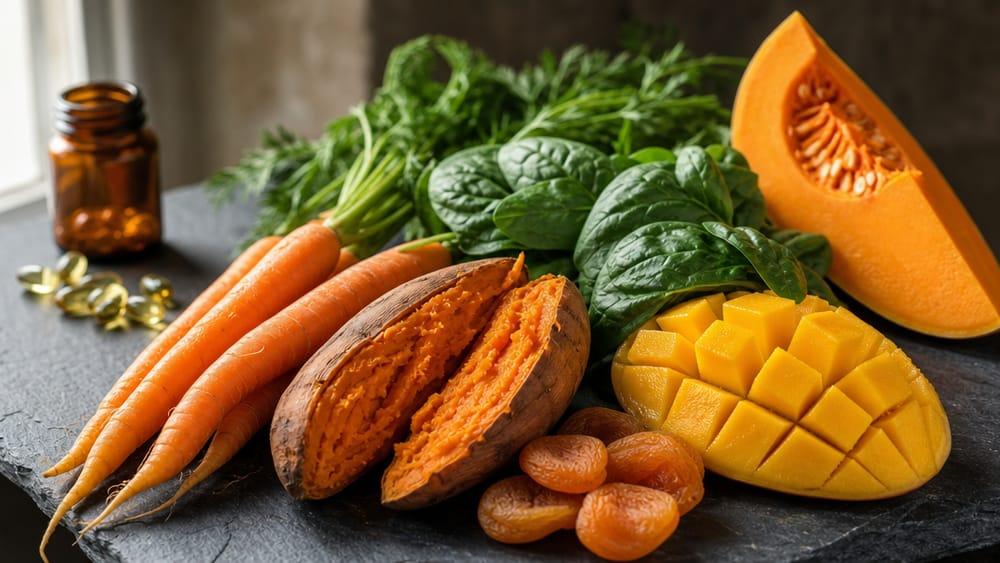
And the same source draws the line where it belongs: "Unlike preformed vitamin A, beta-carotene is not known to be teratogenic or lead to reproductive toxicity." Carrots, sweet potatoes and spinach are not the subject of that warning.
Then there is pharmacological stacking. The references note that medicines such as acitretin and bexarotene, "taken together with a vitamin A supplement could cause dangerously high levels of vitamin A in the blood" — alongside isotretinoin, which StatPearls named as a cause of toxicity outright. In the exact opposite direction, orlistat "can decrease the absorption of vitamin A. This can cause low blood levels of vitamin A in some people." The same supplement, then, can be too much for one person and too little for another — and what separates them is a medication list, not anything printed on the bottle.
The Saudi picture: who takes supplements, and who knows the dose?
The sharpest local figures available come from a cross-sectional study published in Nutrients in 2025 covering 1,006 participants in western Saudi Arabia (Alshehri and colleagues). The results have to be read together, not one at a time:
- 70.5% used dietary supplements
- Multivitamins were the most common at 44.9%, then mono-vitamins at 39.9%, then minerals at 7.5%
- Only 41% had correct knowledge of dosing
- 39.7% were unaware of possible side effects or drug interactions
- 31.2% had not consulted a healthcare professional
The gap here is not in the usage — usage is high and often perfectly reasonable — but between usage and knowing the dose. With a fat-soluble vitamin that is stored rather than excreted, "I'm not sure of the exact dose" is not a small knowledge gap, because the error compounds instead of being washed out.
The study states its own limits, and it is only fair to carry them over as written: "The convenience sampling method may limit the generalizability of the findings, and reliance on self-reported data introduces potential response bias. Additionally, recruitment through social media platforms may have led to selection bias, underrepresenting individuals with lower socioeconomic status, limited digital access, or lower education levels." In other words, these percentages describe people who answered an online survey. They are not a national rate.
Why these percentages don't add up — and shouldn't
A second Saudi study, published in IJERPH in 2025 across 477 adults in five regions (Al Turki and colleagues), found that 58% had used a supplement in the previous twelve months and that 81% of that use was vitamins. It reported that "around 53% of participants also indicated supplement use based on self-direction, marketing influences, general recommendations, or advice from family and friends, reflecting a substantial reliance on informal sources alongside professional guidance."
And here is a lesson in reading numbers. The study itself cautions that "given that participants were allowed to select multiple reasons for supplement use, the total percentages exceed 100%." So the figures sitting next to each other are overlapping, not mutually exclusive, and you cannot subtract one from another to manufacture a third. Better to say what the paper said: informal sources are strongly present alongside professional advice, not instead of it.
One figure deserves to be taped to the door of every household with a shared vitamin bottle: the daily upper limit for a child aged one to three (600 mcg in the US references, 800 mcg in the European review) is lower than the daily recommended intake for an adult man (900 mcg RAE). No calculation is required here. One household is not one dose.
The other side: deficiency is still the bigger global problem
It would be easy to read an article like this as a case against vitamin A. That would be a serious error, and the WHO's own page corrects it twice over:
- Vitamin A deficiency "is a public health problem in more than half of all countries, especially those in Africa and South-East Asia," and its most severe effects "are seen in young children and pregnant women in low-income countries."
- It is "the world's leading preventable cause of childhood blindness": per the same page, "an estimated 250 000–500 000 children who are vitamin A-deficient become blind every year, and half of them die within 12 months of losing their sight."
The WHO adds that night blindness "is one of the first signs of vitamin A deficiency," and that even mild deficiency "may increase children's risk for respiratory and diarrhoeal infections." Meanwhile, the NIH's consumer fact sheet notes that "vitamin A deficiency is rare in the United States because most people get enough vitamin A from the foods they eat."
The message is not "cut back on vitamin A." It is this: this is an essential nutrient with a window, and a window has two edges, not one. Someone already getting enough from food gains nothing from an extra dose — they simply move toward the side with no exit.
Practical steps before you buy, or before you continue
- Read the form, not just the name. Look on the label for "retinol" or "retinyl palmitate" (the preformed version, the one the ceiling governs) versus "beta-carotene."
- Convert to one unit. Don't compare a bottle in IU against a bottle in mcg RAE. Multiply retinol IU by 0.3 to get micrograms.
- Add up every source, not just the supplement. The multivitamin, the cod liver oil, the "skin support" capsule and the liver at dinner all land in the same total.
- Count frequency, not portion. With a nutrient that is stored, what matters is how many times a month, not how big the plate was once.
- Don't take a high dose because "it can't hurt." That sentence is true of water-soluble vitamins and false here.
- Ask about your medicines — especially retinoid and prescription skin medications, and anything that affects fat absorption.
Who should be careful, and when to ask a doctor
This article is educational and is not a substitute for medical advice; it is not a basis for starting a supplement or stopping a medicine. Talk to your doctor or pharmacist before any supplement containing vitamin A if you are:
- Pregnant or planning a pregnancy — this group comes first by a distance, because the harm here is not undone by stopping.
- Taking retinoid medications (such as isotretinoin or acitretin) or bexarotene.
- Living with liver disease or abnormal liver tests.
- Managing a condition that affects fat absorption, the pancreas or the intestine, or taking orlistat.
- A current or former smoker, specifically regarding beta-carotene supplements.
- Buying supplements online without local registration, or on promises of weight loss or "immune boosting" — an angle we covered in detail in herbal slimming products and what lab analyses actually find.
And see a doctor promptly if severe headache, blurred vision, persistent muscle and joint pain, or marked skin dryness appear while you are taking a high dose — because those are precisely the symptoms the sources above name.
Where does Bakery 8 stand in all this? 🥖
Honesty starts with what we cannot offer: no Bakery 8 product solves this, none is a meaningful source of vitamin A, and none protects you from it. If you're after vitamin A, your answer is in the produce aisle and in your doctor's office, not on a bakery shelf.
More than that: we have to disown one of the selling points our own dietary pattern is marketed on — "better absorption of fat-soluble vitamins." The mechanism StatPearls described above — absorption via micelles, dependent on bile and pancreatic enzymes — cuts both ways. The amount actually absorbed from a fat-soluble vitamin capsule is not set by the number on the bottle alone, but by the meal it rides in. And when that meal is high in fat, the logic says the absorbed fraction differs. To be straight about it: we do not have a figure telling you how much it differs on a specific ketogenic pattern, and we found no such figure in the sources we read. Anyone selling you "better absorption" as a benefit and then not handing you that number — and we are among those who don't have it — ought to say so, rather than converting the uncertainty into a promise.
There is a third point that belongs to our audience specifically. Low-carbohydrate patterns frequently recommend liver as a "nutrient-dense" choice, and it genuinely is one. But the arithmetic above doesn't move: one serving exceeds an adult's daily ceiling by more than double. So let it be a recommendation with a counted frequency, not an open-ended one.
What we actually offer is narrower and clearer: sugar-free, gluten-free baked goods built on almond flour, for people who want to keep carbohydrates low without giving up bread or something sweet. Samoli bread and toast from our bread range, for a meal built around food rather than around a capsule; and keto granola from the granola range, for a breakfast that satisfies without a sugar spike. That is the whole of what we promise: food, not a dose. And the word "healthy" on any product — ours included — is not a number, and does not read as permission for more.
Frequently asked questions
What is the daily upper limit for vitamin A in adults?
The Tolerable Upper Intake Level for adults is 3,000 mcg RAE per day, equivalent to 10,000 IU — the same figure used in both the US references and the European review. Crucially, that ceiling applies to the preformed vitamin (retinol and its esters) from animal-source foods and supplements, not to beta-carotene from food.
Can beta-carotene from carrots and spinach cause vitamin A toxicity?
No. Plant carotenoids are converted by the body according to need, and EFSA set no upper level for beta-carotene because the data were insufficient. The most that happens with prolonged excess is yellow-orange skin, which the references describe as harmless and reversible on stopping. The one warning attached to it concerns beta-carotene supplements in current and former smokers.
How long does it take the body to clear excess vitamin A?
Not hours. Vitamin A is stored in the liver and is not excreted the way water-soluble vitamins are. Per Cleveland Clinic, symptoms of chronic toxicity usually take between one and four weeks to resolve after the supplement is stopped. That is why the arithmetic is cumulative across weeks and months rather than daily.
Is liver off the menu, then?
Not off the menu, but counted. A 3-ounce serving of pan-fried beef liver contains 6,582 mcg RAE — 731% of the Daily Value, and more than twice an adult's upper limit in a single serving. The sensible move is to space out how often you eat it, and to pay particular attention if you are simultaneously taking a supplement containing the preformed form.
I'm pregnant and taking a multivitamin — should I be worried?
Don't stop or start on your own; show the bottle to your doctor or pharmacist so they can read the vitamin A form and amount with you. The published advice is not to take more than 3,000 mcg RAE (10,000 IU) daily of vitamin A supplements if you are pregnant or might become pregnant, and the reason is that harm in this situation is not corrected by stopping later.
References
- Office of Dietary Supplements, National Institutes of Health (NIH ODS) — Vitamin A and Carotenoids fact sheet, Health Professional version.
- Office of Dietary Supplements, National Institutes of Health (NIH ODS) — Vitamin A fact sheet, Consumer version.
- LiverTox: Clinical and Research Information on Drug-Induced Liver Injury — "Vitamin A" chapter, National Institute of Diabetes and Digestive and Kidney Diseases; last update 4 November 2020.
- StatPearls — "Biochemistry, Fat Soluble Vitamins"; last update 19 September 2022.
- European Food Safety Authority (EFSA) — "Overview on Tolerable Upper Intake Levels as derived by the SCF and the EFSA NDA Panel," Version 11, August 2025, citing the NDA Panel scientific opinion on the tolerable upper intake level for preformed vitamin A and β-carotene (2024).
- Cleveland Clinic — "Vitamin A Toxicity: How Much Vitamin A Is Too Much?"
- World Health Organization (WHO) — "Vitamin A deficiency," Nutrition Landscape Information System (NLIS).
- Alshehri AA, Alqahtani S, Aldajani R, Alsharabi B, Alzahrani W, Alguthami G, Khawagi WY, Arida H. "Knowledge, Attitudes, and Practices of Dietary Supplement Use in Western Saudi Arabia: A Cross-Sectional Study." Nutrients. 2025;17(7):1233. doi:10.3390/nu17071233
- Al Turki M, Othman F, Aljasser D, Alzaben AS. "Patterns and Determinants of Dietary Supplement Use and Their Public Health Implications Among Adults in Saudi Arabia: A Cross-Sectional Study." International Journal of Environmental Research and Public Health. 2025;22(10):1512. doi:10.3390/ijerph22101512
Related keywords: vitamin A toxicity · how much vitamin A is too much · hypervitaminosis A · vitamin A upper limit · preformed vitamin A vs beta-carotene · retinol · vitamin A and pregnancy · fat-soluble vitamins · mcg RAE · vitamin supplements