

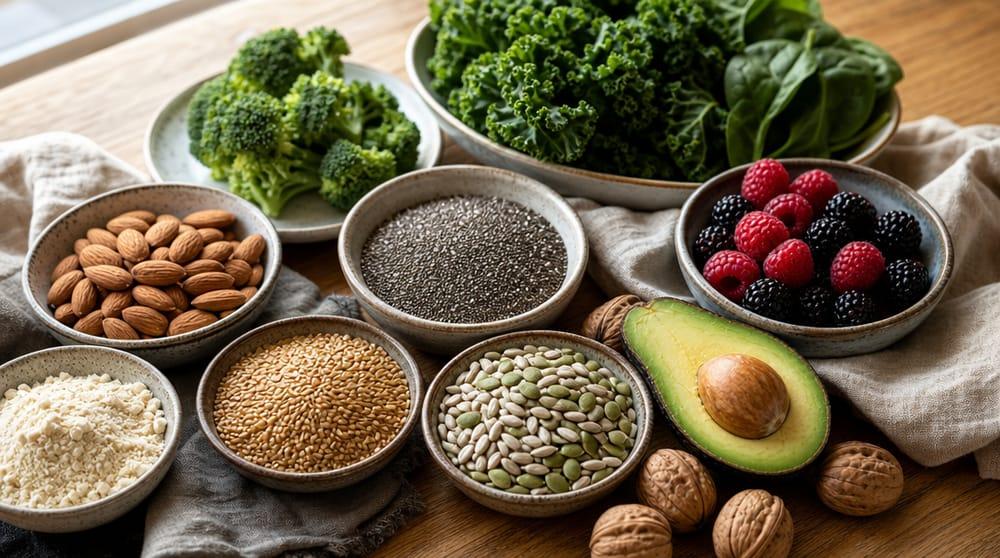
Dietary fiber is usually split into two boxes: soluble (dissolves in water) and insoluble (doesn't). That split is chemically accurate — but it is a poor predictor of what a fiber will actually do inside you. The two properties that really determine the benefit are whether the fiber forms a viscous gel, and whether your colon bacteria ferment it. That is why not every "soluble" fiber lowers cholesterol, and not every "insoluble" fiber fixes constipation.
This guide takes the familiar split apart, shows what the evidence really says about viscosity, fermentability and particle size, how many grams you need per day, and why people on low-carbohydrate diets fall into a silent fiber gap — and how to close it without bloating. This is educational content and does not replace your doctor's advice.
What is dietary fiber, exactly? 🌾
Dietary fiber is plant carbohydrate that your small-intestine enzymes cannot digest, so it reaches the colon largely intact. That definition is not just descriptive. The U.S. Food and Drug Administration defines it on the label as "non-digestible soluble and insoluble carbohydrates (with 3 or more monomeric units), and lignin that are intrinsic and intact in plants; isolated or synthetic non-digestible carbohydrates (with 3 or more monomeric units) determined by FDA to have physiological effects that are beneficial to human health."
Notice the last clause. An isolated fiber does not count as "dietary fiber" on the label merely because it resists digestion — it must demonstrate a beneficial physiological effect. Fiber that is naturally present and intact in vegetables, fruits, whole grains, pulses and nuts needs no such demonstration, because the foods containing it have already been shown to be beneficial. Hold on to that distinction; it comes back later.
The familiar split: soluble vs insoluble fiber
Soluble fiber
It dissolves in water and, as Mayo Clinic puts it, "forms a gel-like material in the stomach that slows down digestion." Sources include oats and oat bran, barley, peas and beans, apples, bananas, avocados, citrus, carrots and psyllium. It is the type usually credited with lowering cholesterol and blunting the post-meal glucose rise.
Insoluble fiber
It does not dissolve in water and, again per Mayo Clinic, "supports the movement of material through the digestive system and adds bulk to stool." Sources include wheat bran, whole-wheat flour, nuts, seeds, and the skins and seeds of fruits and vegetables, plus cauliflower, green beans and kale. It is the type usually credited with regularity.
All true — as chemistry. As a prediction tool, it is weak. Here is why.
Why do researchers say the soluble/insoluble split is not enough?
A landmark review titled "Understanding the Physics of Functional Fibers in the Gastrointestinal Tract: An Evidence-Based Approach to Resolving Enduring Misconceptions about Insoluble and Soluble Fiber" (McRorie and McKeown, Journal of the Academy of Nutrition and Dietetics, 2017) addressed exactly this question, and concluded that water solubility is not what creates the clinical effect. Two other properties are: viscosity and fermentability.
Property one: viscosity — does it turn into a gel?
"Viscous fibers thicken in the presence of water, forming very viscous solutions or even visco-elastic gels," explains the Linus Pauling Institute at Oregon State University. The key point is that soluble does not mean viscous:
- Soluble and highly viscous: beta-glucans from oats and barley, psyllium husk, raw guar gum.
- Soluble but low viscosity: gum arabic, methylcellulose, low-molecular-weight beta-glucan.
The practical difference is large. Only highly viscous fibers reduce LDL cholesterol, because they trap bile released into the small intestine and prevent its reabsorption, forcing the liver to pull more cholesterol out of circulation to make new bile. According to the Linus Pauling Institute, a recent meta-analysis found that a median psyllium dose of 10.2 g/day lowered LDL cholesterol by 0.33 mmol/L and non-HDL cholesterol by 0.39 mmol/L. The same logic applies to glucose: viscous fibers slow gastric emptying and glucose absorption, while non-viscous soluble fibers largely do not.
Property two: fermentability — do your gut bacteria eat it?
Some fibers are fermented quickly in the colon; others pass through nearly untouched:
- Readily fermented: inulin, fructooligosaccharides, resistant starch.
- Poorly fermented: wheat bran, cellulose, lignin, and psyllium.
Fermentation produces short-chain fatty acids — acetate, propionate and butyrate — and butyrate is the preferred fuel of the cells lining the colon. That is a real benefit, but it has a price: fast fermentation means gas. This is why one person bloats on a "soluble fiber" supplement and not on a different soluble fiber that happens to be poorly fermented. For more on that, see our articles on bloating and gas and on feeding your gut microbiome.
The most common myth: "bran always fixes constipation" 🚫
Plenty of people add wheat bran and find their constipation gets worse. Per the Linus Pauling Institute, the reason is not the fiber type but the particle size:
- Large, coarse insoluble particles (coarse wheat bran) mechanically stimulate water and mucus secretion, so stool output increases and softens.
- Finely ground wheat bran adds only dry mass, and its net effect can be constipating rather than laxative.
By contrast, viscous but poorly fermented fibers such as psyllium hold water throughout the colon, producing a "stool-normalizing" effect: softening hard stool and firming loose stool. The lesson: "eat more fiber" is incomplete advice. The right question is which fiber, in what texture, at what particle size?
How do regulators handle the distinction?
Regulators do not accept the word "soluble" on its own. The FDA has listed the isolated or synthetic carbohydrates that meet its fiber definition: beta-glucan soluble fiber, psyllium husk, cellulose, guar gum, pectin, locust bean gum and hydroxypropylmethylcellulose — with a proposal to add inulin and inulin-type fructans, mixed plant cell wall fibers, resistant starch, glucomannan and others. The acceptable physiological effects are specified too: lowering post-meal blood glucose or insulin, lowering fasting LDL cholesterol or fasting glucose, lowering blood pressure, increasing bowel movement frequency, improving mineral absorption, and reducing calorie intake.
The authorized heart-health claim (21 CFR 101.81) is even clearer. It is not granted to "soluble fiber" in general, but to specific doses from specific sources — 3 g or more per day of beta-glucan from whole oats or barley, or 7 g or more per day of soluble fiber from psyllium seed husk, each with a per-serving minimum. Even the claim's wording is deliberately cautious: soluble fiber from such foods, as part of a diet low in saturated fat and cholesterol, "may reduce the risk of heart disease."
What does the evidence say about fiber overall? 📊
Move from fiber type to total amount and the picture gets much stronger. The series of systematic reviews and meta-analyses published in The Lancet in 2019 (Reynolds and colleagues) pooled 185 prospective studies covering 135 million person-years and 58 clinical trials with 4,635 adults. Comparing the highest with the lowest fiber consumers:
- All-cause mortality: relative risk 0.85 (15% lower).
- Coronary heart disease mortality: 0.69 (31% lower).
- Coronary heart disease incidence: 0.76 (24% lower).
- Stroke incidence: 0.78 (22% lower).
- Type 2 diabetes: 0.84 (16% lower).
- Colorectal cancer: 0.84 (16% lower).
The greatest benefits appeared at 25–29 g per day, with additional protection at higher intakes and a linear dose-response with no clear plateau. The clinical trials showed more modest mean differences: body weight lower by 0.37 kg, total cholesterol by 0.15 mmol/L, and systolic blood pressure by 1.27 mm Hg. In fairness, prospective data are associations and cannot prove causation on their own — but their consistency with the trials strengthens confidence.
Harvard adds supporting numbers: women eating 25 g or more per day had a 13% lower risk of diverticulitis, and in a study of more than 90,000 women the highest fiber intake was associated with a 25% lower risk of breast cancer.
How many grams of fiber do you need per day?
- World Health Organization (2023 carbohydrate guideline): a strong recommendation for adults to consume at least 25 g per day of naturally occurring dietary fiber as consumed in foods; for children, at least 15 g (ages 2–5), 21 g (ages 6–9) and 25 g (ages 10 and older).
- U.S. Adequate Intake: 25 g for women and 38 g for men, or 14 g per 1,000 calories. Mayo Clinic lists 21 g for women over 50 and 30 g for men over 50.
- American Diabetes Association: at least 14 g per 1,000 kcal, with a clear preference for naturally fiber-rich foods over supplements, "for the additional benefits of coexisting micronutrients and phytochemicals."
Reality falls well short. Average U.S. intake was about 17 g per day (2017–2020), and only around 6% meet the adequate intake. Harvard cites an even lower figure of roughly 15 g. The fiber gap is not a rounding error.
The fiber gap in Saudi Arabia: knowledge that doesn't reach the plate 🇸🇦
A cross-sectional study published in the International Journal of Environmental Research and Public Health in 2020 (Alfawaz and colleagues) surveyed 1,363 adults in Riyadh, Saudi Arabia, and found solid awareness in some areas and clear gaps in others:
- 84.3% knew fiber helps prevent obesity, 70.5% linked it to cardiovascular health, and 68.9% to blood sugar regulation.
- 59.4% correctly identified the daily requirement (25–38 g).
- But only 21.0% recognized its role in reducing flatulence, and only 16.4% connected it to preventing constipation.
- In actual choices: 84.4% preferred white bread over brown, and 69.9% chose fried potatoes.
- The barriers named most often: cost (72.1%), a belief that the benefits are limited (56.5%), taste (52.8%) and availability (51.6%).
The message is clear: partial knowledge exists, but it is not reaching the plate. The fix is not another lecture — it is practical, available options that actually taste good.
The silent fiber gap on keto and low-carb diets ⚠️
Here is a point rarely stated plainly: low-carbohydrate diets are more exposed to fiber shortfall than most. The Linus Pauling Institute notes that intake may be closer to 10 g per day among low-carbohydrate dieters. The reason is structural, not personal: in a conventional diet most fiber comes from grains, pulses and fruit — precisely the first foods removed.
But the shortfall is not inevitable; it just requires deliberate planning. Low-carb-friendly fiber sources include:
- Plenty of non-starchy vegetables: spinach, kale, broccoli, cauliflower, zucchini, cucumber, peppers.
- Avocado — among the most fiber-dense fruits with minimal impact on blood glucose.
- Seeds: chia, ground flaxseed, pumpkin and sunflower seeds.
- Nuts and almond flour: fiber and fat instead of starch.
- Berries — blueberries, strawberries and raspberries in moderate portions.
This is where understanding net carbs and how to count them pays off: fiber is subtracted from total carbohydrate, so adding fiber serves your goal twice — physiologically and arithmetically.
A seven-step plan to close the fiber gap without bloating ✅
- Read "Total Carbohydrate" then "Dietary Fiber" on the label, not the marketing on the front of the pack. Our full guide: how to read a nutrition label.
- Increase slowly: about 2–3 g every few days so your gut bacteria can adapt. A sudden jump is the number-one cause of bloating, gas and cramping.
- Drink water. Fiber works by absorbing water; without it you can make the problem worse.
- Deliberately mix the two kinds: a viscous source (for cholesterol and post-meal glucose) plus a coarse-particle source (for regularity).
- Put vegetables in every meal — the cheapest, fastest way to raise your daily number.
- Two tablespoons of seeds a day (chia or ground flax) is an easy addition to yogurt, salad or bread.
- Don't chase extreme numbers. The American Diabetes Association notes that a few studies showed modest A1C reductions (−0.2% to −0.3%) above 50 g per day, but such intakes may cause gastrointestinal side effects. A sustainable 25–30 g beats 50 g for one week.
Who should be careful, and when to see a doctor 🩺
- People with IBS: rapidly fermented fibers can be particularly troublesome, a sensitivity Harvard specifically flags. Choices here should be individualized with a specialist.
- Anyone with intestinal strictures or recent gastrointestinal surgery: do not increase fiber without medical guidance.
- People with diabetes on insulin or glucose-lowering medication: an improved response may warrant a dose review with your doctor.
- Chronic constipation, a persistent change in bowel habits, bleeding or unexplained weight loss: these warrant medical evaluation, not a supplement experiment.
- Children and older adults: needs differ and should be individualized.
This article is educational and does not replace medical advice. Talk to your doctor or a registered dietitian before any major change, especially if you take medication or live with a chronic digestive condition.
Where does Bakery 8 fit into this? 🥖
Let's be honest: no bread — and no baked product — makes up for a plate with no vegetables on it. Fiber is built by the whole pattern of eating, not by one loaf. But when today's decision is loaf versus loaf, the base matters. Bakery 8 (مخبز ثمانية) in Riyadh, Saudi Arabia builds its products on almond flour, sugar-free and gluten-free, which means fat, fiber and protein instead of refined starch:
- Samoli bread, cloud bread and toast — a low-carb base for a sandwich you fill with vegetables, avocado and eggs.
- Keto granola — a direct swap for sweetened breakfast cereal, best over yogurt with chia seeds and berries.
- Crackers and manakish — a savory snack alongside hummus or guacamole instead of potato chips.
- Sugar-free chocolate, desserts and cake — a sweet moment with no added sugar, so one evening doesn't undo a week's plan.
Our rule of thumb: let the baked item be the base, and let vegetables and seeds be the filling. That is when the daily fiber number actually moves.
Frequently asked questions ❓
Is soluble fiber better than insoluble fiber?
Neither is universally better; they do different jobs. Viscous fibers (mostly soluble) lower LDL cholesterol and blunt post-meal glucose, while coarse insoluble fibers support regularity. In practice the best approach is an eating pattern that includes both, from a variety of whole foods, every day.
Can fiber supplements replace high-fiber foods?
No. Both the American Diabetes Association and Harvard recommend getting fiber from food first, because foods carry vitamins, minerals and plant compounds that a supplement does not. Supplements can help in specific situations under professional guidance, but they are not a substitute for the plate.
Why did I bloat after increasing fiber?
Usually because the increase was too fast, or because the fiber is rapidly fermented and produced gas in the colon. The standard fix: add only 2–3 g every few days, drink more water, and try less-fermentable sources. If discomfort persists for weeks, see your doctor.
Can you get enough fiber on a keto diet?
Yes, but it takes planning. Lean on non-starchy vegetables, avocado, nuts, seeds, almond flour and moderate portions of berries. Without that planning, intake can drop to around 10 g per day — far below the World Health Organization's recommendation of at least 25 g.
Does fiber lower blood sugar directly?
Viscous fiber slows gastric emptying and glucose absorption, which softens the post-meal rise. But it is not a medication and it does not treat diabetes. Any change to medication or insulin should be made with your doctor, never on the basis of a dietary change alone.
The bottom line
Soluble versus insoluble is a useful starting point, not the end of the story. What actually determines the effect is viscosity, fermentability and particle size — which is why "just add bran" sometimes fails, and why regulators require a specific fiber at a specific dose before allowing a health claim. At the same time, the big message stays simple: most of us never reach 25 g a day, and closing that gap with a variety of whole foods is one of the highest-return, lowest-effort moves in nutrition.
Start today with one step: add an extra vegetable serving, a spoonful of seeds, and read the label on what you buy. And if you are looking for a low-carb, sugar-free base to build your meals on, browse Bakery 8's products and pick what fits your plan.
References
- World Health Organization. Carbohydrate intake for adults and children: WHO guideline, 2023 (Recommendations 4 and 5 on dietary fibre).
- Reynolds A, Mann J, Cummings J, Winter N, Mete E, Te Morenga L. Carbohydrate quality and human health: a series of systematic reviews and meta-analyses. The Lancet. 2019;393(10170):434–445.
- McRorie JW Jr, McKeown NM. Understanding the Physics of Functional Fibers in the Gastrointestinal Tract: An Evidence-Based Approach to Resolving Enduring Misconceptions about Insoluble and Soluble Fiber. Journal of the Academy of Nutrition and Dietetics. 2017;117(2):251–264.
- Linus Pauling Institute, Oregon State University. Fiber — Micronutrient Information Center (viscosity, fermentability, bran particle size, psyllium).
- U.S. Food and Drug Administration. Questions and Answers on Dietary Fiber (definition, approved list, accepted physiological effects).
- U.S. Food and Drug Administration. 21 CFR 101.81 — Health claims: Soluble fiber from certain foods and risk of coronary heart disease.
- Evert AB, et al. Nutrition Therapy for Adults With Diabetes or Prediabetes: A Consensus Report. Diabetes Care. 2019;42(5):731–754.
- Fu L, et al. The Role of Dietary Fiber in Health Promotion and Disease Prevention: A Practical Guide for Clinicians. StatPearls / NCBI Bookshelf.
- Mayo Clinic. Dietary fiber: Essential for a healthy diet.
- Cleveland Clinic. Fiber: How Much Do You Need and How to Get It.
- Harvard T.H. Chan School of Public Health, The Nutrition Source. Fiber.
- Alfawaz H, Khan N, Alhuthayli H, Wani K, Aljumah MA, Khattak MNK, Alghanim SA, Al-Daghri NM. Awareness and Knowledge Regarding the Consumption of Dietary Fiber and Its Relation to Self-Reported Health Status in an Adult Arab Population: A Cross-Sectional Study. International Journal of Environmental Research and Public Health. 2020;17:4226.
Related keywords: soluble fiber, insoluble fiber, viscous fiber, fiber fermentation, fiber gap, fiber on keto, how many grams of fiber per day, fiber and cholesterol, fiber and blood sugar, almond flour fiber.