

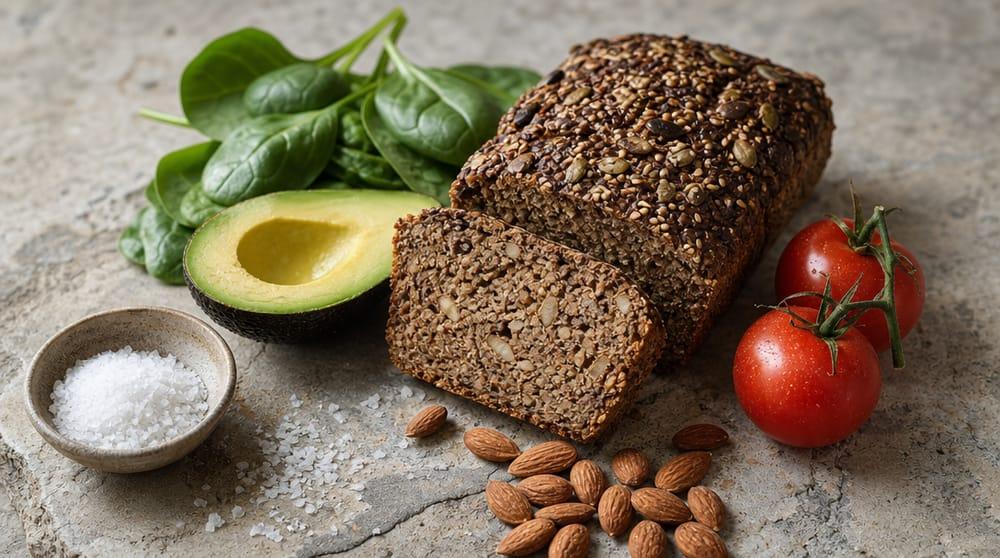
Salt is not sodium, and the shaker on your table is not the main source of what you actually eat. The World Health Organization recommends less than 2,000 mg of sodium a day for adults — under 5 grams of salt, roughly one teaspoon — while the global average intake was 4,278 mg a day in 2021, about 11 grams of salt. And the fact that matters most for a reader here in Riyadh, Saudi Arabia: the Saudi Ministry of Health reports that around 40% of daily salt intake comes from bread, and that roughly 75% of dietary salt comes from processed foods and meals prepared outside the home. In other words, most of your sodium was already in the food before your hand ever reached the shaker — which is why "I don't add salt" is not a sodium strategy.
This article takes the problem apart in an unusual order: first the arithmetic that confuses everyone, then where sodium actually hides, then the number missing from the whole equation — potassium — then why people don't all respond the same way, and finally the good news: your palate can be reset, and there is experimental evidence for it.
Salt vs sodium: the conversion nobody does
Table salt is chemically sodium chloride. Sodium is a mineral — one of the two elements in salt, not the salt itself. This distinction is not pedantry, because it causes a daily misunderstanding: health guidance is usually written in grams of salt, while food labels are written in milligrams of sodium. You read "less than 5 grams of salt," then look at a package saying "450 mg sodium," and the two numbers refuse to talk to each other.
The conversion is simple and worth memorising:
- 1 gram of salt equals about 400 mg of sodium.
- 5 grams of salt equals about 2,000 mg of sodium — the WHO daily ceiling.
- To turn sodium into salt, multiply by about 2.5. So 450 mg of sodium is roughly 1.1 g of salt — about a fifth of your entire daily allowance from a single package.
Watch for a second trap: some labels give sodium per 100 g and others per serving, and a serving size is a unit of measurement, not a recommendation. If the serving is 30 g and you eat 90 g, you are eating three times the printed number. The US Food and Drug Administration's triage rule helps here: 5% or less of the Daily Value for sodium per serving is considered low, and 20% or more is considered high, against a Daily Value of 2,300 mg. (We covered label-reading as a full skill in an earlier article on the Bakery 8 blog.)
Why removing the salt shaker isn't enough
This is the heart of it. Ask someone about salt and their mind goes straight to the shaker — which is in fact the smallest part of the equation. According to the American Heart Association, more than 70% of dietary sodium comes from packaged or restaurant foods, about 14% occurs naturally in foods, and everything added during cooking and at the table together accounts for only about 11% of total intake. The FDA says the same thing in different words: "Most dietary sodium (over 70%) comes from eating packaged and prepared foods — not from table salt added to food when cooking or eating."
So a person who gives up the shaker entirely may have addressed roughly a tenth of the problem and left nine tenths untouched. The irony is that this person usually feels they have "cut down on salt," and stops looking.
Where does sodium hide in a Saudi kitchen?
The answer may surprise you, and as a bakery we are obliged to state it plainly: the Saudi Ministry of Health reports that around 40% of the salt consumed daily comes from bread, followed by cheese, tomato products and processed meats. The reason is not that any single piece of bread is especially salty — it is that bread is eaten several times a day, so it accumulates. The FDA makes the same point: bread products may not look high in sodium per serving, but they add up precisely because they are eaten repeatedly.
The rest of the major-source lists look similar worldwide and locally: sandwiches and cold cuts, pizza, canned and packaged soups, savoury snacks and crackers, cheeses, sauces and pickles. Notice that most of these do not necessarily taste salty. Bread is the perfect example — mild on the tongue, heavy in the arithmetic.
How much sodium does your body actually need?
Sodium is not the enemy; it is essential for fluid balance and for nerve and muscle function. The gap is between what the body needs and what we eat. The Harvard T.H. Chan School of Public Health puts the body's requirement at about 500 mg of sodium a day for those vital functions, while average American intake runs around 3,400 mg. The Adequate Intake is 1,500 mg a day and the Chronic Disease Risk Reduction level is 2,300 mg as a maximum.
The reference numbers you will meet:
- WHO: less than 2,000 mg of sodium a day (under 5 g of salt).
- FDA: a Daily Value of 2,300 mg.
- American Heart Association: no more than 2,300 mg, with an ideal of 1,500 mg for most adults, especially those with high blood pressure — plus one very practical line: "Cutting out just 1,000 milligrams a day can improve blood pressure and heart health."
That last sentence deserves a pause. The goal is not to jump from 3,400 to 1,500 overnight; the goal is a slope. One thousand milligrams less is about 2.5 grams of salt, and it can come from changing two or three decisions a day without any sense of deprivation.
Why does any of this matter? Harvard describes the mechanism directly: as sodium accumulates, the body holds onto water to dilute it, which increases both the fluid surrounding cells and the volume of blood in the bloodstream, raising the workload on the heart and the pressure on artery walls. WHO estimates that about 1.7 million deaths a year in 2023 were associated with consuming too much sodium.
Potassium: the number missing from the equation
Most salt conversations revolve around a single figure: how much sodium? But physiology works on a ratio, not a solitary number. Potassium acts in the opposite direction to sodium in fluid regulation and blood pressure, which is why the honest description of a diet is its sodium-to-potassium ratio.
WHO recommends a potassium intake of at least 90 mmol a day (3,510 mg) for adults — a conditional recommendation, because the evidence on the precise optimal level is limited. It adds a striking note: if a person follows both the sodium and potassium recommendations, the molar ratio of sodium to potassium works out to roughly one to one. Harvard reports that people with the highest ratio of sodium to potassium in their diets had double the risk of dying of a heart attack.
Where do we stand locally? A Saudi study published in the journal Nutrients in 2025 measured 24-hour urinary excretion — the gold standard, not a questionnaire — in young adults aged 19–29 in Jeddah between October and December 2024, with 173 participants completing the full collection. Mean urinary potassium was 48.6 ± 23 mmol per 24 hours, an estimated intake of 1.9 ± 0.89 g a day, and the sodium-to-potassium ratio was 3.2 ± 1.4. Only 4.1% of participants met the potassium recommendation of more than 90 mmol a day. Women's intake was lower than men's by 0.52 g (95% CI 0.25–0.78; p < 0.001).
Read that again: the target ratio is close to one, and the measured ratio was above three. That opens a much more comfortable door, because a large share of the improvement requires no deprivation at all — it requires addition: leafy greens, avocado, unsalted nuts, legumes. You are not only chasing one number downwards; you are fixing a fraction from both ends.
Are potassium-based salt substitutes a good idea?
This is one of the most pressing questions right now, and the honest answer is a clear "yes, but."
The strongest evidence came from SSaSS, which enrolled 20,995 participants across 600 rural Chinese villages with a mean follow-up of 4.74 years, replacing ordinary table salt with a substitute in which part of the sodium chloride is replaced by potassium chloride. Results: stroke 29.14 versus 33.65 events per 1,000 person-years (P = 0.006); major adverse cardiovascular events 49.09 versus 56.29 (P < 0.001); death from any cause with a rate ratio of 0.88 (95% CI 0.82–0.95). As for hyperkalaemia — the central safety worry — there was no difference between groups (3.35 versus 3.30 per 1,000 person-years, P = 0.76).
In 2025 WHO issued guidance on lower-sodium salt substitutes: if you choose to use table salt, it suggests replacing it with a substitute containing potassium. But pay attention to how the recommendation is classified, because that classification is part of the information: it is conditional, the certainty of the evidence is low, and it is aimed at adults in the general population. It explicitly does not apply to pregnant women, to children, or to people with kidney impairment or any condition that compromises potassium excretion. WHO's potassium recommendation likewise excludes those with impaired urinary potassium excretion.
In practice: a potassium-enriched salt substitute is not a universally "healthy" product to be picked off a shelf without asking. If you take ACE inhibitors, angiotensin receptor blockers, spironolactone or potassium supplements, or you have kidney disease or heart failure, this is a medical decision, not a shopping decision.
Why doesn't everyone respond the same way? Salt sensitivity
You may have noticed one person cut their salt and watched their blood pressure fall clearly, while another did the same and barely moved. That is not a contradiction; it is a described phenomenon called salt sensitivity of blood pressure, meaning simply that blood pressure changes in parallel with changes in salt intake.
In a scientific statement from the American Heart Association, salt sensitivity is estimated at about 25% of normotensive people and 30% to 50% of people with hypertension. The statement notes that salt sensitivity diagnosed through careful dietary protocols — rather than surrogate methods — appears to be an independent risk factor for cardiovascular events, with some questions still open.
What should you take from this? Not "so there's no point cutting salt." The right conclusions are two: that you may not see an immediate change on the monitor without that meaning the effort is worthless, and that regular home measurement before the change and several weeks after it is the only way to learn which type you are. Try it, measure, then decide with your doctor.
The DASH-Sodium trial supports the gradual-slope idea: it enrolled 412 adults and tested three sodium levels — 3,300, 2,300 and 1,500 mg a day — and found blood pressure fell with every reduction in sodium, that combining the DASH eating pattern with low sodium beat either one alone, and that the benefit appeared in people with and without high blood pressure alike.
The good news: your palate learns — and that is proven
What stops most people from cutting salt is not disagreement; it is the fear that food will taste of nothing. This is exactly where the loveliest finding in the whole file sits.
The Institute of Medicine's report on strategies to reduce sodium intake summarises the evidence as follows: after eating a diet with a 30–50% overall reduction in sodium for two to three months, volunteers gradually developed a preference for less salty foods. That is a genuine resetting of the preference threshold, not temporary endurance.
More useful still is the just-noticeable-difference threshold. People generally cannot detect a difference between two concentrations of a taste substance when the gap is smaller than about 10%. That opens the "invisible slope" strategy: reduce in small steps and the tongue never registers it.
And this has been tested on bread specifically — which concerns us as a bakery. In a single-blind randomised controlled trial published in the European Journal of Clinical Nutrition, 110 volunteers had the salt in their bread cut by 5% a week over six weeks until the total reduction reached one quarter. The result: the intervention group was no more likely than the control group to report a difference in the bread's saltiness from week to week (P = 0.8), and there was no difference in flavour scores (P = 0.08) or liking (P = 0.95). The Institute of Medicine report states it plainly: 25% of the salt in bread can be removed, over a cumulative series of small decreases, without people recognising a taste change.
Take that idea into your kitchen. Do not delete the salt from your favourite recipe; cut it by 10% every two weeks. Three months later you will have roughly halved it, without ever passing through a single moment where the food felt "different."
A practical seven-day plan
- Day 1 — count, don't estimate. Turn over three packages you eat daily (bread, cheese, a sauce or crackers), write down the sodium per serving, then multiply by the servings you actually eat. That number is your real starting point.
- Day 2 — treat the biggest source, not the easiest one. Start with the item that delivers the most total sodium in your day, which is usually something you eat several times rather than once. The shaker comes last, not first.
- Day 3 — add instead of subtracting. Put a serving of leafy greens, avocado or unsalted nuts into two meals. You are treating the denominator of the fraction, not only the numerator.
- Day 4 — the filling before the base. In a sandwich, sodium usually concentrates in the processed meat, the cheese and the sauces more than in the bread itself. Swap one of them for fresh protein, eggs or vegetables.
- Day 5 — cook at home one extra time. One fewer meal from outside per week is among the single largest changes available, because roughly 75% of salt comes from processed food and food prepared outside the home.
- Day 6 — rebuild the flavour. Lemon, vinegar, garlic, onion, cumin, black pepper, fresh herbs and sumac. Flavour is not salt; salt is only one of its tools.
- Day 7 — start the slope. Cut 10% of the salt in your usual recipe and hold it there for two weeks before the next reduction. Measure your blood pressure at home before, and again four to six weeks later.
Who should be more careful, and when to talk to your doctor
This section is not a footnote; it is the part that may change your decision.
- People with kidney disease or heart failure, and anyone on potassium-retaining medication (ACE inhibitors, ARBs, spironolactone, potassium supplements): do not start using potassium-enriched salt substitutes on your own. The WHO recommendation does not apply to you in the first place.
- Pregnant women and children: explicitly excluded from the salt-substitute recommendation. Any dietary change in pregnancy or childhood goes through a doctor.
- Anyone starting a low-carb or ketogenic diet: here is a point that may look like the opposite of this whole article. A 2025 scoping review in Frontiers in Nutrition covering 89 studies explains that starting a ketogenic diet is accompanied by increased renal excretion of sodium and water — falling insulin raises sodium excretion — that this loss peaks between days 1 and 4, and that initiation symptoms such as headache, dizziness, fatigue and muscle cramps typically appear within 2–3 days and resolve in most people within 2–4 weeks. So sodium needs may rise temporarily at that specific stage. This does not mean a person with high blood pressure should add salt; it means the general recommendation gets individualised. Discuss it with your doctor, especially if you take blood-pressure medication.
- Anyone working or training in Riyadh's heat and sweating heavily: the requirement differs from someone sitting in an air-conditioned office all day, and the difference is individual enough to deserve a medical question rather than self-experimentation.
Signs that call for a doctor rather than self-experimentation: persistent swelling in the feet or legs, shortness of breath, recurrent headaches with high blood-pressure readings, or a sudden rise in weight over a few days. This article is educational and does not replace diagnosis or treatment; any change to a medication or a diet goes through your doctor.
Where does Bakery 8 stand in all this?
Honesty first: no bread treats high blood pressure, and no food product replaces measuring your blood pressure and following up with your doctor. And when the Ministry of Health says around 40% of daily salt comes from bread, it would be dishonest for a bakery to skip over that sentence. Bread — any bread, ours included — contains salt, and integrity requires us to ask you to apply everything you just read to our label too.
What we can claim is one specific thing: that the base of your day can be made from ingredients you recognise and can count.
- Bread and toast made with almond flour: the sandwich base you build yourself — and this is the most practical idea in the section, because the sodium in a sandwich usually concentrates in the processed meat, the salty cheese and the sauces far more than in the base. When you assemble it at home, you decide the filling.
- Keto granola: an alternative to processed breakfast cereal, with no added sugar, and an easy way to raise potassium by pairing it with avocado, unsalted nuts or plain yoghurt.
- Crackers and manakish: savoury snacks appear on every major sodium-source list — so turn the pack over and count the portion you will actually eat, not the portion printed on it.
- Sugar-free desserts and chocolate: not part of the sodium equation, but they serve the same idea — a plan someone can stay on beats a perfect plan abandoned after two weeks.
And if you find that any product — ours first — does not fit your daily sodium count, don't buy it. That is the correct use of what you just read.
Frequently asked questions
Is sea salt or pink salt less harmful than table salt?
Not meaningfully, in sodium terms. Mayo Clinic notes that table salt, pink salt, sea salt and other cooking salts all contain sodium. The differences lie in crystal size and trace minerals, not in being meaningfully "lower in sodium." Count the sodium, not the name or the colour of the salt.
How many teaspoons of salt are allowed per day?
The WHO ceiling is less than 5 grams of salt a day, roughly one teaspoon, equivalent to about 2,000 mg of sodium. Remember that most of that is already spent inside the foods you buy, so the room left for the shaker is smaller than you think.
If I cut salt, when will I see a difference in blood pressure?
It depends on your salt sensitivity — about 25% of normotensive people and 30–50% of people with hypertension are salt sensitive, according to the American Heart Association. Regular home measurement before the change and four to six weeks after is the practical way to learn your own response, and reviewing the result with your doctor is the next step.
Are potassium salt substitutes safe for me?
The 2025 WHO recommendation is conditional and rests on low-certainty evidence, and it does not apply to pregnant women, children, or people with kidney impairment or reduced potassium excretion. If you take a potassium-retaining medication, or have kidney disease or heart failure, the decision is purely medical. Ask your doctor before buying.
Will food taste bland if I use less salt?
The evidence says the opposite, if you do it gradually. People cannot detect a difference smaller than about 10% in concentration, and a trial that cut bread salt by 5% a week until it reached a quarter found participants noticed no difference in saltiness, flavour or liking. After two to three months on a lower-sodium diet, it shifts from endurance to an actual preference for less salty food.
Conclusion
The shaker on your table accounts for a small share of your sodium; the larger share entered your food before you ever saw it. So real salt reduction starts with three moves: convert between salt and sodium so you understand what you are reading, treat the repeated daily sources rather than the exceptional ones, and raise potassium as much as you lower sodium so you fix the fraction from both ends. Then do it on a gradual slope — because your palate, and this is experimentally proven, resets itself.
If you are looking for a daily base made from ingredients you recognise and can count, browse the Bakery 8 range at getbakery8.com — and turn the label over first, ours before anyone else's.
References
- World Health Organization — Fact sheet: Sodium reduction, 2025.
- World Health Organization — Guideline: Potassium intake for adults and children, 2012 (via NCBI Bookshelf).
- World Health Organization — Use of lower-sodium salt substitutes: WHO guideline, 2025.
- Neal B et al. — Effect of Salt Substitution on Cardiovascular Events and Death (SSaSS), New England Journal of Medicine, 2021 (figures via the American College of Cardiology and TCTMD trial summaries).
- US Food and Drug Administration — Sodium in Your Diet.
- American Heart Association — Sodium Sources; Shaking the Salt Habit to Lower High Blood Pressure.
- Elijovich F et al. — Salt Sensitivity of Blood Pressure: A Scientific Statement From the American Heart Association, Hypertension, 2016.
- Institute of Medicine — Strategies to Reduce Sodium Intake in the United States, chapter: Taste and Flavor Roles of Sodium in Foods (via NCBI Bookshelf).
- Girgis S et al. — A one-quarter reduction in the salt content of bread can be made without detection, European Journal of Clinical Nutrition.
- Saudi Ministry of Health — Awareness Platform: Salt.
- Nutrients 2025;17(20):3227 — Time to Consider Potassium Intake in Saudi: A Cross-Sectional Assessment Using 24 h Urinary Excretion.
- National Heart, Lung, and Blood Institute (NHLBI) — Health Benefits of the DASH Eating Plan (DASH and DASH-Sodium trials).
- Harvard T.H. Chan School of Public Health — The Nutrition Source: Salt and Sodium.
- Mayo Clinic — Sodium: How to tame your salt habit.
- Frontiers in Nutrition, 2025 — Symptoms during initiation of a ketogenic diet: a scoping review.
Related keywords
sodium and salt, how much salt per day, sodium in bread, sodium to potassium ratio, potassium salt substitutes, salt sensitivity blood pressure, reduce salt gradually, reading sodium on a nutrition label, salt and blood pressure, hidden sources of sodium.