

Potassium is an essential mineral that helps lower blood pressure by offsetting sodium and relaxing blood vessel walls, and most people do not get enough of it. But advice that is right for the majority becomes a real hazard for a specific minority: anyone whose kidneys cannot clear potassium efficiently, or who takes medication that reduces how much they excrete. The striking part is that the global recommendation carries that exception written into its own text — and the people it excludes are usually the last to know they are excluded.
In January 2025 the World Health Organization issued a new recommendation suggesting that regular table salt be replaced with lower-sodium salt substitutes containing potassium. The headlines framed it as a one-step fix: change the shaker, lower your pressure. Reading the full recommendation tells a more careful story — it is a conditional recommendation resting on low certainty evidence, it names excluded groups explicitly, and it asks for a health system in which kidney disease does not go undiagnosed for long.
So this article is not about whether potassium is good for you. It is. It is about a harder question: how do you know whether you are in the majority who benefit, or the minority who are harmed?
What potassium actually does
Potassium is a mineral and an electrolyte found inside almost every cell in your body. Its best-known job concerns blood pressure. The National Institutes of Health Office of Dietary Supplements (NIH ODS) puts it this way: "Higher potassium intakes may help decrease blood pressure, in part by increasing vasodilation and urinary sodium excretion." The American Heart Association says it more plainly — foods with potassium "help control blood pressure by blunting the effects of sodium."
When you fall short, the consequence is not just fatigue. The same NIH fact sheet notes that "getting too little potassium can increase blood pressure, deplete calcium in bones, and increase the risk of kidney stones," with severe deficiency causing constipation, tiredness, muscle weakness and, at its worst, an irregular heartbeat.
So why isn't the advice simply "get more of it"? Because potassium — unlike most nutrients we have written about — does not have an open-ended safety margin for everyone. Your body clears the excess through your kidneys. When that exit is narrowed, excess stops being excess and becomes accumulation.
How much do you need — and why the label number confuses people
The current reference intakes set the Adequate Intake for adults at 3,400 mg a day for men and 2,600 mg for women (2,900 mg in pregnancy). The World Health Organization, in its 2012 guideline, recommends increasing potassium intake from food "for reduction of blood pressure and risk of cardiovascular disease, stroke and coronary heart disease in adults" — a strong recommendation — with a suggested level of at least 90 mmol/day (3,510 mg/day).
Here is the detail that trips people up: the Daily Value printed on nutrition labels is 4,700 mg, which is higher than the Adequate Intake itself. The "%" on the package measures you against a ceiling higher than your actual target, so small-looking percentages are not the alarm they appear to be.
For scale: average intake from food among US adults is 3,016 mg for men and 2,320 mg for women. Falling short is not the exception. It is the norm.
What about Saudi Arabia? Here the number is measured, not estimated
Most nutrition studies ask people what they ate — a method with well-known accuracy problems. That is what makes the most recent Saudi study on this question worth attention: it measured potassium directly in 24-hour urine collections, the reference standard for estimating intake.
The study (Albar SAA, Almaghrabi MA, Nutrients 2025;17(20):3227) was conducted in Jeddah between October and December 2024 and surveyed 600 young adults aged 19–29, of whom 173 provided valid collections. The findings:
- Mean urinary potassium excretion: 48.6 ± 23 mmol/24 h, equivalent to an estimated daily intake of about 1.9 ± 0.89 g.
- Only 4.1% of participants met the WHO-recommended level of at least 90 mmol/day.
- Mean sodium-to-potassium ratio: 3.2 ± 1.4, against an optimal ratio of roughly 1.0.
The authors' own limitations deserve to be carried over honestly: the sample was small, drawn from one city, restricted to a narrow young age band, recruited by convenience sampling, and based on a single collection per participant. This is a strong signal, not a national survey. Even so, the gap is far too wide to be a statistical accident.
Salt substitutes: the strongest evidence — and the riskiest generalisation
What are they?
A lower-sodium salt substitute is simply salt in which part of the sodium chloride has been replaced with potassium chloride. In the largest trial ever run on them the blend was 70% sodium chloride and 30% potassium chloride. According to WHO, the formulations studied across the evidence base ranged from 41% to 75% sodium chloride and from 19% to 50% potassium chloride.
And here is a practical point most shoppers miss: these products are not one thing. NIH ODS notes that the potassium content of salt substitutes "varies widely, from about 440 mg to 2,800 mg potassium per teaspoon." One teaspoon — and a sixfold difference between brands. "Salt substitute" is not a known dose. It is a broad category.
The trial that changed the conversation
The Salt Substitute and Stroke Study (SSaSS) is the largest ever conducted in this field: 20,995 participants across 600 villages in rural China, all of whom had either survived a previous stroke or were over 60 with high blood pressure. Mean follow-up was 4.74 years. The results:
- Stroke: 29.14 versus 33.65 events per 1,000 person-years (rate ratio 0.86; p = 0.006).
- Fatal stroke: rate ratio 0.77 (95% CI 0.65–0.91).
- Major adverse cardiovascular events: 49.1 versus 56.3 per 1,000 person-years (p < 0.001).
- Death from any cause: rate ratio 0.88 (0.82–0.95).
- And most important for safety: hyperkalemia at 3.35 versus 3.30 per 1,000 person-years (p = 0.76) — no difference.
That is a powerful result by any standard. Which is exactly why the brakes deserve to be read with the same care as the numbers.
Three brakes the headline leaves out
One: who were the participants? Professor Salim Yusuf noted that the population was "highly selected," and that its baseline sodium intake (4.3 g/day) exceeded the North American average (around 3.5 g) — which makes a literal transfer of the result to other populations uncertain.
Two: what survives if you remove that one trial? A recent network meta-analysis (Lai H, Nesrallah G, Guyatt GH, et al., BMC Medicine 2026;24:106, doi:10.1186/s12916-026-04635-z) pooled 34 randomised trials and 37,063 participants across 15 countries. Moderate-potassium substitutes lowered systolic blood pressure by roughly 4.39 to 4.64 mmHg on moderate-to-high certainty evidence. But the authors state plainly that the mortality and cardiovascular benefits are "predominantly driven by one large Chinese trial," and that excluding it "eliminated statistical significance for all-cause mortality." In other words: the blood-pressure effect is solid; the survival effect stands on one leg.
Three: the grade of the recommendation itself. The 2025 WHO recommendation is not strong; it is conditional, on "low" certainty evidence by GRADE. That is not us downgrading it. That is what WHO said about its own guidance.
The recommendation that carries its own exception
Here is the sentence that rarely reaches the headlines. WHO states that the recommendation "is intended for adults (not pregnant women or children) in general populations, excluding individuals with kidney impairments or with other circumstances or conditions that might compromise potassium excretion."
It then adds a deeper condition for implementation: the use of these substitutes "should be implemented in settings with adequate access to health care, where conditions in which increased potassium intakes are potentially harmful (e.g. kidney disease) would not go undiagnosed for a long time."
None of this is new. WHO's earlier potassium guideline (2012) already stated that its recommendations apply to all individuals, including pregnant and lactating women, "except for those with impaired urinary potassium excretion."
Notice what that does. The general advice is safe on condition that each person knows the state of their kidneys. And early kidney disease is usually silent. The exception is written clearly — but it is addressed to people who do not know it is about them.
Even the American Heart Association phrases it in a way worth pausing over: salt substitutes "are not expensive and can be used freely unless you have certain medical conditions, such as kidney disease, or take certain medications." The whole weight of that sentence sits on "unless."
Why you can't feel high potassium
Hyperkalemia is usually defined as a serum potassium above roughly 5.0 to 5.5 mEq/L. What matters clinically is that mild elevations are "often asymptomatic," while severe hyperkalemia can precipitate life-threatening cardiac arrhythmias, muscle weakness or paralysis.
You might assume an ECG would catch it. Not necessarily. StatPearls states explicitly that "patients with chronic hyperkalemia may exhibit relatively normal ECG tracings despite markedly elevated serum potassium concentrations."
The clearest illustration was published in Cureus in 2025: an 88-year-old man with stage G3b chronic kidney disease whose potassium reached 7.5 mEq/L — an emergency-level figure — and who nonetheless "remained asymptomatic, with no electrocardiographic changes, bradycardia, or hemodynamic instability." An interview revealed that his family had given him potassium-enriched salt as a gift during his hospital stay. The authors concluded that the case "highlights the risk of hyperkalemia associated with potassium-enriched salt in patients with CKD and underscores the need for physicians to educate such patients about this risk."
The lesson is not that salt substitutes are poison. The lesson is that feeling fine is not evidence of being fine.
Who should ask a doctor before any salt substitute or potassium supplement?
This list is not meant to frighten. It is meant to be precise:
- Anyone with chronic kidney disease, at any stage. NIH ODS puts it starkly: in people with impaired urinary potassium excretion due to chronic kidney disease, "even dietary potassium intakes below the AI can cause hyperkalemia."
- Anyone taking ACE inhibitors or angiotensin receptor blockers (ARBs) — these "reduce urinary potassium excretion, which can lead to hyperkalemia."
- Anyone taking potassium-sparing diuretics such as spironolactone — among the most common drug causes.
- Regular users of NSAIDs, and people with heart failure, liver disease or diabetes. Cleveland Clinic states that salt substitutes "can be dangerous when you have conditions such as kidney disease, heart disease, high blood pressure, liver disease or diabetes."
- Older adults. The American Heart Association notes that "too much potassium can be harmful in older people and those with kidney disorders."
Why does this matter especially here? Because the person most likely to reach for a salt substitute — older, hypertensive — is the same person most likely to have reduced kidney function. In the largest published Saudi analysis (Alshehri MA, Alkhlady HY, Awan ZA, et al., BMC Nephrology 2025;26:37) covering 664,684 individuals across all 13 administrative regions, overall chronic kidney disease prevalence was 4.76%, most of it stage 3 (3.5%). But the age gradient is the point: from 0.45% among those aged 18–29 to 50.94% above 90. The authors themselves caution that their definition relied on reduced eGFR alone without albuminuria, and that a cross-sectional design cannot establish causality.
In other words, the curve of "who needs lower blood pressure" and the curve of "who may not tolerate an extra potassium load" intersect at the same age. That overlap is the whole issue.
One last paradox: hardly anyone uses them anyway
All of the above might suggest everyone is swapping their salt. The opposite is true. An analysis presented at the American Heart Association Hypertension Scientific Sessions in September 2025, covering 37,080 adults in the US National Health and Nutrition Examination Survey from 2003 to 2020, found salt-substitute use peaked at 5.4% in 2013–2014 and then fell to 2.5% by 2017–2020. Even among people with treated but uncontrolled hypertension, use ranged only between 3.7% and 7.4%. (This was a conference poster and has not yet been through full peer review, so read it as a signal rather than a settled fact.)
So the real picture is not a dangerous wave. It is a double absence: the people who could benefit don't know, and the people who should be cautious are never asked. Both gaps close with the same single conversation.
What to do, practically
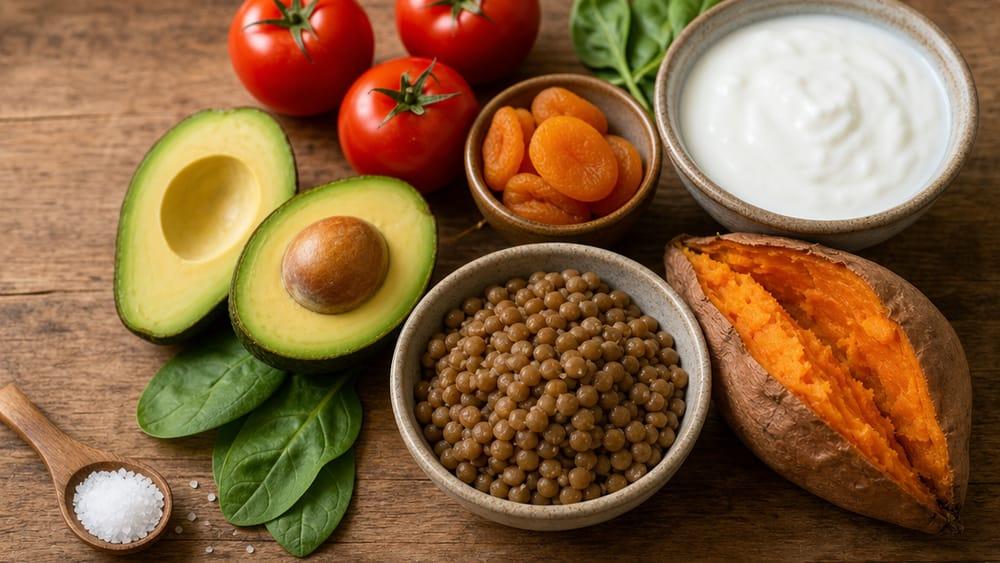
- Start with food, not a package. Good sources with their numbers: dried apricots (½ cup) 755 mg, cooked lentils (1 cup) 731 mg, baked potato (1 medium) 610 mg, banana (1 medium) 422 mg, 1% milk (1 cup) 366 mg — plus spinach, avocado, tomatoes, yogurt and fish.
- Read the ingredient line, not the brand name. Look for "potassium chloride." The difference between brands can be sixfold in a single teaspoon.
- Don't start a salt substitute before you know two numbers: your estimated glomerular filtration rate (eGFR) and your serum potassium. Both are inexpensive routine tests.
- Don't take a potassium supplement on your own initiative. For good reason, most over-the-counter supplements provide no more than 99 mg per serving — a ceiling set on safety grounds. If you need more than that, it is a physician's decision, not a pharmacy-shelf one.
- If you are on the caution list, the rule is blunt: "Don't take salt substitutes unless they're approved by your physician."
- Don't chase a single pressure reading either. A properly taken home measurement tells you far more than one clinic number — which we covered in Home Blood Pressure Monitoring.
Where does Bakery 8 stand on this?
Honestly: on the sidelines. No bread — ours or anyone else's — will bring your potassium up to the recommended level, and nothing on our shelf counts as a meaningful potassium source. The real sources are vegetables, fruit, legumes, dairy and fish, and we don't sell those.
We will go further, and this does not serve us: the low-carbohydrate pattern our products serve tends to cut back precisely some of the richest potassium sources — potatoes, legumes, much fruit, and sometimes milk. If you follow that pattern, potassium is a gap you have to plan around, not a benefit you inherit. We made the same admission about magnesium, and we repeat it here because it is true.
What we can honestly claim is narrow and specific: if you are building a carb-aware meal, you can make what goes around the bread the potassium source — slices of samoli or cloud bread with mashed avocado, spinach and egg, or a bowl of yogurt with keto granola and a handful of nuts. The bread is not the potassium here; it simply doesn't stand in its way. That is all we claim — and nothing more than that.
When to seek medical help
See a doctor promptly if any of the following appear, especially if you use a salt substitute or potassium supplement, or take any of the medications above:
- Unexplained muscle weakness, numbness or difficulty moving.
- Palpitations or a sense of an irregular heartbeat.
- Fainting or severe dizziness.
- Sudden fatigue with nausea in someone with known kidney disease.
And remember that an absence of symptoms does not rule out a high level — as the case above showed. This article is educational only and does not replace medical advice. Never start or stop any medication or supplement based on an article.
Frequently asked questions
Is a salt substitute safe if I have high blood pressure?
For most adults with hypertension and no kidney disease or potassium-retaining medication, yes — that is what WHO suggests, as a conditional recommendation. But "most" is not "all." If you have kidney disease, or take an ACE inhibitor, an ARB or a potassium-sparing diuretic, the decision belongs to your doctor after a serum potassium and kidney function check.
How much potassium do I need each day?
The Adequate Intake for adults is 3,400 mg for men and 2,600 mg for women, while WHO recommends at least 90 mmol (3,510 mg) a day from food. The Daily Value printed on labels (4,700 mg) is higher than both, so don't treat it as your personal target.
Would I feel it if my potassium were high?
Usually not. Mild elevations are typically asymptomatic, and even an ECG can look relatively normal in chronic cases despite a markedly raised level. A blood test is the only reliable way, which is why it is ordered regularly for people with kidney disease or on certain medications.
Are potassium supplements better than food?
No — food delivers potassium slowly, alongside water, fibre and other minerals. Over-the-counter supplements are capped at around 99 mg per serving on safety grounds, a small amount against a daily need in the thousands. Any higher dose requires a prescription and monitoring.
Does a low-carbohydrate diet lower potassium?
It can, because several of the richest sources — potatoes, legumes, some fruit and milk — are usually reduced. The answer is not to abandon the pattern but to plan deliberately: spinach, avocado, tomatoes, nuts, fish and yogurt within the carbohydrate limits you follow.
References
- National Institutes of Health, Office of Dietary Supplements. Potassium — Fact Sheet for Health Professionals.
- National Institutes of Health, Office of Dietary Supplements. Potassium — Fact Sheet for Consumers.
- World Health Organization. Guideline: Potassium Intake for Adults and Children. Geneva: WHO; 2012.
- World Health Organization. Use of Lower-Sodium Salt Substitutes: WHO Guideline. Geneva: WHO; 2025.
- Neal B, Wu Y, Feng X, et al. Effect of Salt Substitution on Cardiovascular Events and Death (SSaSS). N Engl J Med. 2021;385(12):1067–1077.
- Lai H, Nesrallah G, Guyatt GH, et al. Comparative effects of salt substitutes on blood pressure, cardiovascular events and mortality: a systematic review and network meta-analysis. BMC Medicine. 2026;24:106. doi:10.1186/s12916-026-04635-z
- Simon LV, Rout P. Hyperkalemia. StatPearls Publishing; updated 1 December 2025.
- Kusunoki M, Fujihara T, Ishida R, Yamamori Y. Hyperkalemia Caused by Potassium-Enriched Salt in a Hospitalized Patient. Cureus. 2025;17(6):e86704. doi:10.7759/cureus.86704
- Albar SAA, Almaghrabi MA. Time to Consider Potassium Intake in Saudi: A Cross-Sectional Assessment Using 24 h Urinary Excretion. Nutrients. 2025;17(20):3227. doi:10.3390/nu17203227
- Alshehri MA, Alkhlady HY, Awan ZA, et al. Prevalence of chronic kidney disease in Saudi Arabia: an epidemiological population-based study. BMC Nephrology. 2025;26:37. doi:10.1186/s12882-025-03954-2
- American Heart Association. A Primer on Potassium.
- Cleveland Clinic. Are Salt Substitutes a Healthy Way to Lower Your Sodium Intake?
- American Heart Association Newsroom. U.S. survey finds salt substitutes rarely used by people with high blood pressure (Hypertension Scientific Sessions 2025, poster TAC228, 4 September 2025).
Related keywords: potassium, salt substitutes, potassium chloride, potassium-rich foods, hyperkalemia, high potassium, blood pressure, chronic kidney disease, sodium-to-potassium ratio, ACE inhibitors, potassium-sparing diuretics.