

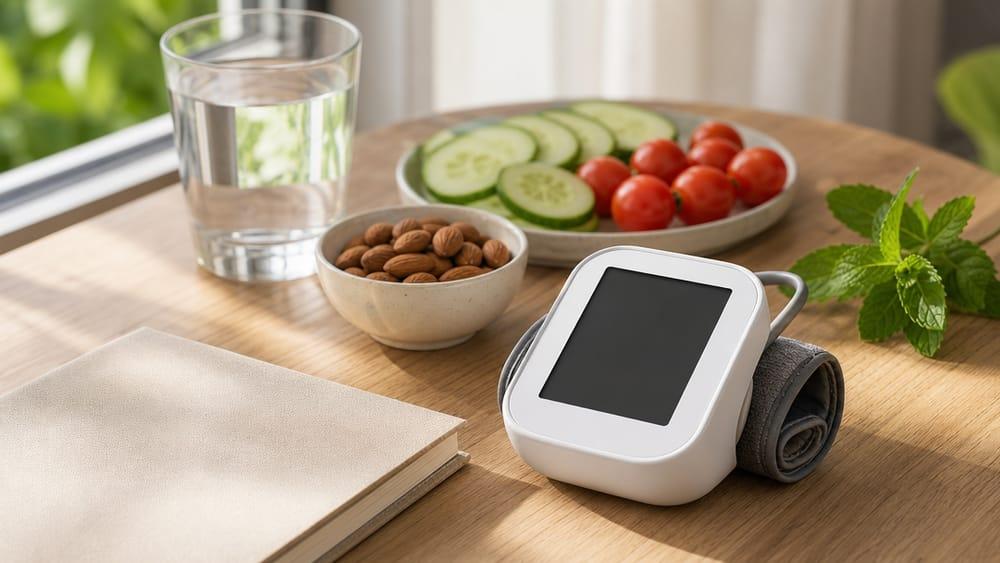
Home blood pressure monitoring is how medical guidelines recommend confirming a diagnosis of high blood pressure before treatment starts, because a single clinic reading can be wrong in both directions: it can raise a false alarm ("white coat hypertension"), or it can falsely reassure you while your pressure runs high in everyday life ("masked hypertension"). And what matters most: real risk follows the pressure your body lives with all day and all night, not the number that appeared during one minute on the clinic machine.
In this article from Bakery 8 (مخبز ثمانية) we explain why a clinic reading on its own is not enough, what pushes the number up or down without your true blood pressure changing at all, and how to measure blood pressure at home in a way you can actually rely on — step by step.
🩺 What counts as high blood pressure, and why is it called the "silent killer"?
Blood pressure is the force of blood pushing against your artery walls. It is written as two numbers: systolic (the top number, while the heart contracts) and diastolic (the bottom number, between beats). The American Heart Association (AHA) classifies readings like this:
- Normal: systolic below 120 and diastolic below 80.
- Elevated: systolic 120–129 and diastolic below 80.
- Stage 1 hypertension: systolic 130–139 or diastolic 80–89.
- Stage 2 hypertension: systolic 140 or higher or diastolic 90 or higher.
- Severe hypertension: higher than 180 and/or higher than 120.
The catch is that you usually cannot feel it. As University of Utah researcher Adam Bress put it, commenting on a study published in JAMA in February 2026: "High blood pressure is what we call a silent killer. You can't feel it for the most part." So don't wait for a symptom to tell you. The number is the only way to know — provided the number is right.
📊 How many people in Saudi Arabia don't know their blood pressure is high?
The answer is sobering: most of them. An analysis of the Kingdom of Saudi Arabia World Health Survey 2019 (KSAWHS), covering 8,266 adults whose blood pressure was actually measured and published in Frontiers in Cardiovascular Medicine in February 2026, found a hypertension prevalence of 12.69% (17.32% age-standardised). The authors wrote: "Among adults with hypertension, only 34.8% were aware of their condition." In other words, roughly 65% did not know.
In a community screening campaign in the Aseer region during Ramadan 2025 (657 participants, International Journal of General Medicine, June 2026), 56.3% of those with high readings had never been diagnosed, and around 90% of those already diagnosed had uncontrolled readings on the day.
But notice the brake the authors applied themselves: "Blood pressure was measured during a single visit, which may overestimate hypertension prevalence." That one sentence is precisely what this article is about. A single day's reading is enough to raise a question mark, but not enough to reach a verdict. The message is not "most of us are ill." It is this: many people have not been measured enough to know — in either direction.
🔍 Why isn't a clinic reading enough?
Because the number you see in the clinic is one moment in an unusual place, after traffic, a wait, and perhaps some nerves. That is why the US Preventive Services Task Force (USPSTF), in its 2021 Grade A recommendation, advises screening adults with office blood pressure measurement and then obtaining "blood pressure measurements outside of the clinical setting for diagnostic confirmation before starting treatment" — either 24-hour ambulatory monitoring or home monitoring with validated devices. The 2025 AHA/ACC guideline (Jones and colleagues, 14 August 2025) likewise lists home monitoring among its key emphases.
Error one: the false alarm (white coat hypertension)
Mayo Clinic defines white coat hypertension this way: "Your blood pressure is higher at a healthcare professional's office than in other settings, such as at home." The USPSTF estimates it occurs in about 8% of cases, while Cleveland Clinic cites a wider range of roughly 10%–30% among people with high office readings, depending on how it is defined and who is studied.
Error two: the false reassurance (masked hypertension)
This is the reverse: your pressure looks normal in the clinic but runs high in daily life. Cleveland Clinic notes it may affect up to 30% of adults whose office readings look normal. Mayo Clinic says some people "always get different blood pressure readings outside a medical office — even when blood pressure is measured correctly and repeatedly," and that if accurate home readings are consistently higher, "you may be at risk of a heart attack or stroke."
⚖️ Which number actually predicts risk?
This is the strongest evidence in the article. In a study published in The Lancet in 2023 (Staplin and colleagues), researchers followed 59,124 patients from 223 primary care centres across all 17 regions of Spain for a median of 9.7 years. There were 7,174 deaths, including 2,361 cardiovascular deaths. The findings:
- 24-hour systolic pressure: associated with all-cause death at a hazard ratio of 1.41 per one-standard-deviation increase (95% CI 1.36–1.47).
- Clinic systolic pressure: only 1.18 (1.13–1.23).
- Masked hypertension: hazard ratio 1.24 for all-cause death and 1.37 for cardiovascular death — almost the same as sustained hypertension (1.24 and 1.38).
- White coat hypertension: not associated with increased mortality risk in this study.
The authors concluded that ambulatory blood pressure, "particularly night-time BP," was more informative about the risk of death than clinic blood pressure.
The lesson we take from it: masked hypertension — where the clinic numbers look "reassuring" — carried a risk close to that of obvious, sustained hypertension. The comforting number can be more dangerous than the worrying one.
And the brake, in both directions: this is an observational study of patients who had already been referred for ambulatory monitoring, so it cannot prove cause and effect, and it does not mean white coat hypertension is entirely harmless. Mayo Clinic cautions that it "might raise the risk of getting long-term high blood pressure" and may carry a higher risk of heart and blood vessel disease. The practical takeaway: don't dismiss a high clinic reading, and don't take comfort in a normal one if your home readings are high. Collect more numbers.
✋ What changes the number without changing your blood pressure?
Before blaming the device or your nerves, consider that errors in technique alone can create differences as large as a whole diagnostic stage.
1) Arm position
In a randomised crossover trial from Johns Hopkins published in JAMA Internal Medicine in 2024 (Liu and colleagues, 133 adults), the recommended position — arm supported on a desk at heart level — was compared with common alternatives:
- Arm resting on the lap: systolic overestimated by 3.9 mm Hg (95% CI 2.5–5.2), diastolic by 4.0.
- Arm hanging unsupported at the side: systolic overestimated by 6.5 mm Hg (5.1–7.9), diastolic by 4.4.
The study's senior author, Dr. Tammy Brady, stressed that "arm position makes a huge difference." Think about it: 6.5 mm Hg can move a reading of 127 (elevated) to 133 (stage 1).
2) Cuff size
In the Cuff(SZ) randomised crossover trial (Ishigami and colleagues, JAMA Internal Medicine, August 2023, 195 participants), a "regular" adult cuff was used on people who needed a different size:
- People who needed a small cuff: readings came out about 3.6 mm Hg lower.
- People who needed a large cuff: systolic readings rose by about 5 mm Hg.
- People who needed an extra-large cuff: readings rose by about 20 mm Hg — from an average of 125/79 to 144/87, shifting them from "elevated" into stage 2.
Strikingly, only about 28% of participants actually fitted the regular cuff. If your upper arm is on the larger or the slimmer side, cuff size is part of the diagnosis.
3) The half hour before
The AHA advises: don't smoke, drink caffeinated beverages or exercise within 30 minutes before measuring, and empty your bladder. That includes your cup of Arabic coffee or tea: if you measure in the morning, measure first, then have your coffee.
🏠 How to measure blood pressure at home correctly (step by step)
These steps follow the American Heart Association's home-monitoring guidance:
- Choose the right device: an automatic, cuff-style upper-arm monitor — not a wrist or finger device. Check that it is clinically validated; one useful reference is Validate BP, a free listing run by the American Medical Association (AMA) and reviewed by an independent expert committee.
- Check the cuff size: measure around the middle of your upper arm and compare it with the range printed on the cuff.
- For 30 minutes beforehand: no coffee, tea, smoking or exercise, and empty your bladder.
- Sit quietly for 5 minutes: back supported, feet flat and uncrossed, no talking, no phone.
- On bare skin: remove clothing from the arm and place the bottom of the cuff just above the bend of the elbow.
- Arm supported at heart level: on a table, with a pillow underneath if needed.
- Two readings, one minute apart: every session — and record both.
- At the same time every day: in practice, often morning (before medication, breakfast and coffee) and evening, for several days in a row before your appointment. Ask your doctor which schedule suits you.
- Record everything: date, time and both readings. Don't delete the "odd" ones.
- Bring your monitor to the clinic: Mayo Clinic suggests taking your device to your next appointment to compare it with the office equipment.
⌚ Is a smartwatch enough?
Not yet. In December 2025 the American Heart Association published a scientific statement in Hypertension concluding that cuffless blood pressure devices are not currently recommended for diagnosing or treating high blood pressure. The writing group chair, Dr. Jordana Cohen, put it plainly: "The speed of commercialization has outpaced the science."
And in February 2026 a study in JAMA (Bress and colleagues, University of Utah) estimated — by modelling national US survey data — that the hypertension-notification feature on one popular smartwatch would not alert 59% of people with undiagnosed hypertension, while 8% of people without hypertension could receive a false alert. The recommendation: the alert supplements cuff-based screening; it does not replace it. If your watch hasn't alerted you, that does not mean your blood pressure is normal. (This was a modelling study rather than a field trial, and its results apply to one device and one population.)
🤔 When should one high reading worry me?
Most isolated high readings call for correct, repeated measurement rather than panic. The important exception, according to the AHA:
- If a reading is higher than 180/120: wait one minute and measure again.
- If it stays that high with symptoms such as chest pain, shortness of breath, back pain, numbness or weakness, vision changes or difficulty speaking: this is an emergency — call an ambulance immediately (997 or 911 in Saudi Arabia).
- If it stays that high without symptoms: contact your doctor promptly.
⚠️ Who should be especially careful (and when to see a doctor)
- People with diabetes or kidney disease: high blood pressure compounds the damage to kidneys, eyes and heart.
- Adults over 40, and anyone with a family history or excess weight: the USPSTF recommends annual screening from age 40 and for those at increased risk.
- Pregnant women: high blood pressure in pregnancy needs dedicated medical follow-up; don't rely on home readings alone.
- Anyone on blood pressure medication: do not stop or change your dose based on home readings or an article — take your log to your doctor and decide together.
- Anyone whose home readings are consistently higher than their clinic readings: this is not an error to ignore; it may be masked hypertension that deserves 24-hour ambulatory monitoring.
This article is for health education only and is not a substitute for medical advice.
🍞 What about food? A frank word from Bakery 8
We will not tell you that any bread lowers blood pressure. No bread — not ours, not anyone else's — lowers your blood pressure, and no food turns a badly taken reading into a correct one. Bread in general is a source of salt in the diet, so read the nutrition label on everything you buy, our products included.
What actually moves blood pressure is everyday habits: physical activity (see our article on how many steps you actually need), sleep and its timing (see our piece on shift work and your body clock), body weight, and medication your doctor prescribes when it is needed.
Our part is small and specific: correct measurement comes before coffee and breakfast. Once your two morning readings are done, breakfast can be simple and low in carbohydrates: a slice of samoli or cloud bread with eggs and fresh vegetables, a handful of keto granola with unsweetened yoghurt, or crackers with a lower-salt cheese. Nothing more than that.
❓ Frequently asked questions
What is the difference between white coat and masked hypertension?
White coat hypertension means your reading is high in the clinic but normal at home, so things look worse than they are. Masked hypertension is the reverse: normal in the clinic but high in daily life, so things look better than they are. Both can only be detected with measurements taken outside the clinic, at home or with a 24-hour ambulatory monitor.
How often should I measure my blood pressure at home?
The American Heart Association recommends measuring at the same time every day, taking two readings one minute apart at each session. In practice, many people measure morning and evening for several consecutive days before a doctor's appointment and record every reading. The exact schedule and how long to continue should be set by your doctor based on your condition and medication.
Are wrist blood pressure monitors accurate?
The American Heart Association recommends an automatic, cuff-style upper-arm monitor, so wrist devices are not the first choice for home use — especially since arm position alone shifted readings by several millimetres in the Johns Hopkins trial. If you must use one, make sure it is clinically validated, follow its instructions exactly, and compare it with the clinic device at your appointment.
My clinic reading is normal. Do I still need to measure at home?
Not necessarily everyone, but consider it if you have diabetes or kidney disease, a family history of high blood pressure, or clinic readings close to the threshold (120–129). Masked hypertension may affect a meaningful share of people whose office readings look normal, and in a large Spanish cohort it carried a risk close to that of sustained hypertension.
Can a smartwatch replace a blood pressure monitor?
No. In December 2025 the American Heart Association issued a scientific statement explaining that cuffless blood pressure devices are not currently recommended for diagnosis or treatment. A 2026 modelling study in JAMA estimated that one smartwatch's alert would miss 59% of undiagnosed hypertension. Use a validated, cuff-based upper-arm monitor instead.
✨ The bottom line
Blood pressure is not one number; it is a pattern your arteries live with all day and all night. A clinic reading is a moment, not a verdict. It can frighten you for no reason, or reassure you without cause. The answer is neither worry nor denial, but more numbers, taken better: a validated device, a cuff that fits, a supported arm, five quiet minutes, and a log you take to your doctor.
At Bakery 8 in Riyadh, Saudi Arabia, we believe healthy eating is one part of a bigger picture, never a replacement for it. Browse our low-carb, sugar-free, gluten-free range if it suits the way you eat — and make tomorrow morning's first healthy step this one: measure before your coffee.
📚 References
- Jones DW, Ferdinand KC, Taler SJ, et al. 2025 AHA/ACC/AANP/AAPA/ABC/ACCP/ACPM/AGS/AMA/ASPC/NMA/PCNA/SGIM Guideline for the Prevention, Detection, Evaluation and Management of High Blood Pressure in Adults. JACC / Hypertension, 14 August 2025.
- US Preventive Services Task Force. Hypertension in Adults: Screening — Recommendation Statement (Grade A). 27 April 2021.
- Staplin N, de la Sierra A, Ruilope LM, et al. Relationship between clinic and ambulatory blood pressure and mortality: an observational cohort study in 59,124 patients. The Lancet, 2023. doi:10.1016/S0140-6736(23)00733-X.
- Liu H, Zhao D, Sabit A, et al. Arm Position and Blood Pressure Readings: The ARMS Crossover Randomized Clinical Trial. JAMA Internal Medicine. 2024;184(12):1436–1442. doi:10.1001/jamainternmed.2024.5213.
- Ishigami J, et al. Effects of Cuff Size on the Accuracy of Blood Pressure Readings: The Cuff(SZ) Randomized Crossover Trial. JAMA Internal Medicine, published online 7 August 2023.
- Alshahrani NZ, Alarifi AM, Humieda AH, et al. Prevalence and risk factors of hypertension in Saudi Arabia based on a nationally representative survey. Frontiers in Cardiovascular Medicine. 2026;13:1752357.
- Al-Qahtani FS, Battar SS, Musharraf MH, et al. Undiagnosed and Uncontrolled Hypertension in the Aseer Region, Saudi Arabia: A Ramadan Screening Study. International Journal of General Medicine. 2026;19:1–17.
- American Heart Association. Cuffless blood pressure devices — Scientific Statement, Hypertension, 11 December 2025 (writing group chair: Jordana Cohen).
- Bress and colleagues (University of Utah Health). Impact of a Smartwatch Hypertension Notification Feature for Population Screening. JAMA, February 2026.
- American Heart Association. Monitoring Your Blood Pressure at Home; Understanding Blood Pressure Readings.
- Mayo Clinic. White coat hypertension: When blood pressure rises at the doctor's office; Blood pressure readings: Why higher at home?
- Cleveland Clinic. 24-Hour Ambulatory Blood Pressure Monitoring.
- American Medical Association. Validate BP — Validated Device Listing.
Related keywords: home blood pressure monitoring, how to measure blood pressure at home, white coat hypertension, masked hypertension, blood pressure cuff size, arm position blood pressure, normal blood pressure range, ambulatory blood pressure monitoring, validated blood pressure monitor.