

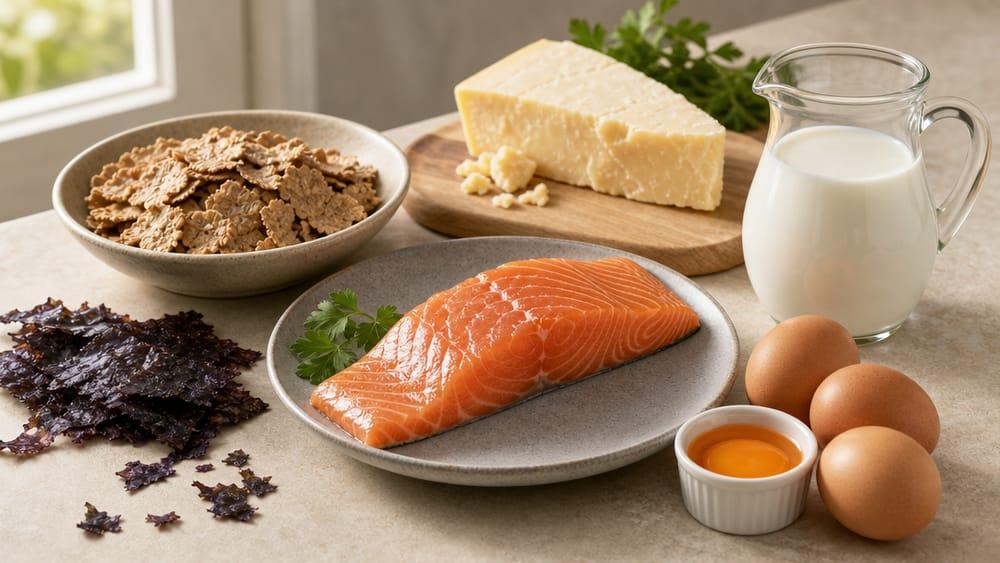
Vitamin B12 is almost the only vitamin where having it in your food is not enough for it to reach your body. Between the bite and the bloodstream lies a four-station journey involving your salivary glands, your stomach, your pancreas and the very end of your small intestine — and if a single station breaks down, a deficiency can develop even though what was on your plate was perfectly adequate. That is why the most important question is usually not "how much B12 am I eating?" but "can my body extract it?"
This article walks through that journey, shows where the chain breaks and for whom, explains why a reassuring blood count can coexist with nerves that are anything but, and reviews what the evidence actually says. It is general health education and does not replace a conversation with your doctor.
What is vitamin B12, and why is it different from other vitamins?
Vitamin B12 (cobalamin) is a water-soluble vitamin involved in making red blood cells, building DNA and forming the myelin sheath that wraps your nerves. That last job is what makes its deficiency different from most others: the consequence is not only fatigue — it can be nerve damage.
But the crucial difference is not what it does; it is how it arrives. While most vitamins are absorbed by a relatively simple mechanism, vitamin B12 requires a precise extraction-and-delivery chain: the parcel is on the truck, but opening it needs one key, then another key, then a specific employee at the end of the line.
The journey of vitamin B12: four stations before it arrives
The US National Institutes of Health Office of Dietary Supplements (NIH ODS) describes the route clearly in its professional fact sheet, and it can be summarised as four consecutive stations.
Station one: saliva
The fact sheet states it directly: "The freed vitamin B12 then binds with haptocorrin, a cobalamin-binding protein in the saliva." In other words, the journey begins before the food even reaches your stomach.
Station two: stomach acid
In the stomach, acid and digestive enzymes separate the vitamin from the food protein it was bound to. This is precisely the step that declines with age.
Station three: intrinsic factor
Here is the most famous step: "In the duodenum, digestive enzymes free the vitamin B12 from haptocorrin, and this freed vitamin B12 combines with intrinsic factor, a transport and delivery binding protein secreted by the stomach's parietal cells." Intrinsic factor is not a nutrient and not a supplement — it is a protein your own stomach manufactures. You cannot buy it and you cannot eat your way around it.
Station four: the end of the small intestine
Finally: "The resulting complex is absorbed in the distal ileum by receptor-mediated endocytosis." Absorption happens specifically in the last section of the small intestine — so disease affecting that section, or its surgical removal, severs the journey at its final station.
The conclusion worth reading twice: the food contains the vitamin, but the body has to extract it. Four stations, and one failure is enough.
The ceiling few people know: why one big meal cannot fix a deficiency
The recommended daily amount for adults is 2.4 mcg (2.6 mcg in pregnancy, 2.8 mcg in lactation) — a small amount that anyone eating meat, fish, eggs or dairy clears easily.
But there is a detail that is rarely explained: intrinsic factor has a limited carrying capacity. NIH ODS puts it plainly: "Bioavailability of vitamin B12 from food varies by vitamin B12 dose because absorption decreases drastically when the capacity of intrinsic factor is exceeded (at 1–2 mcg of vitamin B12)."
Two practical consequences follow:
- Regularity beats volume. One enormous B12-rich meal is not absorbed in full; spreading intake across the day is more efficient.
- This explains why supplement doses look absurdly large — 1,000 mcg against a daily need of 2.4 mcg. A large oral dose does not travel through intrinsic factor at all; it relies on passive diffusion across the intestinal wall, a side road so inefficient that only a small fraction gets through, which is exactly why the number on the bottle has to be big.
Where does the chain break, and for whom?
This is the heart of the article: in the overwhelming majority of cases, vitamin B12 deficiency is an absorption problem, not a dinner-table problem.
1) Age and weakening stomach acid
The NIH ODS consumer fact sheet is blunt: "Many older adults don't have enough hydrochloric acid in their stomach to absorb the vitamin B12 that's naturally present in food." Which is why the same source gives an explicit practical recommendation: "People over 50 should get most of their vitamin B12 from fortified foods or dietary supplements because, in most cases, their bodies can absorb vitamin B12 from these sources."
Notice the logic of that advice. It does not say "eat more meat." It says "route around the broken station" — because the B12 in fortified foods and supplements is not bound to a food protein that needs acid to release it.
A review in American Family Physician (Langan RC, Goodbred AJ, 2017;96(6):384–389) estimates the problem affects nearly 20% of those older than 60 in the US and UK. That is an estimate from other populations, and should be read as an indication of scale rather than a Saudi figure.
2) Pernicious anaemia: an immune attack on the factory
NIH ODS calls pernicious anaemia "the most common cause of clinically evident vitamin B12 deficiency." Here the immune system attacks the stomach cells that make intrinsic factor. Mayo Clinic explains the result simply: "Without this substance, the intestines can't take in B-12."
And a point that should not be glossed over: no diet, however perfect, treats this. No meat, no liver and certainly no bread rebuilds a protein the stomach has stopped producing. The treatment is medical, usually lifelong, and determined by a doctor.
3) Stomach surgery and weight-loss operations
NIH ODS notes that people who have had stomach or intestinal surgery "might not make enough hydrochloric acid and intrinsic factor to absorb vitamin B12." StatPearls confirms that "any patient with a history of gastric bypass surgery may be at risk for developing a B12 deficiency." Given how common bariatric surgery has become in the region, laboratory follow-up after the operation is a routine part of care.
4) Disease at the end of the small intestine
Because absorption happens specifically in the distal ileum, disease there severs the journey. StatPearls: "any damage to the terminal ileum… will impair the absorption of B12." Mayo Clinic names Crohn's disease and celiac disease among the conditions that "can keep the body from taking in vitamin B-12." If you are managing a chronic bowel condition, that is one more reason to discuss B12 testing with your doctor — and we have already explained why symptoms going quiet is not the same as disease going quiet in our article on what remission actually means in inflammatory bowel disease.
5) Medications — with an important brake
Two drugs come up every time. The first is metformin: NIH ODS says it "might reduce vitamin B12 absorption and lower blood levels of vitamin B12," and American Family Physician suggests considering screening in people using it "for more than four months."
The second is acid-suppressing medication, of which NIH ODS says it "can interfere with vitamin B12 absorption from food by slowing the release of hydrochloric acid into the stomach" — a mechanism entirely consistent with the chain described above.
But intellectual honesty demands a brake here. In preliminary findings from the TUDA Ageing Cohort Study (Clements M, Ward M, Hughes CF, et al., Proceedings of the Nutrition Society 2020;79(OCE2):E587, in 5,186 adults aged 60 and over), people with atrophic gastritis differed clearly from healthy controls: total B12 188 versus 262 pmol/L and methylmalonic acid 0.65 versus 0.37 µmol/L (P < 0.001 and P = 0.001 respectively). But for proton pump inhibitor users the finding was, verbatim: "No differences in B12 biomarker concentrations were observed between PPI users and healthy controls."
So the mechanism is theoretically plausible, yet this particular study found no measured effect of those drugs on B12 biomarkers in older adults. These are preliminary findings published as a conference abstract, not a completed systematic review, so no decision should rest on them alone. The moderate conclusion: do not stop a medication your doctor prescribed because of an article. If you have used acid suppressants for years, that is a conversation for the clinic, not a decision for the kitchen.
The same cohort adds one more finding that is, in effect, this whole article in miniature. Regular consumption of fortified foods "impacted positively on B12 biomarker status in all participants" — and yet it "appeared insufficient to restore normal vitamin B12 status in those with atrophic gastritis." Improve the supply and it still is not enough when the machinery is broken.
6) A strict plant-based diet: here the problem really is intake
This is the one entry on the list where the problem is the food rather than the extraction. NIH ODS is categorical: "Plant foods do not naturally contain vitamin B12," which is "present in foods of animal origin, including fish, meat, poultry, eggs, and dairy products." StatPearls notes that "patients who have followed a strict vegan diet for approximately 3 years may develop a B12 deficiency" — liver stores postpone the appearance by years, which is exactly what allows the deficiency to travel in silence.
NIH ODS also flags a more vulnerable group: "When pregnant women and women who breastfeed their babies are strict vegetarians or vegans, their babies might also not get enough vitamin B12." That is a good reason for early medical follow-up.
Why anaemia can mislead you: blood and nerves can diverge
The stereotype of B12 deficiency is anaemia: pallor, fatigue, breathlessness. That is true — but it is neither the whole picture nor the most dangerous part of it.
When the deficiency persists, the myelin sheath is damaged. StatPearls describes the result: "damage to the myelin results in a condition known as subacute combined degeneration of the spinal cord," which affects "various parts of the spinal cord… resulting in a loss of proprioception, ataxia, the development of peripheral neuropathy, and dementia." Mayo Clinic is equally direct about untreated deficiency: it "can lead to issues with the nerves, brain or spinal cord. These might include lasting tingling in the hands and feet or trouble with balance."
And here is the hinge that changes how you should think about the whole subject. American Family Physician notes that "clinical evaluation seems to show an inverse relationship between the severity of megaloblastic anemia and the degree of neurologic impairment." The blood picture can be the least alarming thing in exactly the cases where the neurological damage is clearest.
Which is why there is an explicit treatment rule: the same review states that "if vitamin B12 deficiency coexists with folate deficiency, vitamin B12 should be replaced first to prevent subacute combined degeneration of the spinal cord." That order is not a procedural nicety; it is nerve protection.
Practically: "there's no anaemia" is not a ruling-out of B12 deficiency — especially when the complaint is numbness, unsteadiness or a change in memory. Those belong in front of a doctor, not in a self-diagnosis.
Recovery varies. StatPearls describes subacute combined degeneration as a condition in which the symptoms "partially resolve, and the progression may stop." The word "partially" is what makes delay more costly here than in most nutritional stories.
Is spirulina a source of vitamin B12?
A very common question, and the literature's answer is clear and disappointing. In a review by Watanabe F, Yabuta Y, Bito T and Teng F in Nutrients (2014;6(5):1861–1873), the authors report that edible blue-green algae supplements "often contained large amounts of pseudovitamin B12" — a molecule chemically similar enough to register on microbiological assays, but inactive in the human body. Their conclusion is verbatim: "Therefore, edible cyanobacteria and their products are not suitable for use as sources of Vitamin B12 for vegetarians."
By contrast, the same review treats dried purple laver (nori) as a studied exception: "Consumption of approximately 4 g of dried purple laver… supplies the RDA of 2.4 μg/day." Even so, the authors advise vegetarians to "maintain an adequate intake of Vitamin B12 by consuming supplements that contain Vitamin B12 or Vitamin B12-fortified foods."
The wider lesson goes beyond spirulina: a label reading "high in vitamin B12" does not guarantee your body will benefit. Measurement is one thing; biological activity is another.
Who actually warrants testing?
This is not a vitamin to be tested in everybody for no reason. Testing targets people with a risk factor or with symptoms. American Family Physician groups the risk factors clearly:
- Decreased ileal absorption: Crohn disease, ileal resection, tapeworm.
- Decreased intrinsic factor: atrophic gastritis, pernicious anaemia, post-gastrectomy.
- Inadequate intake: alcohol abuse, age over 75, vegans and vegetarians.
- Prolonged medication use: H2 blockers for more than 12 months, metformin for more than 4 months, PPIs for more than 12 months.
As for the tests themselves, the usual first step is serum B12. NIH ODS notes that values "lower than 200 or 250 pg/mL" are "generally being considered subnormal," and that methylmalonic acid levels are "the most sensitive markers of vitamin B12 status." Interpreting those numbers is your doctor's job — they are the ones who connect them to symptoms and context.
Tablets or injections? What the evidence actually says
American Family Physician states that "oral administration of high-dose vitamin B12 (1 to 2 mg daily) is as effective as intramuscular administration for correcting anemia and neurologic symptoms," rating that recommendation evidence level B — inconsistent or limited-quality patient-oriented evidence — and adds that "intramuscular therapy leads to more rapid improvement and should be considered in patients with severe deficiency or severe neurologic symptoms."
Higher up the evidence pyramid the brake becomes clearer still. The Cochrane review (Wang H, Li L, Qin LL, Song Y, Vidal-Alaball J, Liu TH, 2018, Cochrane Database of Systematic Reviews, Issue 3, CD004655) included only three randomised trials with 153 participants in total (74 oral, 79 intramuscular). Its verdict, verbatim: "Low quality evidence shows oral and IM vitamin B12 having similar effects," and "very low-quality evidence that oral vitamin B12 appears as safe as IM vitamin B12."
The most important observation in the whole review is not a number but an absence: "No trial reported on clinical signs and symptoms of vitamin B12 deficiency, health-related quality of life, or acceptability." What those trials measured was the level in the blood — not how a person felt or how their nerves worked.
Practically: high-dose tablets are a reasonable and partly supported option in many situations, but this is not a decision to make on your own. Severity, the presence of neurological symptoms, and the underlying cause decide the route — and a doctor decides all three.
What we still don't know: a window into 2026 research
In a study by a Cornell University team working with the University of Alabama at Birmingham, published in the Journal of Nutrition on 19 January 2026, vitamin B12 deficiency was found to affect mitochondrial energy production in skeletal muscle — a pathway not traditionally linked to this vitamin.
But the lead researcher, Martha Field, applies the brake herself: "The findings are based on cell models and require confirmation in humans." A promising research direction, then, not a clinical recommendation. Nothing here justifies a healthy person starting a supplement to improve their muscles.
The Saudi picture: not a supplement gap — a map gap
A national survey published in Nutrients (Alrefaei AF, Kabrah SM, 2025;17(24):3897, in 1,652 participants across several regions of the Kingdom) found that only 31.1% had ever been tested for vitamin B12, while 68.9% had never been tested — and yet 18.1% were taking a B12 supplement. Only 45.0% could identify its food sources, around 60% named social media and the internet as their main information source, and 96.4% supported awareness campaigns.
A Riyadh survey published in Frontiers in Nutrition (Bin Abdulrahman KA, Alshehri AF, Almutairi FM, et al., 2025;12:1635075, in 1,314 participants) makes the paradox sharper: 89.3% had heard of vitamin B12, but only 38.7% could identify its dietary sources, and only 46.4% knew about its neurological effects. Most telling of all, 20.5% named fruits and vegetables as a source — directly contradicting the NIH line that plant foods do not naturally contain vitamin B12. The authors conclude that "knowledge of dietary sources and prevention strategies was limited, and misperceptions (e.g., fruits and vegetables as sources) were common."
Both surveys should be read carefully: each is cross-sectional, self-reported, and recruited through social media — a method that attracts people already interested in the topic. They describe awareness, not the prevalence of deficiency.
But the direction is consistent across both: the supplement is common, the test is rare, and for a sizeable group the food map is simply wrong. This is not a gap in the scientific evidence. It is a gap in the map — people take the tablet without knowing whether they need it, where the vitamin comes from, or what it means when it fails to arrive.
When to see a doctor, and who should pay closer attention
See your doctor if you notice any of the following, particularly if it persists or worsens:
- Numbness or tingling in the hands or feet.
- Problems with balance or walking.
- An unexplained change in memory, concentration or mood.
- Unexplained fatigue, pallor or breathlessness on minimal exertion.
- A sore or inflamed tongue or mouth.
Closer attention is warranted for: people over 50; anyone who has had stomach or weight-loss surgery; people with Crohn's disease, celiac disease or any condition affecting the end of the small intestine; long-term users of metformin or acid suppressants; and strict vegans — especially those who are pregnant or breastfeeding.
This article is educational: it does not diagnose, does not prescribe, and does not replace your doctor. Starting a supplement or stopping a medication is a medical decision, not a reading decision.
Where does Bakery 8 stand on this?
Plainly: this article has no product on our shelf.
Vitamin B12 comes from animal foods, fortified foods and supplements. Our products — samoli bread, cloud bread, toast, granola — are built on almond flour and seeds, contain no meaningful amount of vitamin B12, and we make no such claim. If the point were to sell something, this is not the topic we would have chosen.
Further than that: the biggest causes of deficiency in this article — pernicious anaemia, gastric surgery, ileal disease — are not solved by any diet, or by any bread on earth, ours or anyone else's. They are treated with a high-dose tablet or an injection, often for life, on a doctor's prescription. Saying otherwise would be selling disguised as advice.
In fairness, too: low-carbohydrate patterns do tend to be rich in animal foods, so intake is rarely the problem for people who follow them. But that is not a point in our favour, because this entire article is about absorption rather than intake, and no dietary pattern — keto or otherwise — protects the stomach lining from atrophy or rebuilds intrinsic factor.
What remains for us is a small and honest role: someone living with celiac disease needs strict gluten avoidance to protect their intestinal lining — and protecting the lining is part of protecting absorption. That is exactly what our bread range and granola range are for. That is the limit of what we can honestly claim.
Frequently asked questions
Does a normal blood count mean I don't have a B12 deficiency?
Not necessarily. The absence of anaemia does not rule out deficiency; American Family Physician describes an inverse relationship between the severity of anaemia and the degree of neurological impairment. If you have neurological symptoms such as numbness or unsteadiness, raise them with your doctor even when the blood count looks reassuring.
Why is the supplement dose 1,000 mcg when I only need 2.4 mcg a day?
Because the natural route through intrinsic factor is capacity-limited, and absorption drops sharply beyond 1 to 2 mcg. High doses instead rely on passive diffusion across the intestinal wall — an inefficient side road that only a small fraction crosses — so a large number on the label is needed to deliver a useful amount.
Is spirulina a good plant-based source of vitamin B12?
No. Watanabe and colleagues concluded in Nutrients 2014 that edible cyanobacteria supplements often contain pseudovitamin B12, which is inactive in humans, and are "not suitable for use as sources of Vitamin B12 for vegetarians." Strict vegans need fortified foods or a genuine supplement instead.
Are tablets enough, or do I need injections?
It depends on severity, cause and whether neurological symptoms are present. The 2018 Cochrane review found similar effects on low-quality evidence, and no trial reported clinical symptoms or quality of life. Intramuscular treatment works faster and is preferred in severe cases. The decision is strictly a medical one.
Should everyone test their vitamin B12 every year?
There is nothing supporting universal annual testing. Testing targets people with a risk factor — older age, gastric surgery, disease at the end of the small intestine, metformin use beyond four months, or a strict vegan diet — or people with symptoms suggesting deficiency. Discuss it with your doctor.
Conclusion
Vitamin B12 teaches a lesson larger than itself: it is not enough for something to be in your food — your body has to be able to extract it. Four silent stations — saliva, stomach acid, intrinsic factor and the end of the small intestine — decide whether what you ate actually arrives. With age, after surgery, or alongside bowel disease, one of them can fail without you noticing.
The practical step is simple: know whether you fall into a risk group, pay more attention to neurological symptoms than to your blood count, and start or stop nothing without your doctor. As for us at Bakery 8 / مخبز ثمانية in Riyadh, Saudi Arabia, our role here is small and honest: gluten-free, sugar-free bread for people who need to protect their intestinal lining. Browse our bread range when you need it, and read our articles on magnesium and vitamin D and bone health to complete the picture.
References
- National Institutes of Health, Office of Dietary Supplements. Vitamin B12 — Fact Sheet for Health Professionals. ods.od.nih.gov.
- National Institutes of Health, Office of Dietary Supplements. Vitamin B12 — Fact Sheet for Consumers. ods.od.nih.gov.
- Ankar A, Kumar A. Vitamin B12 Deficiency. StatPearls. Treasure Island (FL): StatPearls Publishing; NCBI Bookshelf NBK441923.
- Langan RC, Goodbred AJ. Vitamin B12 Deficiency: Recognition and Management. American Family Physician. 2017;96(6):384–389.
- Mayo Clinic. Vitamin deficiency anemia — Symptoms and causes. mayoclinic.org.
- Wang H, Li L, Qin LL, Song Y, Vidal-Alaball J, Liu TH. Oral vitamin B12 versus intramuscular vitamin B12 for vitamin B12 deficiency. Cochrane Database of Systematic Reviews 2018, Issue 3. Art. No.: CD004655.
- Watanabe F, Yabuta Y, Bito T, Teng F. Vitamin B12-Containing Plant Food Sources for Vegetarians. Nutrients. 2014;6(5):1861–1873. doi:10.3390/nu6051861.
- Clements M, Ward M, Hughes CF, et al. Impact of food-bound malabsorption on vitamin B12 status in older adults from the TUDA Ageing Cohort Study: preliminary findings. Proceedings of the Nutrition Society. 2020;79(OCE2):E587. doi:10.1017/S0029665120005364.
- Bin Abdulrahman KA, Alshehri AF, Almutairi FM, et al. Assessing the neurological impact of vitamin B12 deficiency among the population of Riyadh, Saudi Arabia. Frontiers in Nutrition. 2025;12:1635075. doi:10.3389/fnut.2025.1635075.
- Alrefaei AF, Kabrah SM. Micronutrient Testing, Supplement Use, and Knowledge Gaps in a National Adult Population: Evidence from Saudi Arabia. Nutrients. 2025;17(24):3897. doi:10.3390/nu17243897.
- Field M, et al. Vitamin B12 deficiency and skeletal muscle mitochondrial energy metabolism. Journal of Nutrition, 19 January 2026 — as reported by the Cornell Chronicle, Cornell University.
Related keywords: vitamin B12 deficiency, vitamin B12 absorption, intrinsic factor, pernicious anaemia, B12 deficiency symptoms, vitamin B12 for vegans, B12 blood test, oral vitamin B12 versus injections.