
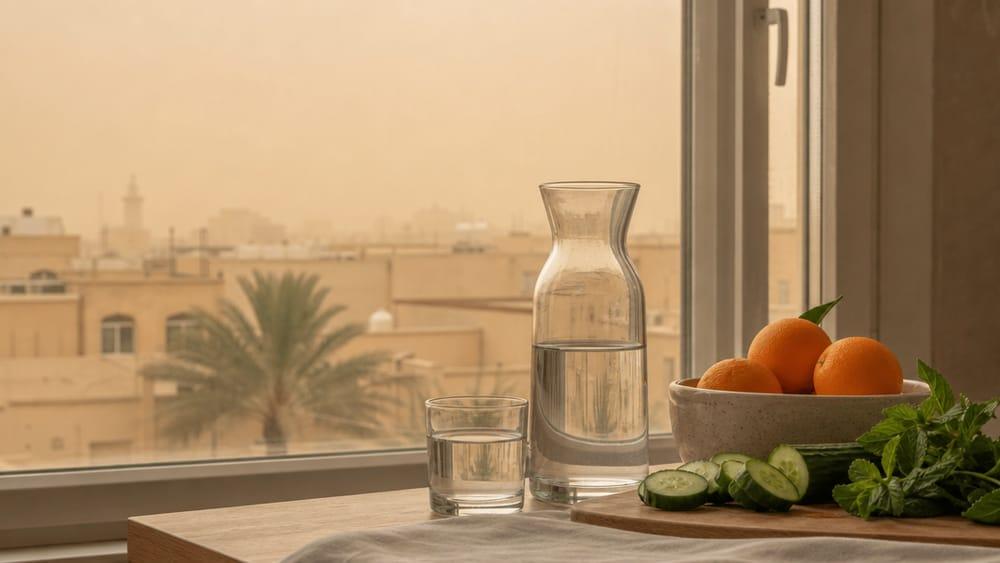
Dust storms affect your health according to particle size, not according to how dramatic the sky looks. The coarse dust you can see mostly gets trapped in your nose and throat; the fine particles you can't see travel deep into the lungs, and some can even reach the bloodstream. That is why, in the research, dust is linked to your heart as much as to your lungs. Closing the windows is a good first step, but it isn't enough if you then light incense and fry food inside a sealed house.
In Riyadh and across Saudi Arabia, dust is part of the weather, not a rare event. So "stay indoors" is not enough on its own. You need to know what actually does the harm, who is most at risk, and which protective steps have evidence behind them and which don't. This article walks through each one.
🌪️ What is the difference between the dust you see and the particles you breathe?
Scientists sort airborne particles by diameter. The U.S. Environmental Protection Agency (EPA) defines PM10 as "inhalable particles, with diameters that are generally 10 micrometers and smaller," and PM2.5 as "fine inhalable particles, with diameters that are generally 2.5 micrometers and smaller."
To put that in perspective, the EPA notes: "The average human hair is about 70 micrometers in diameter – making it 30 times larger than the largest fine particle." Fine particles carry the greatest risk because some can penetrate "deep into your lungs and some may even get into your bloodstream."
Desert dust is a somewhat different animal. The World Health Organization's 2021 Air Quality Guidelines say: "Windblown desert dust contributes to sometimes very high exposures to particles larger than 10 µm. This is a prominent issue in many arid areas in the Middle East, northern Africa, the Gobi Desert and elsewhere."
What that means in practice:
- The dust you see: relatively large particles. They irritate the eyes, nose and throat, and the upper airway filters out most of them.
- The particles you don't see: fine particles that may arrive with the storm or come from everyday sources such as traffic exhaust and combustion. These are the ones that reach deep.
- The colour of the sky is not a gauge: a clear-looking day can carry high fine-particle levels, while a very dusty day can be mostly coarse dust.
❤️ Why is dust linked to the heart, not just the lungs?
This is the finding that surprises most readers. A 2025 systematic review and meta-analysis in Environment International (Tobías et al.) pooled 71 studies from 1993 to 2024 that compared dust days with non-dust days. The pooled results:
- All-cause mortality: about 1.2% higher on dust days (RR 1.0121; 95% CI 1.0045–1.0199; 26 studies).
- Cardiovascular mortality: about 2.5% higher (RR 1.0252; 1.0100–1.0407; 22 studies).
- Respiratory mortality: no significant difference (RR 1.0001; 0.9773–1.0277; 20 studies).
- Respiratory hospital visits and admissions: about 6.9% higher (RR 1.0693; 1.0188–1.1224; 9 studies).
In other words, in these data dust drives up respiratory visits (coughing, breathlessness, asthma attacks), while the excess deaths show up on the heart-and-blood-vessel side. The authors concluded that "exposure to desert dust and sandstorms is linked to increased risks of all-cause and cardiovascular mortality, as well as respiratory morbidity," and rated the overall quality of evidence as moderate.
How to read these numbers fairly:
- These are small relative increases across whole populations. They do not mean every storm is a direct danger to every person.
- The effect tends to concentrate in people who already have heart or lung disease, which is exactly the group that should protect itself most.
- Most of the studies come from Asia and Africa, and the authors themselves note that data limitations "prevent the establishment of specific air quality thresholds."
The EPA's own list of particle-pollution effects points the same way: "premature death in people with heart or lung disease," "nonfatal heart attacks," "irregular heartbeat," and "aggravated asthma."
What about diabetes and long-term exposure?
A very large Chinese cohort study (Ji et al., Environment International 2025) followed 2,260,855 people in northwestern China from 2019 to 2023. Compared with the least-exposed group, the most heavily exposed to sand and dust storms developed cardiometabolic disease earlier: the time ratio for diabetes was 0.784 (95% CI 0.776–0.793) and for cardiovascular disease 0.732, meaning onset came sooner.
The study has real limits, though. Each person's exposure was estimated with machine-learning models, not measured; it is observational, so it shows association rather than cause; and it was done in China, not the Gulf. Treat it as a signal worth watching, not a verdict.
🇸🇦 What do the Saudi studies show? A surprise worth noticing
You might expect local research to show every big storm filling emergency rooms with asthmatic children. The picture is more nuanced than that.
Study one, Riyadh: Alangari and colleagues (Annals of Thoracic Medicine 2015) tracked acute childhood asthma during February and March 2012, when median PM10 was 454 μg/m³ and median PM2.5 was 108 μg/m³. Even so, "there was no correlation between the average daily PM10 levels and the average number of children presenting with acute asthma per day" (r = –0.14, P = 0.45), and days with PM10 above 1,000 μg/m³ (major storms), plus the five days after, were no different from other days. Their conclusion: "Sand storms, even major ones, had no significant impact on acute asthma exacerbations in children in Riyadh, Saudi Arabia."
Study two, Eastern Province: Yousef and colleagues (Journal of Clinical Medicine 2025) analysed 1,750 paediatric asthma emergency visits (ages 2–14) between July 2023 and July 2024. Higher PM2.5 showed "the strongest association" with more visits, on the same day and at short lags, alongside nitrogen dioxide (adjusted OR 1.199) and carbon monoxide (1.036), both products of combustion and traffic. PM10, the fraction closest to coarse dust, was actually inversely associated (AOR 0.482; 95% CI 0.308–0.756).
What the two studies suggest together: the most dramatic scene, the orange storm, is not necessarily the biggest threat to your child's lungs. "Ordinary" air loaded with fine particles and combustion gases may matter more, simply because it is there every day.
And so we don't overcorrect:
- The Riyadh study covered only two months of one year. The Eastern Province study was retrospective, and its authors note it had no data on asthma severity, treatment or admissions, and a small sample.
- The global meta-analysis does show more respiratory visits on dust days.
- So the right message is not "storms are harmless." It is: don't protect yourself only on storm day and then forget about the air for the rest of the year.
🏠 Why isn't closing the windows enough?
Closing the windows is right, but it is only half the job. A sealed house traps what gets in, and it also traps what we make inside it.
The EPA's guide to setting up a "clean room" during heavy air pollution lists practical steps, then names activities to avoid indoors:
- "Smoking and vaping."
- "Frying or broiling food."
- "Burning candles or incense."
- "Vacuuming, unless you use a vacuum with a HEPA filter."
For Saudi homes, the key word there is incense.
Bakhoor in a closed house: what a 2026 study found
In a laboratory study published on 29 July 2026 in Atmospheric Chemistry and Physics (Zhou et al.), Arabian incense (bakhoor) was burned the usual way, on charcoal, inside a test chamber. Ultrafine particles made up 70%–75% of all particles emitted, and their emission rates "substantially exceeded those from sidestream cigarette smoke," which was used as a comparison. Bakhoor particles also triggered a stronger oxidative-stress response inside cells than the cigarette particles did. The authors concluded that bakhoor burning "represents a previously underrecognized source of ultrafine aerosol with substantial oxidative potential."
Keep this study's limits in mind: it was a chamber-and-cell experiment, not a study in people, and it measured no illness or deaths. It does not mean bakhoor equals smoking. The practical takeaway is simple: on a dust day, with the windows shut, postpone the mabkhara. On ordinary days, burn it in a well-ventilated space and away from infants and anyone with asthma.
And if you hear that "antioxidant" pills will undo that oxidative stress, our article on antioxidants and polyphenols explains why the pills lost the big trials. Cutting the source of the smoke beats trying to cancel it out with a tablet.
🛡️ What actually protects you? Steps ranked by evidence
1. Set up one "clean room" at home
Following the EPA's guide:
- Choose a room that is "big enough to fit everyone in your household and comfortable to spend time in."
- "Close all windows and doors in the room, but don't do anything that makes it hard to get out."
- Run the air conditioning with any fresh-air intake closed or set to recirculate.
- Run a portable air cleaner on its highest setting if you have one.
- Spend as much time as possible in that room, and skip strenuous indoor exercise on storm days.
2. Choose an air cleaner by the numbers, not the advert
- What it can do: the EPA says portable air cleaners and HVAC filters "can reduce indoor air pollution; however, they cannot remove all pollutants from the air," and that several studies of portable HEPA cleaners "have demonstrated small improvements in cardiovascular and respiratory health."
- Size matters: match the unit to the room using its Clean Air Delivery Rate (CADR). The EPA's example: a 300-square-foot room (about 28 m²) needs a CADR of at least 195 cfm.
- What to avoid: "Avoid portable air cleaners and furnace/HVAC filters that intentionally produce ozone. Ozone is a lung irritant." The EPA adds that some electrostatic precipitators and ionizers may also emit ozone.
3. If you must go out, not just any mask will do
According to CDC's National Institute for Occupational Safety and Health (NIOSH):
- Cloth and ordinary disposable masks: "Disposable face masks and cloth masks are the least effective at reducing exposures," because they cover the nose and mouth without forming a tight seal.
- N95 respirators: meet "the most rigorous standards," filtering "a minimum of 95%," but only when they seal to the face.
- Beards: "Facial hair is also a common cause for gaps."
- Children: approved respirators "do not come in suitable sizes for very young children," so for them the main protection is staying where the air is cleaner.
- Heart and lung patients: "If you have a medical condition such as a heart or lung problem, ask your doctor before using a respirator."
4. Track air quality, not just the colour of the sky
Because fine particles are invisible, an air-quality index app or platform tells you more than a glance out of the window. Look at the PM2.5 reading specifically, not only the visible dust. WHO notes that governments provide "information to vulnerable groups in real time" as part of early-warning systems, so use official meteorological alerts.
5. After the storm matters too
- Wipe settled dust with a damp cloth rather than shaking it out, and use a HEPA vacuum if you can.
- Clean or change AC filters after repeated dust episodes.
- Don't let one dusty day stop you moving for a week. Walk somewhere indoors and air-conditioned; as our article on daily step counts explains, steady movement matters more than a perfect number.
⚠️ Who should be most careful?
The EPA says "people with heart or lung diseases, children, older adults" are among those "most likely to be affected by particle pollution exposure." Add to that:
- People with asthma: your written asthma action plan is the foundation. Make sure your reliever inhaler is available and in date before dust season, not during it.
- People with COPD, heart disease, or heart-rhythm problems.
- People with diabetes: its cardiovascular complications put them in the higher-cardiac-risk group.
- Pregnant women, infants, and older adults.
- Outdoor workers: construction, delivery and security staff. For them a well-fitted N95 is a work tool, not a luxury.
When to get help right away: if breathlessness gets worse and doesn't ease with your reliever inhaler as prescribed, or you have chest pain, bluish lips, or trouble speaking in full sentences, go to the nearest emergency department.
This article is general health education and does not replace advice from your doctor, especially if you have asthma or a heart or lung condition.
🍞 And food? An honest word from Bakery 8
We won't tell you that any food protects your lungs from dust. No diet, keto or otherwise, and no bread, ours or anyone else's, filters the air you breathe. The real protection is what's described above: a clean room, a properly sized air cleaner, a sealed mask when needed, and incense postponed.
There is one small, honest link. Among the activities the EPA says to avoid in a sealed home is "frying or broiling food." So a dust day is a good day for a meal that needs no frying pan, for example:
- Samoli or cloud bread with cheese, fresh vegetables and cucumber.
- Keto granola with yoghurt for a no-stove breakfast.
- Crackers with labneh or hummus for a quick snack.
These are sugar-free, low-carb and gluten-free, suitable for people with diabetes and keto dieters. Their only advantage on a dust day is that they're ready to eat and need no frying. We claim nothing more for them.
❓ Frequently asked questions
Is the dust I can see the most dangerous part?
Not always. Visible dust is mostly coarse and gets trapped in the nose and throat. The bigger concern is fine PM2.5, which, according to the EPA, reaches deep into the lungs and can partly enter the bloodstream. That's why checking an air-quality index tells you more than looking at the colour of the sky.
Is a regular surgical mask enough on a dusty day?
Usually not. NIOSH says cloth masks and disposable face masks are the least effective because they don't seal to the face. A well-fitted N95 filters at least 95% of particles. If you have a heart or lung condition, ask your doctor before using a tight-fitting respirator.
Do home air purifiers actually help?
Yes, within limits. The EPA says portable HEPA cleaners have shown small improvements in cardiovascular and respiratory health, but they can't remove every pollutant. Size the unit to the room using its CADR, and avoid ozone-generating devices, because ozone itself irritates the lungs.
Is it OK to burn bakhoor on a dusty day?
Better to wait. The EPA advises against burning incense indoors during poor air quality, and a 2026 laboratory study found Arabian incense releases large amounts of ultrafine particles. That study wasn't done in people, but the practical step is simple: ventilate, and don't burn it near anyone with asthma.
Who is most at risk from dust storms?
People with heart or lung disease, including asthma and COPD, plus children, older adults, pregnant women and outdoor workers. A 2025 meta-analysis linked dust days to roughly 2.5% higher cardiovascular mortality, so people with heart disease or diabetes need to take precautions as seriously as people with asthma.
✅ The bottom line
In Saudi Arabia, dust is part of the weather. Dealing with it well isn't about fearing the sight of it; it's about knowing what actually does harm: fine particles, their effect on the heart, and the air we create inside our own homes. Close the windows, set up a clean room, choose your air cleaner and mask by the numbers, and put off the mabkhara and the frying pan. If you want a no-fry dust-day meal, you'll find options at the Bakery 8 store, with delivery across Riyadh, Saudi Arabia.
📚 References
- U.S. Environmental Protection Agency. Particulate Matter (PM) Basics. epa.gov.
- U.S. Environmental Protection Agency. Health and Environmental Effects of Particulate Matter (PM). epa.gov.
- World Health Organization. WHO Global Air Quality Guidelines — Questions and answers (2021 AQGs, incl. the good-practice statement on sand and dust storm particles). who.int.
- World Health Organization. Sand and dust storms — Fact sheet (updated 23 April 2025). who.int.
- Tobías A, Querol X, Roqué M, et al. Short-term exposure to desert dust and sandstorms and all-cause and cause-specific mortality and morbidity: a systematic review and meta-analysis. Environment International. 2025;196:109277.
- Ji W, Gu K, Ke L, et al. Risk of sand and dust storms on cardiometabolic diseases: a cohort study of over 2.2 million participants. Environment International. 2025;204:109821.
- Alangari AA, Riaz M, Mahjoub MO, Malhis N, Al-Tamimi S, Al-Modaihsh A. The effect of sand storms on acute asthma in Riyadh, Saudi Arabia. Annals of Thoracic Medicine. 2015;10(1):29–33.
- Yousef AA, AlShammari RF, AlBugami S, AlAbbas BE, AlMossally FA. Evaluating the Impact of Air Quality on Pediatric Asthma-Related Emergency Room Visits in the Eastern Province of Saudi Arabia. Journal of Clinical Medicine. 2025;14(13):4659.
- Zhou L, Liang Z, Xu W, Huang R-J, Lee PKH, Chan CK. Indoor Burning of Arabian Incense Generates Abundant Ultrafine Particles with Strong Oxidative Potential. Atmospheric Chemistry and Physics. 2026;26:10587–10604 (29 July 2026). doi:10.5194/acp-26-10587-2026.
- U.S. Environmental Protection Agency. Guide to Air Cleaners in the Home. epa.gov.
- U.S. Environmental Protection Agency. Create a Clean Room to Protect Indoor Air Quality During a Wildfire. epa.gov.
- CDC / NIOSH. Community Respirators and Masks. cdc.gov.
Related keywords: dust storms and health, sandstorm health effects, dust and heart health, dust and asthma, N95 mask for dust, HEPA air purifier, bakhoor and indoor air quality, air quality in Riyadh