

Iron deficiency is the most common nutritional deficiency in the world, and the most misunderstood thing about it is that it begins long before anaemia does: your iron stores empty first, while your haemoglobin stays comfortably inside the "normal" range on the lab report. In other words, a standard complete blood count on its own can step straight over a real deficiency without raising a single flag. The number that catches it early is ferritin — the test that measures the store itself, not the end result of the store running out.
This article explains, with credible sources, why haemoglobin is the last thing to fall, which numbers are actually read, why the iron in meat is not the same as the iron in lentils, and why taking a supplement every single day can absorb less iron than taking it every other day. We at Bakery 8 / مخبز ثمانية in Riyadh, Saudi Arabia publish this as general health education — not a diagnosis and not a prescription.
What is the difference between iron deficiency and iron deficiency anaemia?
Confusing these two terms is the root of most delayed diagnoses. Iron deficiency means the stores are depleted. Iron deficiency anaemia (IDA) is the later stage in which the stores have run down so far that the body can no longer make enough haemoglobin. The first precedes the second by months, sometimes years.
The National Institutes of Health (NIH) professional fact sheet on iron describes three sequential stages:
- Stage one — storage iron depletion: "Serum ferritin concentrations and levels of iron in bone marrow decrease."
- Stage two — marginal deficiency: "Iron stores are depleted… but hemoglobin levels are usually within the normal range."
- Stage three — IDA: "Iron stores are exhausted; hematocrit and levels of hemoglobin decline."
Read stage two again: haemoglobin within the normal range while the store is empty. That is precisely the person who walks out of a clinic with a "clean" blood test and very real symptoms.
Does deficiency cause symptoms before anaemia appears?
Yes — and there is a randomised controlled trial designed to answer exactly this question. Published in CMAJ in 2012, it enrolled 198 women aged 18–53 with unexplained fatigue, a ferritin below 50 µg/L, and a normal haemoglobin (above 12.0 g/dL) — meaning no anaemia at all. One group received oral ferrous sulfate (80 mg of elemental iron daily) for 12 weeks; the other received placebo.
Fatigue fell by 47.7% in the iron group versus 28.8% on placebo — "a difference –18.9%, 95% CI −34.5 to −3.2; p = 0.02". Ferritin rose by 11.4 µg/L and haemoglobin by 0.32 g/dL. The authors concluded that "iron supplementation should be considered for women with unexplained fatigue who have ferritin levels below 50 μg/L."
The takeaway is not "take iron if you feel tired." It is that deficiency without anaemia is a measurable state that does not show up on the test most people are given.
What is a ferritin test, and why is it the number that matters?
Ferritin is the protein that stores iron inside the body, and its concentration in blood reflects the size of that store. The NIH fact sheet calls serum ferritin "currently the most efficient and cost-effective test for diagnosing iron deficiency," and states that "a serum ferritin concentration that is lower than 30 micrograms/liter (mcg/L) suggests iron deficiency, and a value lower than 10 mcg/L suggests IDA."
The World Health Organization, in its guideline on using ferritin concentrations to assess iron status, is equally direct: "Ferritin concentration is a good marker of iron stores and should be used to diagnose iron deficiency in otherwise apparently healthy individuals."
Why isn't there one agreed number?
This is the part that confuses people, and the honest answer is that the cut-off depends on who is reading it and in what context:
- WHO, apparently healthy individuals aged 5 years and older: below 15 µg/L.
- WHO, children under 5 years: below 12 µg/L.
- WHO, in the presence of infection or inflammation (5 years and older): below 70 µg/L.
- NIH professional fact sheet: below 30 µg/L suggests deficiency.
- StatPearls clinical reference: a serum ferritin "of less than 45 ng/mL" is recommended for diagnosis.
Put those side by side and the practical problem becomes obvious: a ferritin of 20 carries no warning flag on many lab printouts, yet it sits inside virtually every clinical deficiency band. "Normal" on the page does not mean "sufficient" in the body.
When does a reassuring ferritin mislead?
Ferritin is an acute-phase protein: it rises with inflammation and infection regardless of iron stores. That is why WHO specifies that "in areas of widespread infection or inflammation, serum ferritin should be assessed with the concurrent measurement of two acute phase response proteins, CRP and AGP," and why its threshold table carries the footnote: "Markers of inflammation should be assessed along with the ferritin concentration, and ferritin adjusted as necessary."
Practically: with chronic inflammation or an active infection, a ferritin can look reassuring when it is not — one more reason the result belongs in your doctor's hands rather than a search engine's.
Why isn't the iron in meat the same as the iron in lentils?
Food contains two kinds of iron: haem iron (from animal sources) and non-haem iron (from plants and from supplements). The NIH states that "heme iron has higher bioavailability than nonheme iron, and other dietary components have less effect on the bioavailability of heme than nonheme iron."
The gap is not theoretical: "The bioavailability of iron is approximately 14% to 18% from mixed diets that include substantial amounts of meat, seafood, and vitamin C… and 5% to 12% from vegetarian diets." The milligram figure printed in a nutrition table is a quantity, not a yield.
What raises absorption, and what lowers it?
Per the NIH: "In addition to ascorbic acid, meat, poultry, and seafood can enhance nonheme iron absorption, whereas phytate (which is present in grains and beans) and certain polyphenols in some nonanimal foods (e.g., cereals, legumes) have the opposite effect." And a detail worth remembering: "Unlike other inhibitors of iron absorption, calcium might reduce the bioavailability of both nonheme and heme iron."
Translated into a plate:
- Raises it: vitamin C in the same meal — lemon, bell pepper, tomato, rocket — and the presence of meat alongside a plant source.
- Lowers it: tea or coffee with the meal, dairy or a calcium supplement at the same sitting, and phytate from grains and legumes.
Does tea with a meal really cut iron absorption — and by how much?
Yes, and by more than most people expect. A study in the British Journal of Nutrition (1999) on polyphenol-containing beverages found black tea reduced non-haem iron absorption by 79–94%, peppermint tea by 84%, and cocoa by 71%. The effect was dose-dependent: "beverages containing 20–50 mg total polyphenols/serving reduced Fe absorption from the bread meal by 50–70%, whereas beverages containing 100–400 mg total polyphenols/serving reduced Fe absorption by 60–90%."
The good news is that the fix is not giving up tea — it is moving its clock. In a controlled stable-isotope trial published in the American Journal of Clinical Nutrition, twelve healthy UK women each ate a standardised porridge meal labelled with 4 mg of an iron isotope on three separate occasions. "Iron absorption was 5.7% (water), 3.6% (tea with the meal), and 5.7% (tea 1 h after the meal)," and absorption was significantly higher when tea came an hour later rather than alongside the meal (P = 0.046). The authors concluded that "a 1-h time interval between a meal and tea consumption attenuates the inhibitory effect, resulting in increased nonheme iron absorption."
The change you can make today: don't cancel the tea — delay it by an hour. It is one of the cheapest and most neglected dietary interventions there is.
Why can taking an iron supplement every day absorb less iron?
Here is the counterintuitive part. The body regulates iron uptake through a hormone called hepcidin, described by the NIH as "a circulating peptide hormone… the key regulator of both iron absorption and the distribution of iron throughout the body." Every dose of iron raises hepcidin for hours, which blunts absorption of the next dose taken soon after.
Two open-label randomised trials published in The Lancet Haematology in 2017, in iron-depleted women aged 18–40, tested this directly:
- Consecutive days versus alternate days: cumulative fractional iron absorption was "16·3% in the consecutive-day group versus 21·8% in the alternate-day group (p=0·0013)", and cumulative total iron absorbed was "131·0 mg versus 175·3 mg (p=0·0010)" — more total iron absorbed from fewer doses.
- One morning dose versus two split doses: no significant difference in fractional or total absorption.
The authors concluded that "providing iron supplements on alternate days and in single doses optimises iron absorption and might be a preferable dosing regimen."
This is a question to raise with a doctor, not a protocol to self-apply. Preparation, dose, duration and follow-up labs are all clinical decisions, and taking iron without a genuine need can cause harm — Mayo Clinic puts it plainly: "Don't try to diagnose or treat it on your own," noting that excess iron can damage organs.
Which symptoms deserve attention?
Mayo Clinic lists among the signs of iron deficiency anaemia: extreme tiredness and weakness, pale skin, "chest pain, fast heartbeat or shortness of breath", headache and dizziness, cold hands and feet, a sore or inflamed tongue, brittle nails, and "restless legs syndrome". It also lists a sign many people miss entirely: wanting to eat "things that aren't food, such as ice, dirt or clay".
Cleveland Clinic adds muscle cramps, a fast heart rate and spoon-shaped fingernails, and notes that people taking iron supplements "may notice a difference in about two to three weeks" — while delivering the single most important sentence in this whole article: supplementation is "only a temporary fix because it doesn't address the actual cause."
Iron deficiency is a finding, not a diagnosis: why the cause matters
This is what separates good management from dangerous management. Iron falls for one of three reasons: too little coming in, absorption that is impaired, or loss — and loss is what demands investigation.
- In men and postmenopausal women: StatPearls records that "the AGA recommends bidirectional endoscopy (esophagogastroduodenoscopy and colonoscopy) for men and postmenopausal women with IDA when no other clear source is identified." In these two groups, iron deficiency anaemia is not "poor diet" until proven otherwise.
- In women of reproductive age: heavy menstrual bleeding is a very common cause and deserves a gynaecological assessment, not just a tablet.
- In anyone who doesn't respond to treatment: a malabsorption disorder should be considered.
What does coeliac disease have to do with iron?
An anatomical connection, directly. Iron is absorbed mainly in the proximal duodenum — exactly the stretch of intestine damaged in coeliac disease. A review in Nutrients (2021) explains that "this portion of the intestine is typically destroyed in celiac disease (CD), resulting in a reduction in absorption of iron," and reports that iron deficiency anaemia is the most frequent extra-intestinal manifestation of coeliac disease, with "a prevalence between 12 and 82%" in newly diagnosed patients.
The review's recommendation is explicit: "Since patients with IDA, especially in the case of non-responsive forms to treatment, have a higher risk of having CD than the general population, screening with tissue transglutaminase antibodies is strongly recommended in these subjects." Recovery is gradual: "Normalization from anemic state typically occurs after at least 6 months of GFD, but the process can take up to 2 years for iron stores to replenish."
One critical caveat: testing comes before the diet. Starting a gluten-free diet before coeliac testing can invalidate the results.
How big is the problem in Saudi Arabia and globally?
Globally, the World Health Organization estimates that "40% of all children aged 6–59 months, 37% of pregnant women and 30% of women 15–49 years of age are affected by anaemia" (2019 data), adding that "iron deficiency, primarily due to inadequate dietary iron intake, is considered the most common nutritional deficiency leading to anaemia."
Locally, the Saudi Medical Journal published in 2025 an observational cross-sectional analysis running "from January 2014 to February 2024" across 420,956 individuals from Al Borg laboratory data:
- Iron deficiency anaemia: 19.8% of those tested.
- Non-anaemic iron deficiency: 23.7% — meaning the "silent" group was larger than the group diagnosed with anaemia.
- Females made up 93% of both the IDA and the non-anaemic iron deficiency cases.
- Regional variation ran from 28% in Al-Jouf to 42% in Makkah.
On awareness, a survey of 1,068 participants in Riyadh Province found 62.1% recognised hair loss, 55.5% cold hands and feet and 52.9% weakness as possible signs, while only 53% appreciated that avoiding foods which reduce iron absorption matters. Awareness of symptoms, in other words, runs ahead of awareness of absorption — which is exactly the gap this article tries to close.
A practical seven-step plan
- Don't stop at a complete blood count. With persistent symptoms, ask your doctor specifically about ferritin, alongside an inflammation marker such as CRP so the number is read in context.
- Read your number, not the colour. "Within range" on a lab report is not the same as sufficient — discuss the actual value with your doctor.
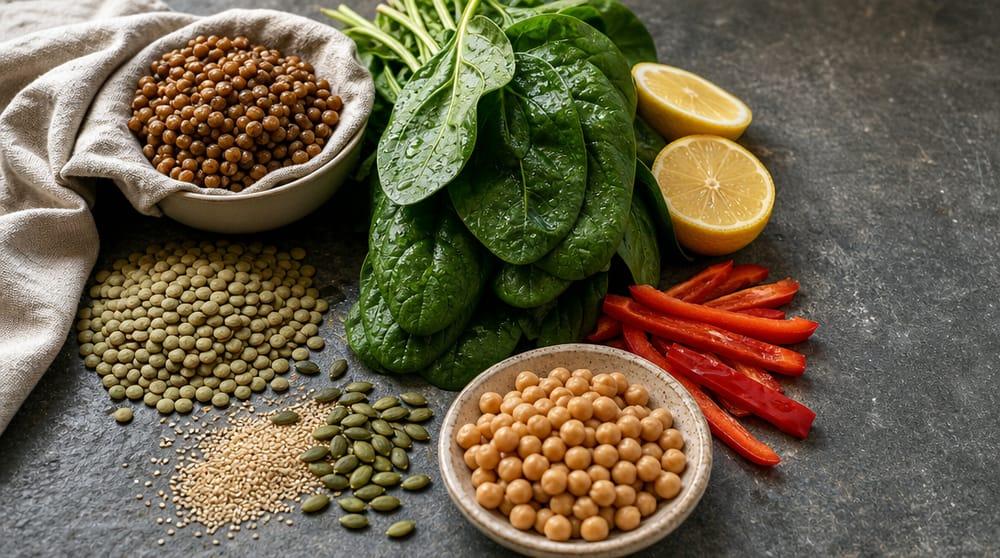
- Build the meal around a real iron source. Lean red meat, liver, sardines, oysters, lentils, chickpeas, white beans, cooked spinach, sesame and pumpkin seeds.
- Add vitamin C to the same plate. Lemon over spinach, bell pepper with lentils, tomato with chickpeas — a free boost to absorption from plant sources.
- Delay tea and coffee by an hour rather than drinking them with the meal, and separate a calcium supplement or a heavy dairy course from your iron-containing meal.
- Don't start a supplement on your own. If one is prescribed, ask about the dosing pattern (a single morning dose, on alternate days), the duration, and when to repeat the blood test.
- Find the cause. Iron deficiency is a result, not a final diagnosis — particularly in men and postmenopausal women.
Who should be especially careful, and when to see a doctor
Per Mayo Clinic and the NIH, higher-risk groups include women with heavy menstrual bleeding, pregnant women, infants and young children, vegetarians and vegans, frequent blood donors, people who have had gastric or bypass surgery, and those with digestive conditions such as coeliac disease and inflammatory bowel disease.
See a doctor without delay if you develop: shortness of breath, chest pain or a racing heartbeat; blood in the stool or black tarry stools; unusually heavy menstrual bleeding; marked pallor with dizziness; or fatigue that persists for weeks without explanation.
Please note: this content is general education and is not a substitute for medical advice. Diagnosing iron deficiency, identifying its cause and choosing treatment are individual clinical decisions — consult your doctor before making changes, and especially before taking any iron supplement.
Where does Bakery 8 fit into all of this?
No bread treats iron deficiency. We say it plainly because honesty matters more than selling: our products are not an iron source, and they do not replace a blood test or a doctor. But there are two honest points where our philosophy meets this subject.
First, the space iron occupies on the plate. When a large share of a meal goes to refined starch and added sugar, less of the plate is left for nutrient-dense foods. Our products are made with no added sugar and on an almond-flour base — they free up room for lentils, spinach, meat and seeds, and for the lemon that helps you absorb them. That is the whole claim: making room, not treating anything.
Second, for anyone diagnosed with coeliac disease. For that group specifically, strict gluten avoidance is not a lifestyle choice but the treatment itself — and it is what allows the duodenum, the very site of iron absorption, to heal gradually, as the Nutrients review cited above describes. That is why Bakery 8's bread is made entirely gluten-free, alongside our keto granola and crackers, which follow the same rule. Testing, always, comes before the diet. More reading is on our blog.
Frequently asked questions
Does a normal haemoglobin mean my iron is fine?
No. The NIH describes a stage in which iron stores are depleted while "hemoglobin levels are usually within the normal range." The test that detects that stage is ferritin, not a blood count alone. This is why many people leave an appointment with a "clean" result despite a genuine deficiency and genuine symptoms.
What is a normal ferritin level?
There is no single number. WHO uses below 15 µg/L for apparently healthy people aged 5 and over, and below 70 µg/L where inflammation is present; the NIH states that below 30 suggests deficiency; the StatPearls clinical reference uses a threshold of 45. The correct reading is done with your doctor, in the context of your symptoms and your inflammation markers.
Should I give up tea if I'm iron deficient?
Not necessarily. Studies show black tea substantially reduces non-haem iron absorption when drunk with a meal, but an AJCN trial found that delaying tea by one hour after the meal attenuates that inhibition and restores absorption to roughly the level seen with water. Change the timing before you consider abstinence.
Is it better to take iron every day?
Not necessarily, because of hepcidin — every dose raises it, blunting absorption of the next. Two trials in The Lancet Haematology showed higher absorption with single alternate-day dosing than with consecutive daily doses. But the dosing pattern is a medical decision: raise it with your doctor rather than altering a prescription yourself.
Can iron deficiency be corrected by diet alone?
It depends on the depth and the cause. Mild deficiency may respond to better dietary intake and better absorption conditions, while established anaemia usually needs prescribed treatment and follow-up testing. More importantly, food cannot treat ongoing blood loss or a malabsorption disorder — which is why finding the cause is the step that can never be skipped.
References
- National Institutes of Health, Office of Dietary Supplements — Iron: Fact Sheet for Health Professionals.
- World Health Organization — WHO guideline on use of ferritin concentrations to assess iron status in individuals and populations, 2020.
- World Health Organization — Anaemia fact sheet (2019 estimates).
- Warner MJ, Kamran MT — Iron Deficiency Anemia, StatPearls / NCBI Bookshelf.
- Mayo Clinic — Iron deficiency anemia: symptoms and causes.
- Cleveland Clinic — Iron-Deficiency Anemia.
- Stoffel NU, Cercamondi CI, Brittenham G, et al. — Iron absorption from oral iron supplements given on consecutive versus alternate days and as single morning doses versus twice-daily split dosing in iron-depleted women, The Lancet Haematology, 2017.
- Vaucher P, Druais PL, Waldvogel S, Favrat B — Effect of iron supplementation on fatigue in nonanemic menstruating women with low ferritin: a randomized controlled trial, CMAJ, 2012.
- Hurrell RF, Reddy M, Cook JD — Inhibition of non-haem iron absorption in man by polyphenolic-containing beverages, British Journal of Nutrition, 1999.
- Fuzi SFA, Koller D, Bruggraber S, et al. — A 1-h time interval between a meal containing iron and consumption of tea attenuates the inhibitory effects on iron absorption, American Journal of Clinical Nutrition, 2017.
- Mahadea D, et al. — Iron Deficiency Anemia in Celiac Disease, Nutrients, 2021.
- Saudi Medical Journal — Unmasking iron deficiency and iron deficiency anemia in Saudi Arabia, 2025.
- Assessment of knowledge and awareness about iron deficiency anemia among the population of Riyadh Province (n = 1,068), 2023.
- Dietary Guidelines for Americans / USDA — Food Sources of Iron: Standard Portions.
Related keywords: iron deficiency, iron deficiency anaemia, ferritin test, low ferritin symptoms, iron absorption, haem vs non-haem iron, tea and iron absorption, iron supplements, hepcidin, coeliac disease and iron.