

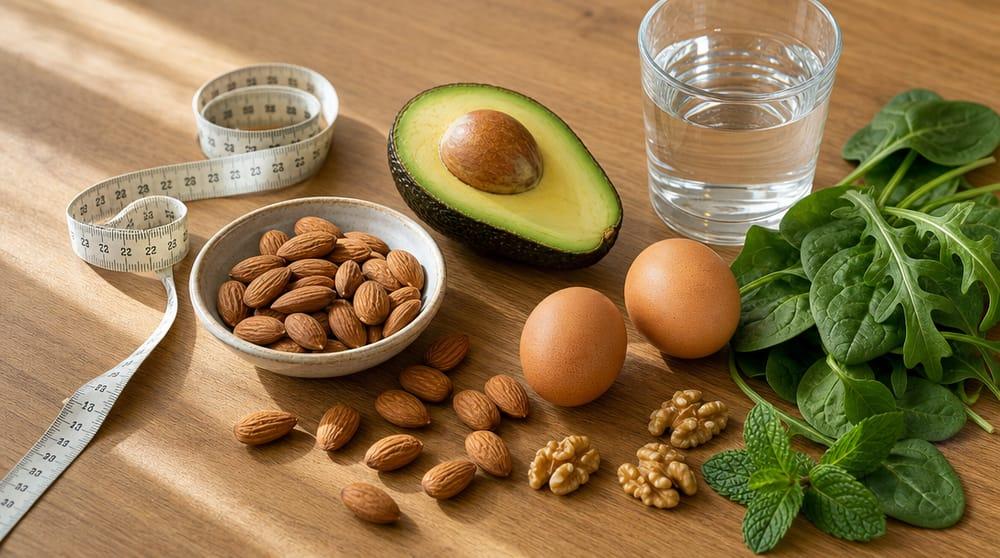
Visceral fat is the deep fat that collects inside your abdominal cavity, wrapped around your liver, intestines and other internal organs. You cannot see it and you cannot pinch it. It makes up only about 10% of your body fat, yet it carries a disproportionate share of the risk for heart disease, type 2 diabetes and fatty liver. And here is the part most people miss: the bathroom scale may never tell you about it, while a cheap tape measure sitting in a drawer will.
This article explains what visceral fat actually is, why weight and BMI fail to detect it, which number major scientific bodies now recommend you measure instead, and — the reassuring part — why visceral fat is among the fastest-responding fat in the body, plus what genuinely moves it versus what does not.
What is visceral fat, and how does it differ from subcutaneous fat?
Your body stores fat in two places that differ not just in location but in function. The first is subcutaneous fat — the layer you feel when you press your fingers into your belly or arm. The second is visceral fat, which Cleveland Clinic describes as fat that "lines your abdominal walls and wraps around many of your internal organs."
Harvard Health puts the distribution in numbers: roughly 90% of body fat is subcutaneous, while "the remaining 10% — called visceral or intra-abdominal fat — lies out of reach, beneath the firm abdominal wall." It sits in the spaces surrounding the liver, intestines and other organs, and is also stored in the omentum, an apron-like flap of tissue lying under the belly muscles.
Only 10% — so why all the attention?
Because that 10% is not an inert storage depot. Fat tissue is hormonally active, and the crucial difference between the two types is the quality of what they release. Harvard Health condenses it into a single sentence: "Subcutaneous fat produces a higher proportion of beneficial molecules, and visceral fat a higher proportion of molecules with potentially deleterious health effects."
Research links excess visceral fat to cardiovascular disease, diabetes, high cholesterol, atherosclerosis and metabolic dysfunction-associated steatohepatitis, according to Cleveland Clinic. Mayo Clinic adds to the list of concerns associated with excess belly fat: high blood pressure, unhealthy blood fat levels, sleep apnea, heart disease, high blood sugar and diabetes, certain cancers, stroke, fatty liver, and early death from any cause.
None of this is a reason to panic. It is a reason to measure. The real problem with visceral fat is not only that it is risky — it is that it accumulates quietly in people whose numbers look perfectly "normal."
Why don't the scale and BMI detect it?
Body mass index is a simple formula: weight divided by height squared. It is useful at population level, but it is completely blind to one decisive question: where is that weight sitting? Two people of identical height and weight can differ enormously in how much fat surrounds their organs, and BMI hands them the same number.
The study that changed how we read "normal weight"
In 2015, Annals of Internal Medicine published an analysis of 15,184 US adults from the NHANES III survey, aged 18 to 90, with mortality follow-up through 2006. The researchers compared people with "normal-weight central obesity" — a BMI in the normal range combined with a high waist-to-hip ratio — against other groups.
The result was striking. In men, normal-weight central obesity was associated with a higher risk of death than in men of normal weight without central obesity (HR 1.87), and higher even than in men classified as obese by BMI (HR 2.42). In women the pattern held: HR 1.48 versus normal weight without central obesity, and HR 1.32 versus women classified as obese by BMI.
Put plainly: where your fat sits may matter more than how much of it there is in total. A reassuring number on the scale does not guarantee that what lies behind your abdominal wall is equally reassuring.
What did the international expert consensus say?
In 2020, Nature Reviews Endocrinology published a consensus statement from the International Atherosclerosis Society and the International Chair on Cardiometabolic Risk Working Group on Visceral Obesity. It is blunt: "BMI alone is not sufficient to properly assess or manage the cardiometabolic risk associated with increased adiposity in adults," and it recommends that "waist circumference be included routinely as a measurement in clinical practice." It adds that "the combination of BMI and waist circumference can identify the highest-risk phenotype of obesity far better than either measure alone."
Note the wording carefully. The statement does not call for abandoning BMI. It calls for adding a second measurement to it. Both together, not one instead of the other.
So which number should you actually measure?
The tool is a cloth tape measure. You do not need a CT scan or an MRI — which, as Harvard Health notes, "are the most precise, but they are expensive and rarely available, so investigators often use estimates based on waist circumference."
The simplest rule: keep your waist under half your height
The UK's National Institute for Health and Care Excellence (NICE) issued a strikingly simple practical recommendation: keep your waist to less than half your height — a waist-to-height ratio under 0.5. NICE defines three bands:
- 0.4 to 0.49 — healthy central adiposity, indicating no increased health risks.
- 0.5 to 0.59 — increased central adiposity, indicating increased health risks.
- 0.6 or more — high central adiposity, indicating further increased health risks.
The advantage of this ratio is that, per NICE, it applies to "people with a BMI under 35 kg/m2 of both sexes and all ethnicities, including adults with high muscle mass" — unlike BMI thresholds, which differ by ethnicity. The calculation is one line: divide your waist in centimetres by your height in centimetres. A man 175 cm tall with a 95 cm waist has a ratio of 0.54, placing him in the middle band.
The absolute thresholds used locally
Saudi Arabia's Ministry of Health publishes waist circumference thresholds for central obesity directly on its awareness platform:
- Men: normal below 94 cm · danger zone 94 to 101 cm · extreme danger 102 cm and above.
- Women: normal below 80 cm · danger zone 80 to 87 cm · extreme danger 88 cm and above.
The Ministry also reports that obesity among adults aged 18 and over in the Kingdom stands at 20.2% and overweight at 38.2%, with a higher rate in women (21.4%) than men (19.2%). Globally, the World Health Organization reports that 2.5 billion adults were overweight in 2022, of whom 890 million were living with obesity, and notes that "additional measurements, such as the waist circumference, can help the diagnosis of obesity."
How do you measure your waist correctly?
A sloppy measurement delivers false reassurance. Mayo Clinic's method:
- Stand and place a tape measure around your bare stomach, just above your hip bone.
- Pull the tape measure until it fits snugly, but does not push into the skin.
- Make sure the tape measure is level all the way around.
- Relax, exhale and measure your waist. Don't suck in your stomach.
Measure at the same time of day, ideally in the morning before eating, and log the number once every two weeks rather than daily. A one-centimetre wobble means nothing; the direction of travel over two months means everything.
The good news: this is the fat that responds fastest
Here the picture flips entirely. The very property that makes visceral fat dangerous — being metabolically active — is what makes it easier to shift.
It moves before the scale does
Harvard Health says of visceral fat that "because it's more readily metabolized into fatty acids, it responds more efficiently to diet and exercise than fat on the hips and thighs." Cleveland Clinic says the same thing more directly: visceral fat is "actually easier to lose than subcutaneous fat," with visible results achievable within two to three months.
Practically, that means the scale is a lagging instrument. Your visceral fat can fall and your metabolic markers improve while the number on the scale barely budges — especially if you are simultaneously building muscle. The tape measure captures that progress. The scale does not.
What do the controlled trials show?
A systematic review and meta-analysis published in PLOS ONE in 2013 pooled fifteen trials covering 852 participants and examined the effect of exercise programmes on visceral adipose tissue without caloric restriction. The standardised mean difference for the change in visceral adipose tissue was −0.497 (95% CI −0.655 to −0.340), and the authors concluded that "an aerobic exercise program, without hypocaloric diet, can show beneficial effects to reduce visceral adipose tissue with more than 30 cm2 (on CT analysis) in women and more than 40 cm2 in men, even after 12 weeks."
The Nature Reviews Endocrinology consensus reaches the same conclusion from another angle: "clinically relevant reductions in waist circumference can be achieved by routine, moderate-intensity exercise and/or dietary interventions" — and this happens with or without corresponding weight loss.
As for the baseline activity recommendation, Mayo Clinic summarises it: moderate aerobic activity such as brisk walking for at least 150 minutes a week, or vigorous aerobic activity such as jogging for at least 75 minutes a week, with strength training at least twice a week.
Why don't ab exercises work on their own? The spot-reduction myth
The popular belief is that abdominal exercises burn abdominal fat. That belief was tested directly in a study published in the Journal of Strength and Conditioning Research in 2011: twenty-four healthy, sedentary adults (14 men and 10 women, aged 18 to 40) performed seven abdominal exercises, two sets of ten repetitions, five days a week, for six weeks.
The outcome: abdominal muscular endurance improved — a real gain — but the published conclusion was that "six weeks of abdominal exercise training alone was not sufficient to reduce abdominal subcutaneous fat and other measures of body composition."
Why? Because the body does not draw fuel from the tank nearest the working muscle; it draws on the overall balance. Ab exercises build the muscle underneath the fat. What shrinks the fat layer is total energy balance, aerobic activity and food quality. The point is not to abandon core work — it is to stop waiting on it for a result it cannot deliver.
The lever almost everyone ignores: sleep
This is one of the clearest demonstrations that the scale lies. In a randomised controlled crossover trial run by Mayo Clinic researchers and published in the Journal of the American College of Cardiology in 2022, twelve healthy, non-obese adults were restricted to four hours of sleep a night for two weeks, following a four-day acclimation period at nine hours.
What happened: they consumed more than 300 extra calories per day, and gained only about a pound — a figure no home scale would flag. But abdominal visceral fat rose by 11% compared with the control sleep condition. More worrying still, visceral fat continued to increase during the recovery-sleep phase, even as calorie intake fell back.
That finding closes the loop we opened with. Two weeks of short sleep redistributed fat to the most dangerous location while the scale stayed almost silent. Anyone tracking weight alone would have noticed nothing at all.
A practical four-week plan
You do not need to overhaul your life. You need three numbers and four changes.
- Today: record your height and your waist circumference using the method above, and calculate the ratio (waist ÷ height). That is your baseline.
- Week one: fix your bedtime. Aim for seven hours or more, consistently — this is not a luxury but a metabolic intervention, as we have seen.
- Week two: build brisk walking up gradually toward 150 minutes a week, spread across most days.
- Week three: swap sweetened drinks for water, and audit the added sugar and refined starch in your daily meals.
- Week four: add two resistance sessions a week and re-measure your waist. Compare the ratio, not the weight.
Quick tips
- Measure every two weeks, not every day; daily noise hides the real trend.
- Keep the tape measure somewhere visible — a tool you never see is a tool you never use.
- If your weight is flat and your waist is shrinking, you are progressing, not stalling.
- Do not rely on clothing sizes; they vary between brands enough to make comparison meaningless.
- Build the plate around protein, vegetables and fibre before you think about removing anything.
- Accumulated activity counts: ten minutes three times a day is not worth less than a single thirty-minute block.
Who should pay closer attention, and when should you see a doctor?
Some groups deserve particular attention to this specific measurement:
- People with a family history of type 2 diabetes or heart disease.
- People diagnosed with prediabetes, insulin resistance or fatty liver.
- People with high blood pressure or abnormal blood lipids.
- Women after menopause, when fat tends to redistribute toward the abdomen.
- People whose weight looks "normal" but whose waist is high — precisely the group in the 2015 study above.
See your doctor if your waist-to-height ratio is 0.5 or above, if your waist exceeds the thresholds listed, if you notice a rapid increase in waist circumference without a change in lifestyle, or if symptoms such as excessive thirst, frequent urination or unexplained fatigue appear. Remember too that NICE restricts the waist-to-height ratio to people with a BMI under 35 kg/m2.
Important note: this article is general education and is not a substitute for medical advice. Do not start any diet or exercise programme, or change the dose of your medication — particularly diabetes and blood pressure medication — without coordinating with your doctor or treating dietitian.
Where does bread fit into this equation?
Let us be completely honest: no bread burns visceral fat. No baked product, whatever its formulation, removes a single centimetre from your waist. What food does in this equation is less dramatic and more realistic: some foods make it easier to stay on a pattern low in added sugar and refined starch, and some make it harder.
That is where Bakery 8's breads — made with almond flour and free of sugar — sit. They are not a treatment. They let a daily habit continue — the breakfast roll, the lunch sandwich — inside a low-carbohydrate pattern, without the sense of deprivation that ends most attempts in their third week. The same applies to keto granola as a replacement for sweetened breakfast cereal, and to savoury crackers when the alternatives on offer at a gathering are high in sugar.
The rule we keep repeating: food makes adherence possible; what actually moves the number on the tape measure is the sum of movement, sleep and energy balance across weeks. For more context, read our articles on insulin resistance, on sleep and blood sugar, and on dietary fibre.
Frequently asked questions
What is the difference between visceral and subcutaneous fat?
Subcutaneous fat is the layer you feel when you press on your belly, and it makes up about 90% of body fat. Visceral fat lies deeper, behind the abdominal wall, around the liver, intestines and organs, and makes up about 10%. The more important difference is functional: subcutaneous fat produces a higher proportion of beneficial molecules, while visceral fat produces a higher proportion of molecules with potentially deleterious effects, per Harvard Health.
How can I tell if I have excess visceral fat without a scan?
With a tape measure. Divide your waist circumference by your height: a result of 0.5 or above places you in NICE's increased central adiposity band. You can also compare your waist against Saudi Ministry of Health thresholds: 94 and 102 cm for men, 80 and 88 cm for women. CT and MRI are more precise, but expensive and rarely available for this purpose.
Can my weight be normal and still have excess visceral fat?
Yes — the condition is called normal-weight central obesity. In an analysis of 15,184 adults published in Annals of Internal Medicine in 2015, men in this category had a higher mortality risk than men classified as obese by BMI (HR 2.42). This is precisely why the 2020 consensus statement recommends measuring waist circumference routinely alongside BMI.
Do ab exercises reduce belly fat?
Not directly. In a 2011 study of 24 sedentary adults, six weeks of abdominal exercise alone was not enough to reduce abdominal subcutaneous fat or change body composition, although muscular endurance improved. Spot reduction is not supported by the evidence; what reduces fat is aerobic activity and overall energy balance over time.
How long does it take to lose visceral fat?
Cleveland Clinic points to visible results within two to three months, because this fat is easier to lose than subcutaneous fat. In the 2013 PLOS ONE meta-analysis, aerobic exercise programmes achieved reductions of more than 30 cm2 in women and more than 40 cm2 in men within 12 weeks, even without caloric restriction.
Does poor sleep really increase belly fat?
In a Mayo Clinic randomised controlled trial published in 2022, restricting sleep to four hours a night for two weeks in 12 healthy people increased visceral fat by 11%, even though body weight rose by only about a pound. Notably, visceral fat continued rising even during the recovery-sleep period.
Conclusion
Visceral fat is the silent term in the equation: ten per cent of your body fat carrying a disproportionate share of the risk, and a scale that may tell you nothing about it. The tool that does tell you sits in any drawer and costs less than a meal, and the rule you need to remember is one line: keep your waist under half your height. The better news is that this is exactly the fat that responds fastest once you actually begin.
And when you are looking for everyday options that support that direction rather than work against it, Bakery 8 (مخبز ثمانية) offers sugar-free, low-carbohydrate baked goods in Riyadh, Saudi Arabia — healthy and delicious, without giving up your table.
References
- Cleveland Clinic. Visceral Fat. 2024.
- Harvard Health Publishing, Harvard Medical School. Taking aim at belly fat.
- Mayo Clinic. Belly fat in women: Taking — and keeping — it off.
- National Institute for Health and Care Excellence (NICE). Overweight and obesity management (NG246): identifying and assessing overweight, obesity and central adiposity. 2025.
- Ross R, Neeland IJ, Yamashita S, et al. Waist circumference as a vital sign in clinical practice: a Consensus Statement from the IAS and ICCR Working Group on Visceral Obesity. Nature Reviews Endocrinology. 2020;16:177–189.
- Sahakyan KR, Somers VK, Rodriguez-Escudero JP, et al. Normal-Weight Central Obesity: Implications for Total and Cardiovascular Mortality. Annals of Internal Medicine. 2015;163(11):827–835.
- Vispute SS, Smith JD, LeCheminant JD, Hurley KS. The effect of abdominal exercise on abdominal fat. Journal of Strength and Conditioning Research. 2011;25(9):2559–2564.
- Vissers D, Hens W, Taeymans J, et al. The Effect of Exercise on Visceral Adipose Tissue in Overweight Adults: A Systematic Review and Meta-Analysis. PLOS ONE. 2013;8(2):e56415.
- Covassin N, Singh P, McCrady-Spitzer SK, et al. Effects of Experimental Sleep Restriction on Energy Intake, Energy Expenditure, and Visceral Obesity. Journal of the American College of Cardiology. 2022;79(13):1254–1265. (Mayo Clinic News Network summary.)
- World Health Organization. Obesity and overweight — fact sheet. 2025.
- Ministry of Health, Kingdom of Saudi Arabia. Obesity — Awareness Platform, Chronic Diseases.
Related keywords: visceral fat, belly fat, waist circumference, waist-to-height ratio, central obesity, body mass index, how to measure your waist, fat around the liver, spot reduction, sleep and belly fat, Riyadh, Saudi Arabia.