

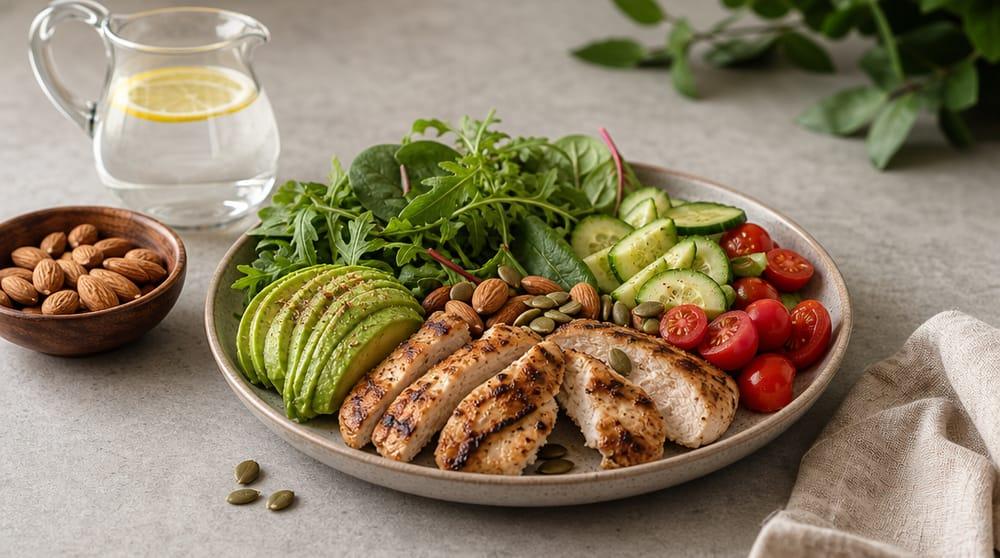
A blood sugar crash after eating — clinically called reactive hypoglycemia — is the shaky, sweaty, dizzy, suddenly-ravenous feeling that shows up roughly two to four hours after a meal. Here is the part almost nobody is told: in most cases blood glucose is not actually low when the symptoms hit, and yet the sensation is completely real and has a clear physiological explanation. This guide separates three things people constantly conflate — the feeling of a crash, a measured low, and the medical condition that needs a doctor today — and then goes through what the evidence says actually stops the episodes.
🩺 This article is educational only and does not replace your doctor's advice, especially if you take diabetes medication or have had bariatric surgery.
What is reactive hypoglycemia, exactly?
Reactive (or postprandial) hypoglycemia describes symptoms that appear after eating rather than during fasting. Mayo Clinic notes these symptoms usually occur within four hours of a meal, while Cleveland Clinic places the most common window at about two hours after eating, sometimes stretching to four.
The symptom list feels familiar because it is fundamentally an adrenaline response: trembling hands, cold sweat, a pounding or racing heart, dizziness, headache, mild nausea, sudden irritability, and a hunger that is very hard to ignore. If glucose genuinely stays low for longer, doctors then see neuroglycopenic symptoms — heavy drowsiness, confusion, difficulty speaking or seeing, and in severe cases seizure or loss of consciousness. That last group is not "the afternoon slump." It is a medical situation.
The core problem is linguistic before it is medical: in everyday speech a "crash" describes a feeling; in medicine it describes a number. The gap between the two is what this article is about.
Why do endocrinologists say most cases aren't true hypoglycemia?
This is the clearest — and most surprising — finding in the evidence. The Endocrine Society Clinical Practice Guideline published in The Journal of Clinical Endocrinology & Metabolism in 2009 does not hedge. It states plainly that "postprandial symptoms without Whipple's triad, previously called 'reactive hypoglycemia,' indicate a functional disorder in which symptoms are not due to hypoglycemia and for which an oral glucose tolerance test is not indicated."
Whipple's triad: the line between a feeling and a diagnosis
The guideline recommends evaluating and managing a hypoglycemic disorder only when Whipple's triad is documented — all three of:
- Symptoms or signs consistent with hypoglycemia.
- A reliably measured low plasma glucose at the moment those symptoms are present.
- Resolution of the symptoms once glucose is raised.
It is the second condition that almost always fails. People measure an hour after the episode passed, or they never measure at all. The clinical reference StatPearls puts the threshold for people without diabetes at below 55 mg/dL (below 3.0 mmol/L), sampled at the time of symptoms wherever possible. For contrast, the NIH's NIDDK uses 70 mg/dL for people with diabetes on glucose-lowering medication — a different number for a different purpose. That is a safety action threshold for someone using insulin or an insulin secretagogue, not a diagnostic criterion for a healthy person.
Why isn't an oral glucose tolerance test used to diagnose it?
Because 75 grams of pure glucose on an empty stomach creates a scenario that resembles no real meal on earth — and a meaningful share of perfectly healthy people dip below threshold during one without having any disease at all. The guideline is categorical: an oral glucose tolerance test should never be used to evaluate suspected postprandial hypoglycemia. When genuine suspicion exists, the appropriate tool is a mixed meal test — a meal resembling what the person actually eats, with glucose and symptoms tracked together — which StatPearls names as the evaluation of choice for the reactive pattern in adults.
None of this means "your symptoms are in your head." It means the popular label is applied to a far wider phenomenon than the diagnosis covers, and knowing the difference protects you from two opposite mistakes at once: worrying about a disease you don't have, or ignoring one you do.
If it isn't low blood sugar, why do I actually feel this?
Because the body doesn't respond only to the glucose level — it responds to the rate of change. When glucose climbs steeply and then falls just as steeply, the sympathetic nervous system reads the rapid descent as an alarm and releases adrenaline. Adrenaline is where the tremor, the palpitations and the sweating come from. That is why you can feel a complete episode while the meter reads a perfectly normal 75 or 80. Some clinicians call this a "relative" drop: the floor isn't low, but the distance you fell was large.
What a study of over a thousand healthy people found
Here is the most interesting evidence in the file, from the PREDICT study published in Nature Metabolism in 2021. Researchers followed 1,070 healthy UK participants (685 in the main analysis) plus a US validation cohort of 100, across 8,624 standardized meals and 71,715 free-living meals, using continuous glucose monitors.
The headline finding: the size of the glucose "dip" two to three hours after a meal predicted hunger and subsequent food intake better than the peak itself. Comparing the biggest dippers (top quartile) with the smallest (bottom quartile):
- Hunger rose by 9% (95% CI 5 to 13).
- Time to the next meal shortened by 24 minutes (95% CI 15 to 33).
- Energy eaten at three to four hours was 75 kcal higher (95% CI 47 to 103).
- Total 24-hour intake was 312 kcal higher (95% CI 226 to 398).
Let's be honest about these numbers: these were healthy people, their dips were not clinical hypoglycemia, and the authors themselves state that the correlations were relatively small. But the practical conclusion is still strong: the swing carries a cost even when it never reaches a disease threshold — earlier hunger, a bigger next meal, and roughly three hundred extra calories a day. That alone is reason enough to care about the shape of your meal's curve, diagnosis or not.
If you want to read those curves yourself, our beginner's guide to continuous glucose monitoring and time in range is in the Bakery 8 blog archive.
The spike creates the crash: how the loop starts
Step by step:
- A rapidly absorbed meal — simple sugars or refined flour — reaches the small intestine fast.
- Blood glucose climbs sharply over 30 to 60 minutes.
- The pancreas answers with an insulin surge scaled to the speed of the rise rather than to the body's real need.
- Insulin is still working after the incoming glucose is spent, so the curve sometimes drops below where it started.
- The fast descent is read as an alarm, adrenaline fires, and the episode arrives: shaking, sweating, irresistible hunger.
- Because the hunger is sharp, the instinctive fix is something sweet and fast — and the loop restarts.
Notice where the real problem sits: not in the trough, but in the peak that preceded it. Treating the episode with sugar treats the symptom and feeds the cause in the same bite. (The important exception: someone taking insulin or an insulin secretagogue who has actually measured a low number. Then the 15-15 rule described by NIDDK applies — 15 to 20 grams of fast carbohydrate, wait 15 minutes, re-check. That is emergency treatment for a documented low, not a daily eating pattern.)
When is a post-meal crash a genuine medical problem?
Here the article turns from reassurance to warning, because there are situations in which the post-meal low is real, documentable, and deserves medical follow-up.
Late dumping syndrome after bariatric surgery
After sleeve gastrectomy or gastric bypass, food passes into the small intestine faster than normal. The international consensus published in Nature Reviews Endocrinology in 2020 distinguishes two patterns:
- Early dumping: within the first hour after a meal, with gastrointestinal and vasomotor symptoms — cramping, bloating, nausea, diarrhea, flushing, palpitations, low blood pressure.
- Late dumping: one to three hours after a meal — and this is reactive hypoglycemia in its true sense: fatigue, weakness, confusion, sweating, tremor.
The mechanism is known. The consensus states that an exaggerated GLP-1 response is the key mediator of the hyperinsulinaemic and hypoglycaemic effect characteristic of late dumping. Its diagnostic criteria include plasma glucose below 50 mg/dL (2.8 mmol/L) between 60 and 180 minutes on a modified test.
A comprehensive review in Frontiers in Surgery in 2024 puts the numbers in context: estimates of post-bariatric hypoglycemia range from 10% to 72% depending on definition and sample, with the review citing 9.1% at 12 months after gastric bypass rising to 13.3% at year five, and 14% one year after sleeve gastrectomy. StatPearls notes that hospital admission for hypoglycemia rises two- to seven-fold after bariatric surgery — though the absolute risk stays small, around 0.2% versus 0.04% in the general population.
The Saudi numbers: why this topic matters here
Because obesity and its surgery are both prominent in the local health picture. The 2024 Health Determinants Statistics Publication from Saudi Arabia's General Authority for Statistics (GASTAT) reports that 45.1% of adults (15+) are overweight and 23.1% have obesity, and that only 10.2% eat the recommended five or more daily servings of fruit and vegetables.
A Saudi study published in Cureus in 2022 followed 240 post-bariatric patients at King Fahad General Hospital in Jeddah (86.6% sleeve gastrectomy) and found dumping syndrome in 31.4% using the modified Sigstad score — roughly one in three.
But the most useful number in that paper isn't the prevalence; it is the link to eating behaviour. The rate was 81.8% among those eating more than one large meal, versus only 10.9% among those eating more than one small meal. It was also 40.8% among those drinking fluids with meals versus 26.8% among those drinking between meals. That first gap is enormous, and it says something encouraging: a large share of these episodes is tied to variables you can actually control — meal size, meal frequency, and when you drink.
Red flags that call for a doctor, not a diet tweak
- Episodes that happen while fasting, overnight, or when a meal is delayed rather than after eating — a completely different pattern that needs evaluation.
- A documented low reading on a meter or lab test taken during symptoms, especially if it repeats.
- Confusion, difficulty speaking or seeing, seizure, or loss of consciousness — a medical emergency.
- Episodes that started after bariatric surgery, or after starting a new medication.
- Episodes in someone taking insulin or an insulin-stimulating diabetes medication.
- Unexplained weight loss alongside the episodes.
In these situations adjusting meals is not enough. A doctor needs to rule out causes such as insulinoma (very rare — StatPearls gives an incidence of 0.4 per 100,000 person-years), adrenal insufficiency, a medication effect, or liver and kidney causes.
What actually stops the episodes?
Because the problem is the shape of the curve, every real solution circles one idea: make the climb slower and the descent becomes gentler.
1) Meal composition before calorie count
Protein, fat and fiber slow gastric emptying and glucose absorption. Cleveland Clinic explicitly advises steering away from simple carbohydrates, refined sugars and high-glycemic foods, and toward higher-fiber, higher-protein choices paired with protein and healthy fats. The international dumping consensus lands on the same principle: fiber-rich, protein-rich foods, with rapidly absorbable carbohydrates eliminated.
The simple working rule: never eat a naked carbohydrate. Carbohydrate alone on an empty stomach is the perfect recipe for a sharp peak — and therefore for a sharp dip.
2) The order of food on the plate
This is the cheapest tool on the list, because it doesn't change what you eat — only when you eat it within the meal. In a crossover study published in Diabetes Care in 2015, 11 participants with type 2 diabetes ate the same 628-kcal meal in two different orders a week apart. When carbohydrate was saved for last, after vegetables and protein, postprandial glucose fell by:
- 28.6% at 30 minutes (P = 0.001)
- 36.7% at 60 minutes (P = 0.001)
- 16.8% at 120 minutes (P = 0.03)
Insulin levels dropped significantly too. The sample is very small (11 people) and all had diabetes, so we shouldn't over-generalize — but the direction is physiologically coherent and the cost is zero. Start with salad and protein; leave the starch for last.
3) Meal size and frequency
Almost every source agrees here. Mayo Clinic recommends several small meals or snacks about three hours apart; Cleveland Clinic suggests a small meal or snack every two to four hours; StatPearls advises smaller, more regular meals with one to two snacks. The Saudi study above gives the principle a hard number: 81.8% versus 10.9%.
4) Fluids: with the meal or after it?
The international dumping consensus advises delaying fluid intake until at least 30 minutes after a meal, because drinking while eating speeds food through to the intestine. That advice is aimed primarily at post-surgical patients, but the Jeddah study found the same direction of effect (40.8% versus 26.8%), and there is no harm in others trying it.
5) Eat slowly and chew thoroughly
A plain recommendation the consensus repeats. How fast food reaches the intestine is part of the equation, and how fast you eat feeds directly into it.
A practical one-week plan
- Day 1: Record, change nothing. Write down the time of each meal, its components briefly, and the minute any symptoms appear.
- Day 2: Add protein to every meal that lacks it, especially breakfast. A protein-free breakfast is the single most reliable cause of a late-morning episode.
- Day 3: Apply food order — vegetables, then protein and fat, then starch last.
- Day 4: Drop the sweetened drink that accompanies the meal. Sweet liquid is the fastest route to a sharp peak.
- Day 5: Fix the size — turn one large meal into two medium ones three hours apart.
- Day 6: Delay fluids half an hour after eating and watch what changes.
- Day 7: Review your log. Look for the pattern: which meal always precedes an episode, and which one never does?
A two-week personal testing protocol
If you want to identify your own triggers instead of applying generic lists, follow these four rules:
- Record before you eliminate. A full week of logging before any change, or you have no baseline to compare against.
- Change one variable at a time. Drop the drink and change the order on the same day and you'll never know which one worked.
- Three out of three. Don't call a food a trigger unless it reproduces the episode three times out of three separate attempts.
- Re-challenge after improvement. Once episodes stop, reintroduce the suspect food once to confirm. Untested lists grow forever and impoverish the plate.
And if you use a continuous glucose monitor, the metric that matters isn't the highest number — it's the distance between the peak and the trough in the three hours after a meal. Make shrinking that distance the goal.
Who should pay closer attention?
- Anyone who has had bariatric surgery: the best-documented pattern, and one that deserves a clinical dietitian rather than solo experimentation.
- People with diabetes on insulin or insulin secretagogues: they face genuine hypoglycemia risk and must never self-adjust doses.
- People with prediabetes or insulin resistance: their swings are more pronounced, so flattening the curve pays twice.
- Pregnant women: any recurrent episode should be discussed with the treating physician.
- Anyone with unexplained weight loss or fasting episodes: needs medical evaluation before any diet change.
🩺 Important: this article is educational and neither diagnoses nor treats. If your episodes recur, occur while fasting, or come with confusion or loss of consciousness, see your doctor — and if you can, measure your glucose during the symptoms. That single reading is the most valuable thing you can bring to the appointment.
Where does Bakery 8 fit in?
Let's start with the honest sentence: no bread treats hypoglycemia. If you have a documented low or post-surgical dumping syndrome, your place is with your doctor and dietitian, not an online store. But if your problem is what it is for most people — the sharpness of the post-meal swing — then the one lever we own is specific: making the starch base of your meal rise more slowly and carry less sugar.
- Bread and toast — an almond-flour sandwich base instead of refined flour, which is exactly where most sharp breakfast peaks begin. Fill it with egg, tuna or avocado and you've applied the "no naked carbohydrate" rule in one move.
- Keto granola — a direct swap for the sweetened breakfast cereal that is among the most common causes of a mid-morning episode; add yogurt and seeds and it becomes a composite plate rather than pure starch.
- Crackers — a savoury option for the between-meal snack that nearly every source recommends to bridge the gap instead of waiting for sharp hunger.
- Sugar-free chocolate, desserts and cake — because the practical answer to the crash-sugar-crash loop isn't banning sweetness forever; it's making sure the available option doesn't restart the loop.
And by the same standard we apply to everyone else: turn our package over, read the label, and work out what suits you. If any product — ours or anyone's — reliably gives you symptoms, the rule is the same: stop it and ask a professional. The rest of the range is at the Bakery 8 store, and more articles are in the blog archive.
Frequently asked questions
Is a blood sugar crash after eating dangerous?
In most cases glucose is not actually low when symptoms occur, and the situation isn't dangerous. It becomes a medical matter if Whipple's triad is met — symptoms, a documented low measured at that moment, and resolution once glucose is raised — or if it comes with confusion or loss of consciousness, or happens while fasting. In those cases see your doctor for evaluation.
How long after a meal do symptoms appear?
Usually within two hours of finishing, sometimes up to four, according to Mayo Clinic and Cleveland Clinic. Late dumping syndrome after bariatric surgery typically appears one to three hours after eating, while early dumping shows up within the first hour with a different, more gastrointestinal set of symptoms.
Should I treat an episode with candy or juice?
If you have no documented low reading and take no diabetes medication, fast sugar fixes the feeling for a few minutes and then restarts the same loop. A snack combining protein, fat and fiber is better. For someone on insulin or a secretagogue who has actually measured a low, the medical 15-15 rule is the correct step, following their doctor's instructions.
Does an oral glucose tolerance test diagnose this?
No. The Endocrine Society guideline states that this test should never be used to evaluate suspected postprandial hypoglycemia, because it creates a scenario unlike any real meal and produces low readings in perfectly healthy people. When suspicion is genuine, the alternative is a supervised mixed meal test.
Does food order really make a difference?
In a small 2015 Diabetes Care study of 11 people with type 2 diabetes, saving carbohydrate for the end of the meal lowered glucose by 28.6% at 30 minutes, 36.7% at 60 minutes and 16.8% at 120 minutes. The sample is small, but the tool is free, safe, and well worth testing on yourself.
Does this mean I should cut carbohydrates entirely?
No. The point isn't elimination but speed and context: slower carbohydrate, in smaller amounts, paired with protein, fat and fiber, and moved to after the vegetables on the plate. Total elimination without a medical reason makes meals poorer and is hard to sustain.
The bottom line
Post-meal blood sugar crashes are complained about far more often than they are diagnosed. The evidence says the sensation is real, that its cause is usually the speed of the fall rather than its depth, and that the swing is paid for even by healthy people: hunger roughly 24 minutes earlier and 312 extra calories a day. It also says there are genuine cases — especially after bariatric surgery — that need a doctor rather than a personal diet experiment.
The four tools worth trying today: protein in every meal, order on the plate, smaller and more frequent portions, and delayed fluids. And if you want a starch base that rises slowly and carries no added sugar, Bakery 8 in Riyadh, Saudi Arabia makes its products for exactly that purpose — healthy and delicious.
References
- Cryer PE, et al. Evaluation and Management of Adult Hypoglycemic Disorders: An Endocrine Society Clinical Practice Guideline. The Journal of Clinical Endocrinology & Metabolism, 2009;94(3):709–728.
- StatPearls (NCBI Bookshelf). Non-Diabetic Hypoglycemia. Treasure Island (FL): StatPearls Publishing, 2026.
- Mayo Clinic. Reactive hypoglycemia: What causes it? Mayo Foundation for Medical Education and Research.
- Cleveland Clinic. How to Treat Reactive Hypoglycemia. Cleveland Clinic Health Essentials.
- Wyatt P, et al. Postprandial glycaemic dips predict appetite and energy intake in healthy individuals (PREDICT). Nature Metabolism, 2021.
- Scarpellini E, et al. International consensus on the diagnosis and management of dumping syndrome. Nature Reviews Endocrinology, 2020.
- Postprandial hypoglycemia as a complication of bariatric and metabolic surgery: a comprehensive review of literature. Frontiers in Surgery, 2024;11:1449012.
- Shukla AP, et al. Food Order Has a Significant Impact on Postprandial Glucose and Insulin Levels. Diabetes Care, 2015;38(7):e98–e99.
- Prevalence of Dumping Syndrome and Its Determinants Among Post-Bariatric Surgery Adult Patients at King Fahad General Hospital, Jeddah, 2019–2020. Cureus, 2022.
- National Institute of Diabetes and Digestive and Kidney Diseases (NIDDK), NIH. Low Blood Glucose (Hypoglycemia).
- General Authority for Statistics (GASTAT), Saudi Arabia. Health Determinants Statistics Publication 2024.
Related keywords: reactive hypoglycemia, blood sugar crash after eating, low blood sugar after a meal, postprandial hypoglycemia, shaky after eating, tired after eating, dumping syndrome, late dumping after sleeve gastrectomy, Whipple's triad, food order and blood sugar, glucose dips, small frequent meals, Bakery 8, Riyadh, Saudi Arabia.