

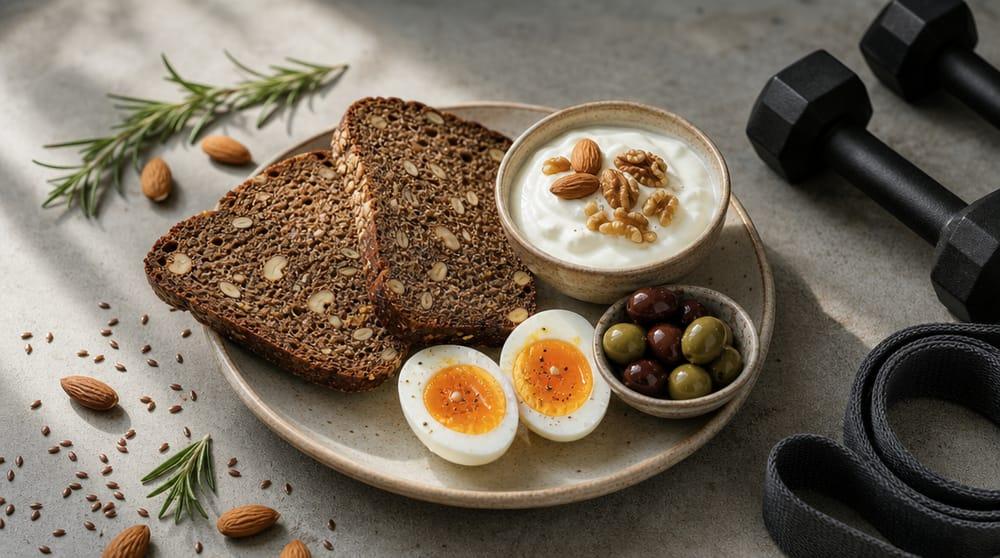
Your muscle is not a cosmetic organ. It is the single largest receiver of sugar in your body: after a meal, roughly 80% of the glucose you absorb is taken up by skeletal muscle, according to a 2022 review in Nutrients. That means blood sugar is an equation with two sides, not one — what arrives on your plate, and how much room your body has to receive it.
Almost everything written about blood sugar covers the first side only: carbohydrates, glycemic index, labels. This article is about the other side — muscle as a storage tank you can enlarge, and as a door you can open through movement without waiting for insulin. The practical news is that both sides are within reach.
This is educational content and does not replace your doctor's advice, especially if you use insulin or glucose-lowering medication.
Where does sugar actually go after it leaves your stomach? 🍽️
When you digest a meal containing carbohydrate, blood glucose rises. But blood is not a storage compartment: the total amount of glucose circulating in your entire bloodstream is small compared with what a single meal delivers. Glucose therefore has to move quickly into a tissue that will receive and store it.
This is where the overlooked player comes in. Hulett, Scalzo and Reusch write in their 2022 Nutrients review that "after ingestion, ~80% of glucose is taken up by skeletal muscle" through an insulin-dependent mechanism. Muscle is not a marginal consumer of sugar — it is sugar's main destination.
The conclusion is simple and powerful: the larger and more receptive the tank, the calmer the rise after a meal. When the tank shrinks or its door stays shut, glucose lingers in the blood — which is the essence of what we call insulin resistance.
Muscle has two doors — and one of them needs no insulin at all 🔑
Glucose does not walk into a muscle cell on its own. It needs a transporter called GLUT4, which normally sits stored inside the cell rather than on its surface. The whole job is getting that transporter out to the outer membrane so a real "door" exists.
Door one: insulin
The Nutrients review explains that "insulin binds the insulin receptor causing phosphorylation of the insulin receptor substrate, which then activates the Akt/PKB pathway," and that "activation of the Akt/PKB pathway triggers the translocation of GLUT4 from the cytosol into the membrane." This is the familiar route — and it is the route that gradually weakens in insulin resistance and type 2 diabetes.
Door two: the muscle contraction itself
The more important point is that a second, entirely separate door exists. The same review notes that "multiple upstream mechanisms including Rac1/actin and Ca2+/calmodulin-dependent protein kinase (CAMK) signaling are activated via muscle contraction," with the enzyme AMPK as a key mediator.
Put more plainly, Kirwan, Sacks and Nieuwoudt write in the Cleveland Clinic Journal of Medicine (2017) that "acute bouts of exercise can also temporarily enhance glucose uptake by the skeletal muscle up to fivefold via increased (insulin-independent) glucose transport," and that "AMPK is the major insulin-independent regulator of glucose uptake."
That deserves a second reading: muscle contraction opens the door even when the insulin pathway is impaired. It is why blood sugar falls with movement in people who have clear insulin resistance — not because their insulin suddenly improved, but because a different key was used.
How long does one workout last? ⏱️
Here sit the good news and the warning together. The good news is that the effect is not momentary. A meta-analysis published in Diabetes in 2022, pooling original data from 13 single-centre studies (106 participants), found that insulin-stimulated glucose uptake was "potentiated … by nearly 50%" after a single bout of exercise, and that "the insulin-sensitizing effect on glucose uptake can persist for several days."
The warning is that it fades. Kirwan and colleagues state plainly that "the effects are short-lived and begin to fade within 48 to 96 hours," and that "an ongoing exercise program is required to maintain the favorable metabolic milieu."
This inverts the usual training question. The question that matters most is not "how hard was my session?" but "when did my muscles last contract?" One heroic workout every ten days leaves your body outside the window most of the time. Three moderate sessions spread across the week keep you inside it almost continuously.
A common correction: do you have to "empty" the tank first? 🔄
The popular internet explanation goes like this: exercise burns the glycogen stored in muscle, creating empty space that receives the sugar from your next meal. It is an elegant story — but the evidence does not support it as the exclusive mechanism.
That same 2022 Diabetes analysis concluded that their data "reveal that insulin-stimulated muscle glucose uptake and the potentiation thereof by exercise are not associated with muscle glycogen synthase activity, muscle glycogen content, or degree of glycogen utilization."
Why does this matter practically? Because it removes a heavy psychological condition. You do not have to exhaust yourself to earn the benefit. The signal the muscle receives is contraction itself and the cascade that follows it, not merely a drained tank. That makes a moderate twenty-minute resistance session a fully legitimate choice, not "half a workout."
The tank itself is a variable: why muscle mass matters 💪
So far we have talked about opening the door. But there is a second variable: the size of the room behind it. The Nutrients review notes that "exercise is known to increase glycogen storage capacities of skeletal muscle, providing a larger glucose sink." Training does not just open the door — it enlarges the storeroom.
What the U.S. national survey data show
In a study published in the Journal of Clinical Endocrinology & Metabolism in 2011, Srikanthan and Karlamangla analysed 13,644 people from the third National Health and Nutrition Examination Survey (NHANES III), using a "skeletal muscle index" — the ratio of total skeletal muscle mass to total body weight.
The result: each 10% increase in that index was associated with an "11% relative reduction in HOMA-IR (95% confidence interval, 6–15%)" and a "12% relative reduction in [prediabetes] prevalence (95% CI, 1–21%)."
This is a cross-sectional study; it observes an association and does not prove causation, and it should be read with that limit in mind. But it fits the physiology exactly: more tissue that takes up sugar means less pressure on insulin.
The tank shrinks quietly
The problem is that the default direction with age is shrinkage, not growth. Cleveland Clinic notes that "you gradually begin losing muscle mass and strength in your 30s or 40s," and that "you may lose as much as 8% of your muscle mass each decade."
And because the scale may barely move when fat replaces muscle, the change passes unnoticed — much as the accumulation of visceral fat escapes the bathroom scale.
The U.S. National Institute on Aging notes that resistance training produces "short-term chemical changes in the DNA of muscle tissue that make them more tuned to specific proteins supporting sugar and fat metabolism," and that these changes "linger in the body for hours after exercise."
What do the clinical trials actually show? 📊
Moving from physiology to measurable outcome requires randomised trials. The broadest meta-analysis here was published by Umpierre and colleagues in JAMA in 2011, covering 47 randomised controlled trials and 8,538 participants with type 2 diabetes.
Compared with control groups:
- Structured exercise training overall: HbA1c fell by 0.67% (95% CI −0.84 to −0.49).
- Aerobic training: 0.73% (−1.06 to −0.40).
- Resistance training: 0.57% (−1.14 to −0.01).
- Combined training: 0.51% (−0.79 to −0.23).
- Above 150 minutes per week: 0.89%, versus 0.36% at 150 minutes or less.
For a figure specific to resistance training alone, Jansson and colleagues published a meta-analysis in BMJ Open Diabetes Research & Care in 2022 covering 20 randomised trials and 1,172 participants, finding an HbA1c reduction of 0.39% (95% CI −0.60 to −0.18).
But the smartest finding in that paper is not the headline number — it is what modifies it. The researchers found that the size of the gain in muscular strength moderated the effect, with "larger improvements in muscular strength leading to greater reductions in HbA1c." They concluded that "RT interventions that had a larger training effect appeared more effective in reducing HbA1c, compared with interventions producing medium and small effects."
In other words: the dose is not attendance, it is actual progress in strength. Someone who has lifted the same weight for a year has stopped giving their muscles a reason to adapt. Progressive overload — one more repetition, or one more kilogram every couple of weeks — is the variable that tracked with the outcome.
For scale, the Cleveland Clinic Journal of Medicine review reports that resistance training is associated with "improvements that range from 10% to 15% in strength, bone mineral density, blood pressure, lipid profiles, cardiovascular health, insulin sensitivity, and muscle mass."
Where does Saudi Arabia stand? 🇸🇦
Here the picture becomes very local. In an analysis of national data published by Alqahtani and colleagues in International Health in 2021 — drawn from the Bulletin of Household Sports Practice National Survey, covering 26,000 families across 13 administrative regions, ages 15 and above — the proportion of non-practitioners was 82.60%.
Broken down, inactivity ran at 71.70% among Saudi males and 91.10% among Saudi females. But the number that speaks directly to this article is this: the only resistance-type activity the survey tracked — body-building — had an overall participation of 5.80%, split across Saudi males (4.31%), Saudi females (0.07%) and non-Saudis.
Read that in this article's language: if muscle is the primary storage site for sugar, then fewer than six people in a hundred are doing anything to enlarge it — and among Saudi women the figure is close to zero, even though women lose muscle mass with age exactly as men do.
In fairness, the picture is changing. A recent study in Scientific Reports (2026) of 14,239 adults attending 48 primary healthcare centres in Riyadh found that 60.7% reported exercising regularly — a figure the authors themselves acknowledged is higher than earlier national estimates of 20–30%, attributing the gap to selection bias and self-reporting. The distance between what we say about ourselves and what national surveys measure is itself a finding.
Globally, the World Health Organization estimates that "31% of the world's adult population, 1.8 billion adults, are physically inactive." Inactivity is not a Saudi problem — but our share of it is larger.
A practical six-step plan 📝
- Make two days a week non-negotiable. The U.S. Physical Activity Guidelines for Americans (2nd edition) advise that adults do "muscle-strengthening activities of moderate or greater intensity and that involve all major muscle groups on 2 or more days a week" — legs, hips, back, abdomen, chest, shoulders and arms.
- Never let 72 hours pass without a serious contraction. Since the effect begins fading within 48 to 96 hours, distribution beats accumulation: three short sessions spread out beat one long session.
- Log your weights and repetitions. Because the size of the strength gain is what tracked with HbA1c reduction, progress needs measurement. A small notebook or a note on your phone is enough.
- Start from body weight if you need to. Sit-to-stand squats, wall push-ups, calf raises and a cheap resistance band are all real contraction. For older adults, the National Institute on Aging suggests trying "to get strength training in the mix one to two times per week."
- Work both sides of the equation. Enlarge the tank through training, and lighten the incoming load with lower net-carb choices. The two work in the same direction, and neither substitutes for the other.
- Make your food support the muscle. Adequate, well-distributed protein is a requirement for building muscle, not a luxury — we covered how protein quality is actually measured in a separate article, so we will not repeat it here.
Four common mistakes ❌
- "Resistance training is for athletes and people chasing size." The numbers above come from people with type 2 diabetes, not bodybuilders. The metabolic goal is tissue that receives sugar, not a particular physique.
- "Walking alone is enough." Walking is excellent and nobody is dismissing it, but it does not produce the strength gain that tracked in Jansson's 2022 analysis with a larger HbA1c reduction. The two are complements, not substitutes.
- "If I don't wreck myself, it doesn't count." The 2022 Diabetes data decoupled insulin sensitisation from the degree of glycogen use. Consistent moderation beats intermittent heroics.
- "Exercise cancels out whatever I eat." It does not. Enlarging the tank does not erase the quality of what enters it; the equation has two sides, and neglecting one works against you.
Who should be careful, and when to talk to your doctor 🩺
Resistance training is safe for most people, but some situations warrant a conversation with your physician before starting or when changing your programme:
- People using insulin or sulfonylureas: because exercise increases glucose uptake, the timing or size of a dose may need medical adjustment to avoid hypoglycaemia.
- People with advanced diabetic retinopathy: some very high-intensity or pressure-raising movements may need modification on an eye specialist's advice.
- People with neuropathy or a diabetic foot: footwear choice and daily foot checks need particular care.
- Uncontrolled hypertension, known heart disease, chronic kidney disease, osteoporosis, or recent surgery.
- Pregnancy and the postpartum period: exercise is generally beneficial, but the details are individual.
Nothing here is intended as diagnosis, treatment, or a replacement for an existing medical plan. If you have diabetes, check your glucose before and after training and discuss the pattern with your care team.
Where does Bakery 8 fit into this? 🥖
No bread builds muscle. We say it plainly because this article is about something we do not sell: regular muscle contraction. No food product — ours included — can replace two resistance sessions a week.
What food can do is the other side of the equation: lighten the load arriving at a tank you are working to enlarge. Our breads are made with almond flour and no added sugar, lowering the net carbohydrate in the very meal you already eat. Our keto granola and crackers work as a snack around training that will not spike you all at once, while sugar-free desserts remain an occasion food that does not undo your week.
That is a modest, honest nutritional benefit, not a therapeutic claim. The heavier — and more rewarding — half is still in your hands, and it is measured in repetitions.
Frequently asked questions ❓
Is resistance training better than aerobic exercise for lowering HbA1c?
There is no decisive winner. In Umpierre's 2011 analysis, HbA1c fell 0.73% with aerobic training and 0.57% with resistance training, and the confidence intervals overlapped. Jansson's 2022 analysis found no statistically significant difference between the two. Practically, the best option is to combine them — or simply the type you will actually keep doing long term.
How long does one session affect blood sugar?
The effect starts immediately and lasts longer than most people assume. The 2022 Diabetes data indicate the insulin-sensitising effect "can persist for several days." The Cleveland Clinic Journal of Medicine review cautions that effects "begin to fade within 48 to 96 hours." Consistency therefore matters more than intensity.
Can I lift weights on a keto or low-carb diet?
Yes, and it is very common. You may notice a temporary dip in high-intensity performance during the first weeks of adaptation, which is well recognised. What matters is adequate protein and progressive loading. If you take glucose-lowering medication, discuss timing with your doctor.
Do I need a gym and machines?
No. The U.S. guidelines call for muscle-strengthening activity "of moderate or greater intensity" involving "all major muscle groups on 2 or more days a week," without specifying equipment. Body weight, a resistance band and heavy water bottles all qualify, provided the difficulty increases over time.
I'm over 60 — is it too late?
No. The National Institute on Aging recommends that older adults get strength training "one to two times per week," and notes that resistance training produces molecular changes supporting sugar and fat metabolism. What matters most at this stage is starting light, using good technique, and progressing slowly — ideally with supervision at first.
Is once a week enough?
Once a week is far better than zero and is a perfectly legitimate start. But it does not cover the week metabolically, because the window of improved insulin sensitivity begins fading within 48 to 96 hours. Aim for at least two days, then three if you can.
The bottom line
When you think about your blood sugar, do not think only about the plate. Think also about where that sugar is heading — and roughly 80% of it is heading into your muscle. You hold two keys: a contraction that opens the door today, and consistent training that enlarges the room over months. The first works even when your insulin does not, and the second makes every future meal easier on your body.
Start with two days a week, log what you lift, and add a little every fortnight. And if you would like to lighten the other side of the equation at the same time, browse the Bakery 8 store and pick what suits your day — healthy and delicious.
References
- Hulett NA, Scalzo RL, Reusch JEB. "Glucose Uptake by Skeletal Muscle within the Contexts of Type 2 Diabetes and Exercise: An Integrated Approach." Nutrients. 2022;14(3):647.
- Kirwan JP, Sacks J, Nieuwoudt S. "The essential role of exercise in the management of type 2 diabetes." Cleveland Clinic Journal of Medicine. 2017;84(7 suppl 1):S15–S21.
- Hingst JR, Onslev JD, Holm S, et al. "Insulin Sensitization Following a Single Exercise Bout Is Uncoupled to Glycogen in Human Skeletal Muscle: A Meta-analysis of 13 Single-Center Human Studies." Diabetes. 2022;71(11):2237–2250.
- Srikanthan P, Karlamangla AS. "Relative Muscle Mass Is Inversely Associated with Insulin Resistance and Prediabetes. Findings from The Third National Health and Nutrition Examination Survey." Journal of Clinical Endocrinology & Metabolism. 2011;96(9):2898–2903.
- Umpierre D, Ribeiro PAB, Kramer CK, et al. "Physical Activity Advice Only or Structured Exercise Training and Association With HbA1c Levels in Type 2 Diabetes: A Systematic Review and Meta-analysis." JAMA. 2011;305(17):1790–1799.
- Jansson AK, Chan LX, Lubans DR, Duncan MJ, Plotnikoff RC. "Effect of resistance training on HbA1c in adults with type 2 diabetes mellitus and the moderating effect of changes in muscular strength: a systematic review and meta-analysis." BMJ Open Diabetes Research & Care. 2022;10(2):e002595.
- U.S. Department of Health and Human Services. Physical Activity Guidelines for Americans, 2nd edition. 2018.
- National Institute on Aging (NIH). "How can strength training build healthier bodies as we age?"
- Cleveland Clinic. "Sarcopenia (Muscle Loss): Symptoms & Causes."
- World Health Organization. "Physical activity" — fact sheet.
- Alqahtani BA, Alenazi AM, Alhowimel AS, Elnaggar RK. "The descriptive pattern of physical activity in Saudi Arabia: analysis of national survey data." International Health. 2021;13(3):232–239.
- "Predictors of exercise participation among Saudi adults attending primary healthcare centers in Riyadh." Scientific Reports. 2026.
Related keywords: muscle and blood sugar, resistance training and diabetes, insulin sensitivity, GLUT4 glucose transporter, muscle glycogen, muscle mass and insulin resistance, age-related muscle loss, HbA1c, strength training for beginners, low-carb bread.