

Gallstones are hard, pebble-like pieces of material — usually hardened cholesterol or bilirubin — that form inside the gallbladder. The fact that surprises most people is that the majority cause no symptoms at all and need no treatment. What decides the next step is not the stone showing up on an ultrasound; it is the pain showing up. And there is a second, more useful surprise: among people actively losing weight, the thing that most reliably creates new stones is not the fat in their food — it is the crash diet, very low in both calories and fat, that many assume is the fastest route.
In this article from Bakery 8 (مخبز ثمانية) in Riyadh, Saudi Arabia, we unpack four points: why a silent stone is a decision to monitor rather than to operate, how to tell biliary colic apart from ordinary bloating, why rapid weight loss raises gallstone risk while healthy fats keep the gallbladder emptying, and why the internet's most popular "gallbladder flush" failed a simple laboratory test. This is educational content and is not a substitute for your doctor's advice.
What are gallstones, and why do they form?
The gallbladder is a small pear-shaped sac under the liver. Its job is to store the bile the liver makes and release it into the intestine when food arrives — specifically when fat arrives. So the gallbladder is not a passive tank; it is a muscle that contracts on a signal. Hold on to that, because it becomes the spine of this whole article.
The National Institute of Diabetes and Digestive and Kidney Diseases (NIDDK) defines them as "hard, pebble-like pieces of material, usually made of cholesterol or bilirubin, that form in your gallbladder." There are two main kinds:
- Cholesterol stones: "usually yellow-green in color and are made of mostly hardened cholesterol." These are the most common — roughly 75% of gallstones in Western nations, according to StatPearls.
- Pigment stones: "dark in color and are made of bilirubin," more closely tied to conditions involving red blood cell breakdown, liver disease and infection.
NIDDK explains the mechanism in a single sentence: stones may form "if bile contains too much cholesterol, too much bilirubin, or not enough bile salts" — or "if the gallbladder does not empty completely or often enough." Notice that last clause. It is not a question of chemistry but of movement. Bile that sits still gives cholesterol crystals a longer window to coalesce into a stone — what StatPearls describes plainly as reduced contractility and biliary stasis creating a prolonged crystallization window.
Why don't you feel them? What "silent gallstones" really means
This is the point that changes the shape of the worry. NIDDK is explicit: "Most people with gallstones do not have symptoms. Gallstones that do not cause symptoms are called silent gallstones." The Cleveland Clinic Journal of Medicine (2018) puts a number on it: gallstones "are asymptomatic in up to 80% of cases," and "only about 20% of patients with asymptomatic gallstones develop clinically significant complications."
How fast do silent stones turn loud? The figures are consistent and fairly reassuring:
- Rate of a gallstone-related complication in any given year: 1% to 3% of people with stones (Cleveland Clinic Journal of Medicine).
- Rate of becoming symptomatic: 1% to 2% per year (StatPearls).
- Over the long run: about 10% develop symptoms within 5 years, and about 20% within 20 years (StatPearls).
In other words, the overwhelming majority of people who discover a stone incidentally on an ultrasound will live alongside it without trouble.
Does finding a gallstone on an ultrasound mean I need surgery?
No — and that is a stated position in the literature, not an opinion. The Cleveland Clinic Journal of Medicine says it directly: "Cholecystectomy is not recommended for patients with asymptomatic gallstones," with narrow exceptions your doctor decides on (such as chronic hemolytic anemia, or groups at elevated risk of gallbladder cancer). NIDDK says the same thing in plainer language: "If your gallstones are not causing symptoms, you probably don't need treatment."
The practical takeaway: the stone is not the event. The pain is the event. So the most useful thing to leave this article with is not a surgical decision but the ability to recognise the pain when it arrives.
How do you tell biliary colic apart from ordinary bloating?
What delays people most is filing a gallbladder attack under "indigestion" or "gas" — even though gallbladder pain has a clear descriptive signature. The Cleveland Clinic Journal of Medicine describes the typical attack as "a constant and often severe pain in the right upper abdomen, epigastrium, or both, often persisting for 30 to 120 minutes," radiating "in the back and right shoulder in up to 60% of patients," and — crucially — "not relieved by change of position or passage of stool or gas."
Here is the practical comparison, line by line:
- Location: Bloating and gas — diffuse, across or low in the abdomen · Biliary colic — upper right abdomen, or just below the breastbone.
- Character: Bloating — pressure and a wave-like cramp that rises and falls · Biliary colic — a constant pain that climbs fast and then plateaus.
- Duration: Bloating — minutes, and it tends to move and change · Biliary colic — 30 minutes to 2 hours, sometimes longer.
- Radiation: Bloating — usually none · Biliary colic — to the back between the shoulder blades or to the right shoulder (Mayo Clinic names both).
- Timing: Bloating — shortly after particular foods · Biliary colic — more than an hour after a heavy meal, or in the evening and during the night (NIDDK).
- What relieves it: Bloating — moving, passing gas, a trip to the bathroom · Biliary colic — none of those help. Practically speaking, this is the clearest discriminator of all.
If your bloating really is recurrent, we covered its causes in a separate article: Bloating and Gas: Why Your Belly Swells After Eating.
Red flags that need urgent medical care
NIDDK lists a specific set of symptoms that warrant seeking care immediately, because they may signal "a serious infection or inflammation of the gallbladder, liver, or pancreas":
- "pain in your abdomen lasting several hours"
- "nausea and vomiting"
- "fever—even a low-grade fever—or chills"
- "yellowish color of your skin or whites of your eyes, called jaundice"
- "tea-colored urine and light-colored stools"
Mayo Clinic adds one more practical sign: "abdominal pain so intense that you can't sit still or find a comfortable position." That is not a wait-until-morning situation.
What changes after the first attack?
Here the arithmetic flips. The Cleveland Clinic Journal of Medicine notes that "patients with a history of biliary pain are more likely to experience it again, with a 69% chance of developing recurrent pain within 2 years." A silent stone is a decision to monitor; a stone that has spoken once will usually speak again — which is why, at that point, the conversation turns to discussing surgery with your doctor.
The part nobody says out loud: crash dieting itself creates stones
This is the hardest paragraph a healthy bakery can write, and the most important. Among the risk factors NIDDK and Mayo Clinic list: obesity, diabetes, high triglycerides, a sedentary lifestyle, being age 40 or older, pregnancy, being female — and "losing weight very quickly." NIDDK states that "very low-calorie diets and weight-loss surgery… can lead to rapid weight loss and raise your risk of gallstones," and that "losing weight too quickly may cause health problems."
Why, exactly? Because the gallbladder needs a signal
Go back to the first idea: the gallbladder is a muscle that contracts when fat reaches the intestine. A severe crash diet does two things at once. It pushes the liver to pour more cholesterol into bile — so the bile becomes supersaturated — while simultaneously depriving the gallbladder of the signal that makes it contract and empty. The result is more concentrated bile sitting still for longer, which is precisely the recipe NIDDK described: "if the gallbladder does not empty completely or often enough."
That is why NIDDK's dietary advice reads as counterintuitive at first: "Eat healthy fats, like fish oil and olive oil, to help your gallbladder contract and empty on a regular basis," alongside "avoid unhealthy fats, like those often found in desserts and fried foods," and "eat more foods that are high in fiber."
The trial that sums the whole story up: 3 grams versus 12 grams
In an Italian study published in the International Journal of Obesity in 1998, researchers put two groups of participants with obesity — none of whom had stones to begin with — on two very low calorie diets that were near-identical in everything except fat: about 3.0 g of fat per day in the first group versus 12.2 g per day in the second. After three months:
- The higher-fat meals "always induced a significantly greater gallbladder emptying" than the lower-fat meals.
- Asymptomatic gallstones developed in 6 of 11 participants — 54.5% — on the lower-fat diet.
- None developed in the higher-fat group.
The subtitle the authors chose says it without hedging: "Use it (fat) to lose it (well)." The sample is small, but the gap is large and the direction held up in what followed.
And what does the systematic evidence say?
A meta-analysis published in Clinical Gastroenterology and Hepatology in 2014 pooled 13 randomised controlled trials covering 1,836 participants losing weight through dieting or bariatric surgery. The findings:
- Ursodeoxycholic acid (UDCA) reduced the risk of ultrasound-verified gallstones — risk ratio 0.33 (95% CI 0.18–0.60), number needed to treat 9.
- In the diet-only trials the effect was stronger: risk ratio 0.17 (0.11–0.25).
- It also reduced the risk of needing a cholecystectomy for symptomatic stones: risk ratio 0.20 (0.07–0.53).
- And most relevant here: "diets high in fat content also reduced gallstones, compared with those with low fat content (risk ratio, 0.09; 95% CI, 0.01–0.61)."
UDCA is a prescription medicine your doctor decides on in specific contexts — not something to start on your own. The immediately actionable message is the dietary one: do not turn your weight-loss effort into a near-fat-free diet.
What does this mean if you follow keto or low-carb?
Let's be precise, because precision here serves you rather than any product. The risk factor the research identifies is not carbohydrate restriction; it is the speed of weight loss combined with a severe deficit of fat and calories. A well-formulated low-carb pattern is not a fat-free diet — it is usually the pattern in which meals retain enough fat to keep the gallbladder contracting regularly. By contrast, a "lose 10 kg this month" challenge built on near-fat-free meals is exactly the pattern that produced that 54.5% figure above, whatever you choose to call it.
And do not lose sight of the other side of the equation: obesity itself and diabetes itself are independent risk factors for stones in every reference. Losing weight gradually and keeping it off is the right long-term direction; the problem is the speed and the severity, not the goal. We covered why the scale is a lagging and misleading instrument in Visceral Fat: Why the Scale Doesn't Show It.
Gallstones in Saudi Arabia: what the local numbers say
In a cross-sectional study conducted in Riyadh in 2017 and published in the Egyptian Journal of Hospital Medicine, 500 Saudi adults recruited across shopping centres in the city underwent abdominal ultrasonography. The result: 8.6% had imaging-confirmed gallstones (43 people). Stones were significantly associated with age over 45, female sex, physical inactivity (81.4% of the gallstone group were inactive), obesity, diabetes, and abnormal blood lipids.
The second half — rapid weight loss — is illustrated by a Saudi retrospective cohort published in Frontiers in Surgery in 2020, covering 490 patients at two centres: King Abdulaziz Medical City in Riyadh and King Abdulaziz Hospital in Al Ahsa. Gallstones developed after bariatric surgery in 6.53%, and 89.82% of those were symptomatic. The one factor significantly associated with stone formation was the percentage of total weight loss (0.33 versus 0.27, p=0.007), with an average formation window of 12–24 months.
Read that last figure again: the meaningful variable was not the surgery itself but how much weight was lost and how fast — which applies to a crash diet exactly as it applies to an operation.
The olive oil and lemon "gallbladder flush": what actually came out?
The recipe has circulated for years: fast, then swallow a large quantity of olive oil with lemon juice, then pass "green stones" the next day, which people photograph as proof the flush worked.
In 2005, two researchers — Sies and Brooker — took a sample of these expelled "stones" to a laboratory and published the result in The Lancet under a wry title: "Could these be gallstones?" The finding: the sample contained no cholesterol, no bilirubin and no calcium — the components that make a real gallstone — and was instead roughly 75% fatty acids. What came out was not stones at all, but soap stones formed inside the digestive tract by the reaction between the oil, the juice and digestive secretions. Put differently: you are not passing your stones, you are manufacturing new lumps and passing those.
Nor is the recipe free of cost: reported effects include abdominal pain and diarrhoea, and there is a documented case of biliary pancreatitis following such a "flush."
What about medicines that "dissolve" stones?
They do exist, but with limits worth knowing. NIDDK notes that ursodiol (Actigall) and chenodiol (Chenix) "are medicines that contain bile acids that can break up gallstones," but "these medicines work best to break up small cholesterol stones," and "you may need months or years of treatment to break up all stones." Mayo Clinic adds that stones typically recur if treatment stops, and that these medications are "reserved for people who can't undergo surgery." There is no fast track — and no food that dissolves a stone once formed.
Surgery: when, and can you live without a gallbladder?
Once stones become symptomatic or cause complications, gallbladder removal (cholecystectomy) is the standard treatment. NIDDK calls it "one of the most common operations performed on adults in the United States," and Cleveland Clinic describes it as "one of the most common procedures performed worldwide."
And the question that worries everyone: what then? NIDDK: "The gallbladder is not an essential organ, which means you can live normally without a gallbladder." Cleveland Clinic explains the mechanism: "Instead of storing extra bile for digestion, your liver sends it straight to your small intestine," and you "might have more trouble digesting fats and heavier meals" at first, but this "should gradually improve over time." Most people "can resume a normal, healthy eating plan after their recovery," and laparoscopic recovery takes about two weeks. The decision belongs to your surgeon, not to an article.
So what can you actually do? A five-step plan
- Lose weight gradually, not as a race. Aim for a sustainable pattern you can hold for months, not a one-month challenge — and discuss any very low calorie diet with your doctor before starting it, especially if you carry another risk factor.
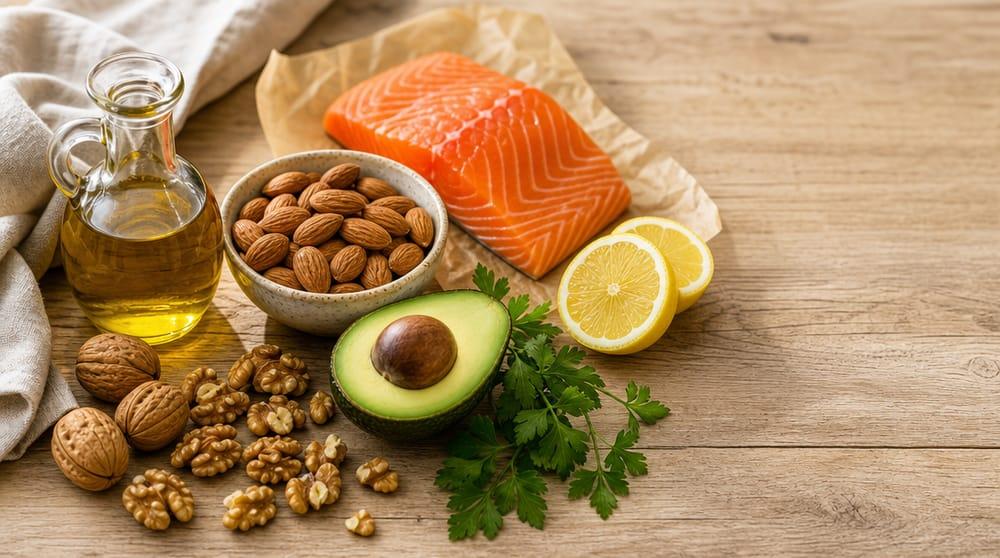
- Don't strip fat out of your meals. Keep a source of healthy fat in your daily meals — olive oil, oily fish, nuts, avocado — precisely because NIDDK links them to helping the gallbladder "contract and empty on a regular basis."
- Don't stretch the gaps between meals without reason. The principle behind it is the same one: a gallbladder that empties regularly is less exposed to biliary stasis. If you follow a fasting pattern for medical or personal reasons and have a history of stones, discuss it with your doctor.
- Move. Physical inactivity was one of the clearest associations in the 2017 Riyadh study, and movement features in every preventive recommendation in this area.
- Raise fibre; cut sugar, fried food and unhealthy fats. That is NIDDK's literal advice, and it also happens to be what the other risk factors — obesity, diabetes, dyslipidaemia — respond to. We broke down the fibre types in Soluble vs Insoluble Fiber.
Four common mistakes worth correcting
- "Stones came out of me after the oil and lemon recipe." The laboratory analysis published in The Lancet says what comes out is not gallstones but soap-like lumps formed during the procedure itself.
- "Fat is the cause, so I'll cut it all out." That is precisely the mistake that multiplied stones in the trials: removing fat entirely during weight loss stops the gallbladder contracting. The task is to choose the kind of fat, not to eliminate it.
- "A stone was found, so the gallbladder must come out." The literature says the opposite for silent stones — and the decision belongs to your doctor after assessing you.
- "Life is over without a gallbladder." It is not an essential organ, and most people return to normal eating after recovery.
Who should pay closer attention, and when to see a doctor
Pay closer attention if more than one of these applies: age over 40, being female, pregnancy or estrogen-containing medicines, obesity, diabetes, abnormal blood lipids, physical inactivity, a family history, liver disease or blood disorders, or a period of rapid weight loss right now.
See your doctor — not the internet — if upper-right abdominal pain recurs after meals, if an attack lasts more than an hour, or if any of the red flags above appear. This article is educational and does not substitute for diagnosis or treatment; any decision involving medication, surgery or a drastic dietary change should go through your treating physician, particularly if you have diabetes or take long-term medicines.
Where does Bakery 8 stand in all this?
No bread dissolves gallstones. No product in our store — or any store — treats a formed stone or replaces a surgeon's opinion. What we can honestly say is much narrower and much more useful: everything above points toward a sustainable way of eating rather than a short, severe diet, and toward meals that keep healthy fat and fibre in them rather than meals that are almost empty.
Bakery 8's breads are made from almond flour with no added sugar and no gluten, and they naturally carry healthy fats from almonds along with some fibre — which makes breakfast an actual meal rather than a skipped one. The keto granola and crackers serve the same role when you need something quick. The point is not that you eat a particular product; it is that your weight-loss plan should not be built on severe deprivation — because that, specifically, is what the research flags as a risk factor.
Frequently asked questions
Are gallstones always dangerous?
No. The Cleveland Clinic Journal of Medicine reports that up to 80% of gallstones cause no symptoms, and that the chance of a complication in any given year is 1% to 3%. The danger is tied to symptoms and complications, not to the mere presence of a stone — which is why cholecystectomy is not recommended for silent stones. Monitoring with your doctor is the appropriate step.
Can gallstones be dissolved with herbs or an olive oil and lemon flush?
There is no evidence for it. In 2005, two researchers analysed the "stones" passed after this recipe and published the result in The Lancet: they contained no cholesterol, bilirubin or calcium and were roughly 75% fatty acids — soap-like lumps formed in the gut, not gallstones. Real dissolving medicines exist but are prescription-only and take months or years.
Do crash diets or keto cause gallstones?
What the research identifies is rapid weight loss combined with a severe shortage of fat, not carbohydrate restriction as such. In a 1998 trial, gallstones formed in 54.5% of those on a diet providing 3 g of fat per day, and in none of the group receiving 12.2 g. Losing weight gradually while keeping healthy fat in the meal is the direction the evidence supports.
How long does gallbladder pain last, and when should I go to the emergency room?
Typical gallbladder pain is described as constant in the upper right abdomen, lasting 30 to 120 minutes, and not relieved by changing position or passing gas. Go to the emergency room immediately if pain lasts several hours, or is accompanied by fever — even a low-grade one — or chills, yellowing of the skin and eyes, tea-coloured urine with light-coloured stools, or persistent vomiting.
Can I live and digest normally after my gallbladder is removed?
Yes. NIDDK states that the gallbladder is not an essential organ and that you can live normally without it, and Cleveland Clinic explains that the liver sends bile straight to the small intestine instead of storing it. You may find very heavy meals harder to digest at first, but this gradually improves, and most people resume a normal, healthy eating plan after recovery.
Conclusion
Gallstones are far more common than you imagine and far calmer than you fear. Most are silent and need no intervention; what matters is knowing the signature of the pain that warrants a doctor and the signs that warrant an emergency room. The part that is genuinely in your hands is how you lose weight: gradually, with healthy fat in the meal, and with regular movement — not through severe deprivation that stops your gallbladder working.
And if part of your plan is making healthy eating easier and less punishing, browse Bakery 8's products — sugar-free, gluten-free breads and sweets, healthy and delicious, delivered in Riyadh.
References
- National Institute of Diabetes and Digestive and Kidney Diseases (NIDDK). Definition & Facts for Gallstones. NIH.
- National Institute of Diabetes and Digestive and Kidney Diseases (NIDDK). Symptoms & Causes of Gallstones. NIH.
- National Institute of Diabetes and Digestive and Kidney Diseases (NIDDK). Eating, Diet, & Nutrition for Gallstones. NIH.
- National Institute of Diabetes and Digestive and Kidney Diseases (NIDDK). Treatment for Gallstones. NIH.
- Mayo Clinic. Gallstones — Symptoms & Causes.
- Mayo Clinic. Gallstones — Diagnosis & Treatment.
- Cleveland Clinic. Cholecystectomy (Gallbladder Removal).
- Gallstones: Watch and wait, or intervene? Cleveland Clinic Journal of Medicine. 2018;85(4):323–331.
- Gallstones (Cholelithiasis). StatPearls [Internet]. NCBI Bookshelf, National Library of Medicine.
- Festi D, Colecchia A, Orsini M, et al. Gallbladder motility and gallstone formation in obese patients following very low calorie diets. Use it (fat) to lose it (well). International Journal of Obesity. 1998;22:592–600.
- Stokes CS, Gluud LL, Casper M, Lammert F. Ursodeoxycholic Acid and Diets Higher in Fat Prevent Gallbladder Stones During Weight Loss: A Meta-analysis of Randomized Controlled Trials. Clinical Gastroenterology and Hepatology. 2014;12(7):1090–1100.
- Sies CW, Brooker J. Could these be gallstones? The Lancet. 2005;365(9468):1388.
- Aldriweesh MA, Aljahdali GL, Shafaay EA, et al. The Incidence and Risk Factors of Cholelithiasis Development After Bariatric Surgery in Saudi Arabia: A Two-Center Retrospective Cohort Study. Frontiers in Surgery. 2020;7:559064.
- Alishi YA, Howaish FA, Alhamdan FA, et al. Prevalence and Risk Factors for Gallstones among Population in Riyadh City, KSA 2017. Egyptian Journal of Hospital Medicine. 2017;69(5):2384–2388.
Related keywords
gallstones, gallstone symptoms, biliary colic, silent gallstones, laparoscopic cholecystectomy, gallstones and dieting, rapid weight loss gallstones, gallbladder flush olive oil lemon, life after gallbladder removal, upper right abdominal pain after eating, healthy fats and gallbladder emptying, gallstones in Saudi Arabia.