

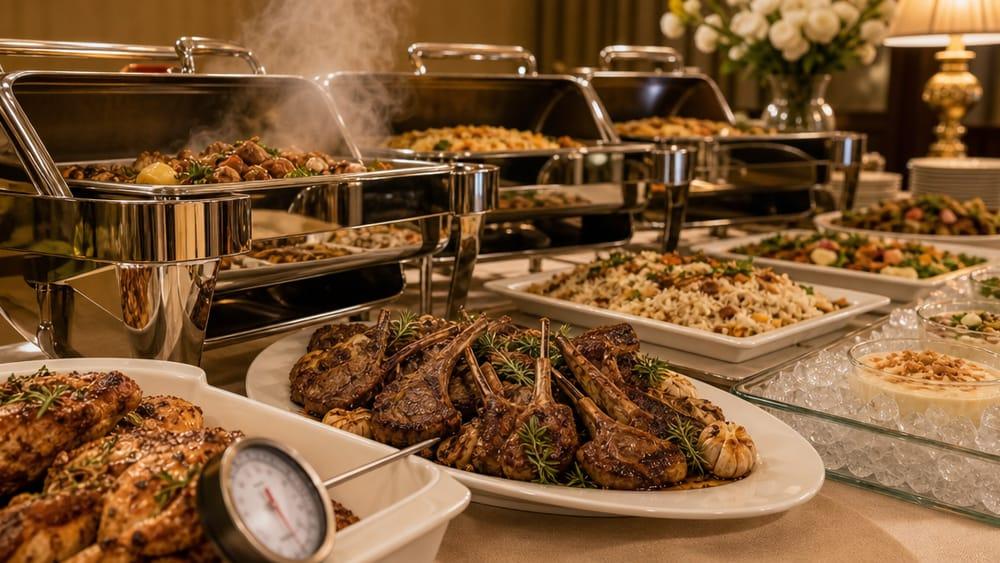
At a large gathering, not every food mistake can be fixed. Heat completely corrects some of them and cannot correct others at all — and the difference has less to do with which bacterium is involved than with when the mistake happened. If dishes sit out for hours, some bacteria may have already produced a toxin that stays in the food even after heat kills the bacteria themselves. That is exactly why "I'll reheat it well" is a sound answer to one class of error and an insufficient answer to another. This article is about banquets, dinner parties and buffets: about the hours food spends on a table, and about the two numbers that govern those hours.
Since food at our gatherings is a matter of hospitality long before it is a matter of microbiology, start with the scale of the problem. The World Health Organization estimates that "866 million – almost 1 in 9 people in the world – fall ill after eating contaminated food," and that "1.52 million die every year." Heavier still: "Children under 5 years of age experience 29% of the health burden due to unsafe food, with 143 000 deaths in 2021." These are global figures, not Saudi ones, but they make one thing plain — the people who pay most for unsafe food are the youngest, and they are usually the first to be served at our tables.
Why the question isn't "has the food gone bad?"
The popular image of food poisoning is spoiled food: an off smell, a strange taste, a wrong texture. But most of what makes people ill at gatherings changes none of those things. A dish that has spent five hours on a warm table can look exactly as it did when it arrived and still have changed in a way the eye cannot see. (In a Saudi survey we will come back to, only 26.3% of men and 31.1% of women knew that smelling or tasting does not show whether food is safe.) More precise than "has it spoiled?" are two entirely different questions:
- Have the living organisms in the food multiplied? That is a question about heat and time, and in many cases the answer is correctable: enough heat kills living cells.
- Have those organisms produced something they left behind? That is a different question, and the answer may not be correctable — because what they left behind is not alive, so there is nothing to kill.
The whole practical difference sits between those two questions. The logic is a cousin of an idea we published days ago in vitamin A toxicity, with one distinction worth naming out loud: there, the hazard was the absence of a route out of the body; here, it is the absence of a step that returns the food to what it was. The first is a disposal problem. The second is irreversibility.
1) The mistake heat can't fix: a toxin isn't alive
Some bacteria do not make you ill by being present; they make you ill through what they secrete into the food before you eat it. The best known is Staphylococcus aureus, a bacterium many healthy people carry on their skin and in their noses without being sick at all. The US Centers for Disease Control and Prevention (CDC) states that "Staph can contaminate food if people who carry the bacteria touch food without first washing their hands," and that "after getting in food, Staph can multiply and make a toxin that causes food poisoning."
And here is the sentence that should change how we think about a buffet, in CDC's own words: "Even though cooking can kill Staph, it does not destroy the toxin in the food." Heat does half the job and stops: it kills the cells and leaves what they made.
This is not a one-off. Bacillus cereus — the organism classically linked to rice, pasta and dairy products — has two entirely different syndromes. The StatPearls review hosted on the US National Institutes of Health's NCBI Bookshelf describes the emetic toxin, cereulide, as "pH-stable and resistant to heat and proteases," and notes that it persists "even after being reheated." Of the diarrheal syndrome's toxins, the same review says plainly: "These toxins are heat-labile" — meaning heat does work on those.
Why do symptoms start unusually fast?
Speed of onset is the best clue a non-clinician has that what happened was a ready-made toxin rather than an infection that needed time to grow. CDC says of staph that "symptoms usually start suddenly within 30 minutes to 8 hours after eating contaminated food," that "they last 24 hours or less," and that "severe illness is rare." For the emetic Bacillus cereus syndrome, StatPearls reports that "symptom onset is generally within 30 minutes to 6 hours" — against "usually within 6 to 15 hours" for the diarrheal form, where the organism must first reach the small intestine.
The simple point: half an hour is not enough time for any bacterium to multiply in your gut and make you ill. If nausea and vomiting arrive very soon after a gathering, the likeliest explanation is that the toxin was in the dish before it reached you.
So is reheating pointless?
No — quite the opposite, and that is what makes the picture confusing. Thorough reheating is an effective answer to most mistakes: Salmonella is a living organism that heat kills, and the diarrheal Bacillus cereus toxins are "heat-labile," as above. The problem is that the fix has a scope, and the scope is not printed on the dish: heat deals with what is alive, not with what has already been produced and finished. So the practical conclusion is not "don't reheat." It is don't let reheating be your primary plan — make it the last step in a chain where the clock was controlled from the start.
2) The clock is cumulative — and going back in the fridge doesn't reset it
The temperature range in which microbes grow fastest has a name and a number. In its guidance sheet on cooling cooked foods, the US Food and Drug Administration (FDA) states that "the 'Temperature Danger Zone' is when food is most susceptible to pathogen growth," "usually between 41°F and 135°F (5°C and 57°C)," and then adds: "The amount of time food spends in this range needs to be minimized by proper cooling."
Look at the phrasing: "the amount of time." The question is not "did the food enter the danger zone?" — every hot dish crosses it on the way down and every cold dish crosses it while being served. The question is how long it spent there in total. And here is the part most people miss: the clock does not reset. A dish that came out of the fridge for an hour, went back, came out for two hours during dinner, went back, and was brought out a third time for late guests has spent the sum of those hours in the danger zone, and nothing about returning it to the cold erases what came before.
For properly cooling cooked food, FDA sets out two numbered steps:
- "A two-hour 'rapid cool' from 135°F to 70°F (57°C to 21°C)."
- "Followed by a 4-hour window where foods must be cooled to 41°F or less (21°C to 5°C)."
And all of this has a reason, which FDA gives at the top of the same sheet: "One of the top contributors to foodborne illness is improper cooling" of time/temperature control for safety foods. Notice what the regulator names as the problem — not cooking, not even serving, but cooling, the step we think about least on the night of a party. One practical consequence follows directly from the cumulative clock, and this is our inference rather than a line from the sheet: when you replenish a buffet, bring out a fresh dish from the fridge or the oven instead of topping up a platter that has been sitting out for two hours, because adding fresh food to old time simply hands the new food the old platter's clock.
3) A buffet is a holding problem, not a cooking problem
Most of our attention at a banquet goes to cooking: is the lamb done, is the chicken cooked through? Those matter, but they are not the questions that decide the table's fate. Once food leaves the heat, the whole file moves to a different question: how do we hold the food somewhere safe until it is eaten?
The answer is two numbers, which FDA gives in its guidance on serving food outdoors: "Hot food should be kept hot, at or above 140 °F" — that is 60 °C — and "cold perishable food should be kept in the cooler at 40 °F or below until serving time" — roughly 4 °C. Everything between those numbers is the danger zone. A table with a genuinely hot half and a genuinely cold half is a safe table; a table that is uniformly lukewarm is the most dangerous arrangement possible, and the most common. FDA adds that cold foods in individual dishes "can be placed directly on ice."
The one-hour rule: in Riyadh, that's the default rule
FDA puts a time limit on perishable food after it is served: "it should not sit out for longer than 2 hours, or 1 hour if the outdoor temperature is above 90 °F," and then: "If food is left out longer, throw it away to be safe."
Ninety degrees Fahrenheit is 32 °C. In Riyadh and most of the Kingdom that is not an exceptional condition; it is the default for long stretches of the year, the default for any gathering in a rest house, garden or courtyard, and the default for any food transported by car. In other words: the stricter rule is our normal rule, not our exception. The practical limit at a summer gathering outdoors is not "until the end of the evening" but one hour from the moment the dish goes down.
This rule has a microbial protagonist all its own, and it belongs to banquets: Clostridium perfringens. Cleveland Clinic describes its behaviour precisely. The bacterium forms spores, and "these spores can't reproduce, but they can contaminate food, even after it's cooked"; then "the bacteria reproduce again when the food gets cool (between 40 and 140 degrees Fahrenheit, or 4 and 60 degrees Celsius) for an hour or longer without being rewarmed or refrigerated." The page is blunt about the window: "You can get C. perfringens from eating food that's been sitting out, even if it's just for an hour or two." The foods most associated with it, per the same page, are "gravies, red meat" and "poultry (chicken, turkey)" — very nearly a description of a Saudi banquet menu.
4) Why gatherings specifically? Because volume is an independent variable
A family can cook the same dish a hundred times without incident, then run into trouble at their first big event. The reason is not that the cooking changed but that the volume did — and volume is not a quantitative detail; it is an independent variable that changes the physics. A small pot cools in minutes because its centre is close to its surface. A huge pot of rice or of gravy cools from the outside in, and its centre can stay inside the danger zone for hours while you assume it has "cooled" because the side of the pot feels cool to the hand. That is precisely the logic of the cooling methods FDA recommends, every one of which attacks depth rather than temperature: "shallow pans," "smaller or thinner portions," "stirring in an ice water bath," and "adding ice as an ingredient."
Volume has a second face: the quantity an organism needs in order to make you ill is not reached in a moment but by doubling — and doubling needs warm hours. So a large gathering gives microbes the thing they actually need: long warm time, in a deep pot that holds that warmth. Which is why planning the cold, not planning the cooking, is a host's real work.
5) What the Saudi numbers say — and what they don't
In a review published in the Saudi Medical Journal (2004;25(1):11-14) by Dr Yagob Al-Mazrou, one observation becomes more pointed after everything above. Across 781 events (6,052 cases) reported to the Ministry of Health, Staphylococcus aureus "was responsible for 41% of events," followed by Salmonella. The organism most prominent in the local record is precisely the organism whose leftovers heat does not fix. The review also reports that "the peak of these accidents occurring during the hot summer months of June to August" — the months in which the one-hour rule applies rather than the two-hour one. The author adds a caveat worth carrying verbatim: "a large proportion of food poisoning outbreaks are never reported to the health system," and he considers part of the recorded rise in notified incidents over that period to be better reporting rather than a true increase. So these are relatively old figures, and a direction of travel rather than a snapshot.
From a more recent study: Beigh and colleagues, writing in Healthcare (2023;11(10):1398), reviewed poisoning records in the Al-Baha region between 2019 and 2022 and found 159 food poisoning cases, with Salmonella the suspected agent in 93.7% and 66% of cases in the 1–10 year age group. The figure that matters here is where it happened: 136 cases (85.5%) occurred at home, against 23 (14.5%) in restaurants and weddings. The lesson is not that restaurants are safe — the study does not measure that — but that the place where we assume safety automatically is where most of the cases in this record accumulate. The authors state their limitations plainly: "The main limitation of our study stems from the fact that it was retrospective and hence patient data was missing," and data "from a single teaching hospital" "may not accurately represent the circumstances in this area."
Finally, the question of knowledge itself. In a cross-sectional survey published in Foods (2022;11(7):935), Ayad and colleagues surveyed 309 household members in Saudi Arabia. Only 29.1% correctly identified the appropriate refrigerator temperature (0–5 °C), and only 17.0% of women and 15.8% of men agreed that thawing frozen food at room temperature is hazardous. Against that, 90.9% correctly identified the symptoms of foodborne illness. Knowledge is present at the symptom end and absent at the end made of the numbers that prevent the symptoms.
We should read that survey honestly. The authors note that "the data did not represent all regions of Saudi Arabia" and that "unequal distribution of sample characteristics such as age, gender and educational level" affected the outcomes. The sample was 93.5% female and 71.8% from the Western region, and it was collected online. So 29.1% describes the people who answered an online questionnaire with those characteristics; it is not a national rate. What these figures do carry confidently is the internal contrast: a wide gap between knowing the symptoms and knowing the numbers, within the very same group.
Who should be more careful, and when to call a doctor
Most food poisoning passes in a day or two with fluids and rest. But not everyone carries the same risk. Mayo Clinic lists those most prone to complications as "infants and children," "people who are pregnant and their unborn babies," "older adults," and "people with weakened immune systems due to another disease or treatments."
The signs that warrant care in adults, per Mayo Clinic: "nervous system symptoms, such as blurry vision, muscle weakness and skin tingling," a "fever of 103 degrees Fahrenheit (39.4 degrees Celsius) or higher," "loose stool that lasts more than three days," and signs of dehydration — "great thirst, dry mouth, little or no urination, and feeling weak, dizzy or lightheaded."
For children, Mayo Clinic advises calling a healthcare professional if vomiting and loose stools come with "little or no urination," "loose stools that last more than a day," "stools that have blood or pus," or "any fever in children under 2 years of age."
And if diarrhea persists long after the gathering has become a memory, the problem has left the territory of food poisoning for a different one entirely, which we covered in an earlier article on chronic diarrhea and why a normal colonoscopy isn't the end of the search. This article is educational, not diagnostic: none of it replaces a conversation with your doctor or pharmacist, particularly if you belong to one of the groups above or take medicines long-term.
A host's checklist: plan the cold before you plan the cooking
- Split the table into two real halves: hot at 60 °C or above, cold at 4 °C or below. No lukewarm third.
- Set a one-hour clock, not a two-hour one, at any outdoor gathering or on any day above 32 °C.
- Replace platters instead of topping them up: new food on a new platter, rather than fresh food added to a dish that has been out for two hours.
- Attack depth, not temperature: divide the big pot into shallow containers before chilling. Depth, not quantity, is what slows cooling.
- Wash hands before touching ready-to-eat food, thaw frozen food in the fridge rather than on the counter, and serve children and older guests from the first round.
Where does Bakery 8 stand in this?
Fairness requires saying this plainly. When you read CDC's list of the foods most at risk if contaminated with staph — "sliced meats, puddings, pastries, and sandwiches," the foods "that are not cooked after handling" — you are reading, in large part, a description of our own shelf. Bakery 8's cream-based desserts, our tiramisu, our ready pastries, and sandwiches built on our bread all belong to the category a health authority puts in the front seat of risk at a long event, precisely because nobody is going to cook them again after they are made. Which means our products' place at a long banquet is the cold half of the table — on ice, or in a shallow container set inside a pan of ice — not the middle of the table among the hot dishes; and the first thing we would ask you to return to the fridge an hour after serving is our own desserts, not the bread and not the crackers.
With the same candour: we do not have a number to give you for how long each of our desserts tolerates a warm table, and we are not going to invent one. Those figures are measured per formulation and per temperature, and we have not measured them in order to tell you. The honest position is to treat that category as perishable by default and to apply the stricter rule to it rather than the cheaper one.
Where we can be useful without overclaiming is the structure of the table itself: bread, crackers and granola are the dry items that need no clock running against them on a majlis table, whereas desserts and chocolate are what need cold and supervision. And for any guest who knows they don't tolerate lactose, our article on lactose intolerance explains that the issue is a quantity rather than a binary.
Frequently asked questions
Does reheating food that was left out make it safe?
Not always. Reheating kills living bacterial cells and inactivates heat-labile toxins, but it does not destroy heat-stable toxins that may have been produced during those hours. CDC says explicitly that cooking kills staph "but it does not destroy the toxin in the food." Reheating is therefore a complement to controlling time, not a substitute for it.
How long can food stay on a buffet table?
Per FDA: two hours at most for perishable food, and only one hour if the outdoor temperature is above 90 °F (32 °C). Beyond that, throw it away. In most months of the year in Riyadh, the rule that applies is the one-hour rule.
Why do symptoms sometimes start within an hour and sometimes a day later?
Because the two causes are different. A ready-made toxin acts quickly (30 minutes to 8 hours for staph per CDC), while an organism that has to reach your intestine and grow there takes longer: 6 to 24 hours for Clostridium perfringens, and 6 hours to 6 days for Salmonella, per Mayo Clinic.
Conclusion
A banquet is not a test of cooking. It is a test of holding. The reason is that some food mistakes are correctable with heat and some are not — what bacteria produced during their warm hours does not disappear when we kill the bacteria. And because the clock is cumulative and never resets, the best thing a host does happens before the guests arrive: deciding what stays hot at 60, what stays cold at 4, and when each dish comes off the table. Those decisions are free. They need nothing but a few minutes of planning and a simple thermometer.
At Bakery 8 we bake sugar-free, gluten-free bread and desserts for people watching their carbohydrates or living with wheat sensitivity — and we would rather they reached your guests in their best condition, which means cold and supervised. Explore the bread and desserts at getbakery8.com, and make planning the cold part of your hospitality.
References
- World Health Organization (WHO) — "Food safety" fact sheet, 2021 data.
- US Centers for Disease Control and Prevention (CDC) — "About Staph Food Poisoning."
- "Bacillus Cereus," StatPearls, NCBI Bookshelf (NBK459121), US National Institutes of Health.
- US Food and Drug Administration (FDA) — "Cooling Cooked Time/Temperature Control for Safety Food" guidance sheet (FDA Food Code, §3-501.15).
- US Food and Drug Administration (FDA) — "Handling Food Safely While Eating Outdoors."
- Cleveland Clinic — "Clostridium Perfringens: Food Poisoning, Symptoms & Prevention."
- Mayo Clinic — "Food poisoning (foodborne illness) — Symptoms and causes."
- Al-Mazrou YY. "Food poisoning in Saudi Arabia. Potential for prevention?" Saudi Medical Journal. 2004;25(1):11-14.
- Beigh S, Mahzari A, Alharbi RA, et al. "A Retrospective Study of Epidemiological Correlations of Food, Drug and Chemical Poisoning in Al-Baha, Western Saudi Arabia." Healthcare. 2023;11(10):1398. doi:10.3390/healthcare11101398
- Ayad AA, Abdulsalam NM, Khateeb NA, Hijazi MA, Williams LL. "Saudi Arabia Household Awareness and Knowledge of Food Safety." Foods. 2022;11(7):935. doi:10.3390/foods11070935
Related keywords: food safety at gatherings · buffet holding temperature · temperature danger zone · reheating leftovers toxin · heat-stable toxin · food poisoning symptoms onset · cooling cooked food · summer food safety Riyadh · Clostridium perfringens banquet · Bakery 8 Riyadh