

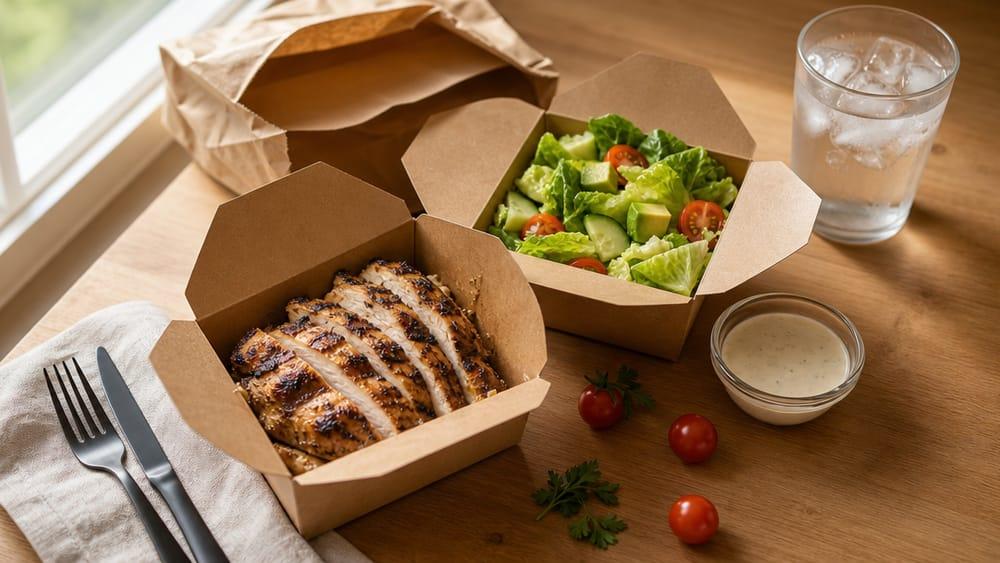
Eating out and ordering through food delivery apps is not a "diet failure" — it is a completely different food environment from your own kitchen. A restaurant meal is engineered to be generous, delicious and profitable, not to fit your daily energy needs. In a study published in JAMA Internal Medicine, the average single meal from independent and small-chain restaurants contained roughly 1,327 calories — about two-thirds of a typical adult's entire daily requirement, in one sitting. This article explains what actually decides your order (usually price and timing, not calories), why reading the number on the screen isn't enough, and the handful of steps that make a real difference — in Riyadh or anywhere else.
🍽️ We will treat this as a question of environment and decision-making, not willpower. At the end you will find a section on who needs extra caution and when talking to your doctor is the right move.
Why a restaurant meal is nothing like a home meal
When you cook at home you make three decisions without noticing: how much fat goes in the pan, how big the portion is, and whether you finish everything in the pot. In a restaurant all three are made for you, and for entirely different goals: taste, perceived value for money, and consistency between branches. The result isn't "bad food" — it is food that is far more energy-dense than most people assume.
One meal, two-thirds of a day
In a study of 157 meals from randomly selected independent and small-chain restaurants, published in JAMA Internal Medicine in 2013, the mean energy content of a single meal was 1,327 kcal (95% CI, 1,248–1,406). Notice the interval: it is relatively narrow, which tells you this is not one outlier restaurant but a repeating pattern. When the researchers compared these meals against human energy requirements, a single meal represented roughly two-thirds of a typical adult's daily need — before breakfast, before dinner, and before anything else that day.
This does not mean eating out is forbidden. It means a restaurant meal is not a unit comparable to a home meal, and treating it as though it were is where the arithmetic breaks. Someone eating out three times a week is not adding three meals to their week; they may be adding the equivalent of two entire days of energy.
The surprise: the small local place is not automatically lighter
The common belief is that "fast food is the problem, but the small local restaurant cooks like home." The numbers do not support it. In the same study, popular meals from independent restaurants contained 49% more energy than popular meals at national chains, and 19% more than the equivalent dishes in national nutrition databases.
The reason is straightforward: large chains work from standardised recipes, measured portions and disclosure requirements, while an independent kitchen cooks by eye and competes on generosity. The practical consequence: the name of the restaurant tells you nothing about the size of the meal. The plate does.
"But I check the calories before I order" — what is that worth?
Good question, and it has a slightly uncomfortable numerical answer.
Eleven calories
Cochrane reviewed the evidence on displaying calories on menus: 25 studies, 16 of them in real-world settings (restaurants, cafeterias, shops), and more than 10,000 participants across high-income countries. The conclusion is that labelling produces a small reduction in the energy people select and purchase — on average 1.8%, which the review itself translates as about 11 calories in a 600-calorie meal.
As the researchers put it plainly, "calorie labelling is certainly no silver bullet," and "we should not expect miracles." That does not diminish the value of the policy at population level — a small effect multiplied across millions of meals is still an effect. But it inverts the personal conclusion: reading the number is not a plan. It is a minor correction to a plan that should already have been made.
And in Riyadh, the number may not even be there
The Saudi Food and Drug Authority requires restaurants in the Kingdom to display calorie counts on their menus — an important step, and we covered food-label literacy in a separate article on the blog. But what happens inside the apps?
A study published in Frontiers in Nutrition in 2023 examined 120 "healthy food" restaurants listed on a widely used delivery application in Riyadh. It found that 43.3% did not comply with calorie-labelling requirements, 32.5% were only partially compliant, and just 24.2% were fully compliant. In other words, three out of four restaurants marketed as "healthy" did not give you the complete number on screen.
On the other side of that screen, a 2024 study in BMC Nutrition surveyed 419 people in Saudi Arabia: 58.9% preferred ordering through an app over visiting the restaurant, and 61.3% of them cited "saving time and effort" as the main reason — but only 46.6% said they had even noticed calorie information on the menus, and only 44.9% expressed any interest in seeing it. The information may be present, but it is not what most people are looking at.
So what actually decides your order? Price — not calories
If calories aren't governing the decision, what is? We now have a very recent Saudi answer.
82.8% versus 24.2%
In a cross-sectional study published in Frontiers in Nutrition on 27 August 2026, covering 303 users of food delivery applications in Saudi Arabia, the ranking of choice determinants was: price (82.8%), then food appearance (56.6%), then delivery timing (49.7%), then restaurant hygiene (43.0%), then availability of healthy options (29.5%) — and in last place, display of calories and nutrient information (24.2%).
Read that ranking again. The single piece of information that took the most regulatory effort to put on the screen is the least influential on the decision, while price leads by an enormous margin. Which makes the next question the important one.
Why does the lighter option feel more expensive? The "healthy-food premium"
On 17 August 2026, Health Promotion International published a cross-sectional analysis of 7,392 menu items from 200 restaurant chains across two major UK delivery platforms. The finding: items containing under 600 kcal were priced 70.3 pence higher per 100 kcal than items of 600 kcal or more (95% CI, 61.9–78.8). Descriptively, the "healthier" items had a lower absolute price (median £5.30 versus £10.49) but a higher price per 100 kcal (£1.54 versus £1.15).
Put plainly: lighter food is not more expensive in absolute terms — it is more expensive per unit of fullness. And if price is the number-one determinant for 82.8% of users, then the feeling that "the healthy option isn't worth the money" is not a character flaw. It is a rational response to a real price structure.
But note the limits of that number. The study was run on two British platforms, with data collected in June 2023, on large chains already subject to mandatory calorie labelling. You cannot transplant "70.3 pence" to Riyadh. What does transfer is the mechanism: when your mental comparison is "how full do I get per riyal," the heavier dish wins almost every time.
Your strongest tool isn't willpower — it's timing
This is the most useful part of the article, and happily the easiest to apply.
38 calories per hour
VanEpps, Downs and Loewenstein ran three field experiments published in the Journal of Marketing Research in 2016, testing a single relationship: the time delay between placing the order and eating the meal.
- Experiment 1 (analysis of 1,389 lunch orders by 394 employees): "for every hour of delay, there is a decrease of approximately 38 calories in the lunch ordered."
- Experiment 2 (296 employees randomly assigned): advance orders were about 30 calories lower (568 versus 598), a marginal difference (p = 0.086).
- Experiment 3 (195 students randomly assigned): those who ordered in advance chose 890 calories versus 999 calories for those ordering at mealtime — 109 calories fewer, roughly 11%, and statistically significant (p < 0.01).
Nothing changed in these experiments except when the decision was made. No extra information, no incentives, no lecturing. The person ordering while hungry in front of a screen is simply not the same person who orders at ten in the morning.
Turning that into a habit
The practical rule: do not open the app hungry. Make "what are we eating tonight" a decision taken at a neutral moment — before noon, on the way home, or the evening before. The American Diabetes Association arrives at the same step from a different angle, advising you to "check out the restaurant's menu online" ahead of time, because "thoroughly scanning through the menu takes time" — time you do not have when you are hungry or being watched by a waiting table.
The intention–behaviour gap, in Saudi and Arab numbers
In that same Saudi study (August 2026), 51.7% of participants were classified as frequent users (two to three times a week or more): 34.4% ordered two to three times weekly, 8.9% four to six times, and 8.3% daily.
More striking: 58.9% reported health-seeking intentions, while fast food was the predominant actual choice for 78.5%. Frequent use was also associated with greater difficulty finding healthy options (p = 0.024), changed eating habits (p < 0.001), and increased appetite (p = 0.020).
Now the honesty brake: the same study found no significant association between how often people used the apps and their BMI (p = 0.659) or the healthfulness of their diet (p = 1.000). It is a cross-sectional survey of only 303 people, based on self-report. So it describes a gap between intention and behaviour; it does not prove that delivery apps cause weight gain. Anyone telling you otherwise is going beyond what the data say.
At a wider scale, a survey published in Frontiers in Public Health in 2025 covered 7,370 adults across ten Arab countries, including Saudi Arabia, and linked the perception of app-driven dietary disruption to the 18–30 age group (odds ratio 1.45; 95% CI, 1.231–1.707). So this is neither an individual failing nor a uniquely Saudi one — it is a feature of a regional digital food environment.
A practical plan: how to order without losing your day
You don't need a banned-foods list. You need six decisions, most of them taken before you get hungry:
- Choose the restaurant, not the dish — and do it while full. The decision that matters most is which kitchen you open at all; once you are inside a particular menu, your options are already narrowed.
- Order early whenever you can. One hour of time gap is worth dozens of calories in practice, with no willpower spent at all.
- Build the plate on a protein-and-vegetable spine. The ADA advises that "a healthy meal should include a balance of vegetables, protein, and carbohydrates" — so choose grilled over fried, "rather than a fried chicken sandwich, try switching to a grilled chicken sandwich," or use "lettuce as the bun" when the only bread on offer is refined white.
- Downsize the default. "Opt for a small size, including the side and the beverage." For a concrete comparison from the same source: a small fries contains "45+ grams of carbs and 200 to 300 calories," while a small fruit cup is "100 to 150 calories and almost half the carbs."
- Ask for sauces on the side. Dressings and sauces are where sugar, fat and salt disappear into a meal that otherwise looks entirely sensible. Drinks have a longer story of their own, which we covered in a separate article — sweetened liquid does not deliver the fullness it charges you for.
- Estimate the portion with your hand. The ADA offers a reference that needs no scale: a fist ≈ one cup, a palm ≈ 3 to 4 ounces of protein, a cupped hand ≈ half a cup. Use it to decide how much of what arrived you will actually eat, rather than eating "what arrived."
🕐 And one final rule that summarises the rest: the plate that arrived is not necessarily one serving. Splitting the meal in two before the first bite — half now, half tomorrow — is the simplest available intervention, and the only one that addresses the 1,327-calorie problem head-on.
Who should be more careful, and when to see your doctor
Eating out is not inherently dangerous for anyone, but some situations warrant extra attention:
- People with diabetes, especially on insulin: the real problem with ordering out is dosing against an unknown carbohydrate content, not the meal itself. Discuss with your doctor or dietitian how to handle meals of uncertain composition.
- People with high blood pressure or kidney disease: restaurant food is a major sodium source, and we devoted a full article to that on the blog. Ask your doctor about your own daily ceiling rather than guessing.
- People with celiac disease or wheat sensitivity: the issue is not only whether a "gluten-free" dish exists on the menu, but cross-contamination in a shared kitchen. Ask explicitly about preparation, not just ingredients.
- Anyone for whom calorie numbers cause anxiety or preoccupation: the Cochrane review itself flagged a lack of data on possible harms of calorie displays for some groups. If tracking numbers feels distressing, speaking with your doctor or a qualified professional is the right step, rather than continuing alone.
- Pregnancy, young children and older adults: make restaurant hygiene and food safety your first criterion, not your last.
This article is educational only and is not a substitute for medical advice. Any change to a medication, an insulin dose, or a therapeutic diet should go through your doctor.
Where does Bakery 8 fit into this picture?
We are not going to claim that a loaf of bread solves an entire food environment, or that any product replaces a conversation with your doctor. But there is one honest observation worth making: in most cases, the immediate trigger for opening a delivery app is not craving a particular meal — it is that there is nothing ready at home. Hunger plus an empty kitchen equals an order placed at the worst possible moment, which is precisely the moment VanEpps and colleagues showed to be the most expensive.
That is where having a low-carb, sugar-free base in the kitchen earns its place: samoli and cloud bread make a grilled-chicken sandwich in ten minutes a realistic alternative to ordering; keto granola solves the fast-breakfast problem without a sharp spike; and crackers and sugar-free desserts turn the after-dinner sweet craving into a planned decision instead of a late-night order. From this article's angle these are not "diet products" — they simply reduce the odds that your decision gets made while you are hungry.
For anyone following a low-carb pattern or avoiding gluten there is an extra benefit: ordering out is exactly where that pattern usually breaks, because bread and sauces are the hardest things to control outside your own kitchen.
Frequently asked questions
Is ordering through an app worse than going to the restaurant?
Not necessarily worse, but different. The app removes barriers of time and effort, presents food in optimised photography, and puts price first in your field of view. In exchange it gives you an advantage you do not have at a table: you can browse the menu and decide hours before you eat — which is the single strongest tool in this whole article.
Does the weak effect of calorie labels mean they are useless?
No. A 1.8% effect is small for an individual but meaningful at population level when multiplied across millions of meals, which is what justifies the policy. The mistake is for you to treat the number as a personal plan. Treat it as a minor correction to a decision you already made, not a substitute for making it.
Why does the healthy option always feel more expensive?
Because it partly is — though not in the way you think. Lighter items are usually cheaper in absolute price but more expensive per 100 calories, meaning you pay more per unit of fullness. When your mental comparison is "how full do I get per riyal," the heavier dish wins. The fix is to change the comparison itself: what will keep me full for hours, rather than what fills the plate right now?
Is ordering from a restaurant labelled "healthy" in the app enough?
Not on its own. In an audit of "healthy food" restaurants on a delivery app in Riyadh, only 24.2% were fully compliant with calorie labelling and 43.3% were non-compliant. In-app categories are marketing constructs by nature; read the dish's ingredients and cooking method, not the label above it.
How many times a week counts as "too much"?
There is no official number and we are not going to invent one. But do the arithmetic yourself: if a typical restaurant meal approaches two-thirds of your daily requirement, three times a week adds close to two full days of energy to your week. What is right for you depends on your goals and health status — and that is a conversation worth having with a dietitian.
Conclusion
Eating out is not a moral failure and does not require guilt. But it is an environment designed around goals that are not yours: a single meal can equal two-thirds of your day, the small local place is not automatically lighter, price drives your decision far more than calories do, and the label helps you by about eleven calories. The one thing experiments have shown actually changes the order is when you make the decision — and that is entirely within your control.
Start with one step this week: decide tomorrow's dinner before noon. And if you want to cut down how often you open the app while hungry, having a ready base in your kitchen is the simplest way — browse Bakery 8's range and pick what makes the fast meal at home faster than delivery. Healthy and delicious, from Riyadh, Saudi Arabia.
References
- Urban LE, Lichtenstein AH, et al. "The Energy Content of Restaurant Foods Without Stated Calorie Information." JAMA Internal Medicine, 2013.
- Clarke N, Marteau TM, Pilling M, Roberts NW, Jebb SA, Hollands GJ. "Energy (calorie) labelling for healthier selection and consumption of food or alcohol." Cochrane Database of Systematic Reviews; and the Cochrane summary "Calorie labelling leads to modest reductions in selection and consumption."
- VanEpps EM, Downs JS, Loewenstein G. "Advance Ordering for Healthier Eating? Field Experiments on the Relationship Between the Meal Order–Consumption Time Delay and Meal Content." Journal of Marketing Research, 2016;53:369–380.
- Alruwaili NW, Alharbi A. "Food choice determinants and perceptions of healthy eating and food safety among online food delivery application users in Saudi Arabia: a cross-sectional study." Frontiers in Nutrition, 27 August 2026.
- Asai Y, Cornelsen L, Kalbus A. "Is there a healthy-food premium? A cross-sectional analysis of the UK online food delivery sector." Health Promotion International, 17 August 2026;41(4).
- Alangari AS. "Restaurants' compliance with calorie labeling policies in food delivery applications." Frontiers in Nutrition, 2023;10:1281293.
- Alkhunein S, Alghafari W, Alzeer H, et al. "Response of the consumers to the menu calorie-labeling on online food ordering applications in Saudi Arabia." BMC Nutrition, 2024;10:25.
- Qasrawi R, Thwib S, Issa G, et al. "The impact of online food delivery applications on dietary pattern disruption in the Arab region." Frontiers in Public Health, 2025;13:1569945.
- American Diabetes Association. "Make Healthy Choices at a Fast-Food Restaurant."
- American Diabetes Association. "How to Eyeball a Serving of Carbs."
Related keywords: eating out, food delivery apps, restaurant calories, ordering healthy food, menu calorie labelling, healthy eating in Riyadh, portion size, online food ordering.