

A diabetes-related foot ulcer is rarely a problem that begins with a wound. It is the visible end of a silent mechanical process: an ordinary pressure repeated on one spot of a foot that has lost its ability to report. That is why the strongest recommendation in the international guideline is not about what you put on the wound, but about what you take off it. Cleveland Clinic notes that "about 15% of people with diabetes will get a foot or toe ulcer," and the difference between reaching that figure and not reaching it is decided in places that do not look medical at all: inside a shoe, in a number of hours, and in an appointment written on a calendar — which is why diabetic foot care is far less about dressing a wound than most people assume.
This article approaches diabetic foot care from one specific angle — mechanical load. We are not repeating what we wrote about numbness versus pain in our article on diabetic neuropathy; we are asking a different question. If the ulcer is a mark left behind, what left it? And what decides where it lands?
Diabetic foot care starts earlier: what actually happens before the wound appears? 🦶
A diabetic foot ulcer usually does not come from an injury you notice. It comes from a very small force you do not notice at all — repeated thousands of times. Cleveland Clinic describes it precisely: ulcers "typically develop in areas where your foot repeatedly rubs or presses against shoes or other surfaces." The decisive word is repeatedly. One step on a ridge inside a shoe does nothing; ten thousand steps on it build a thick callus, then a small bleed underneath it, then an opening.
For that story to complete itself, two conditions must hold together. The first is the repeated load. The second is that the foot is unable to object to it. The practical guideline of the International Working Group on the Diabetic Foot (IWGDF) states that "the vast majority of persons with a diabetes-related foot ulcer will have neuropathy," and that peripheral artery disease "is present in up to 50% of these patients." Neuropathy switches off the alarm; poor perfusion switches off the tissue's ability to repair itself once harmed.
So what produces most of these wounds is neither a rare disease nor bad luck, but two simple daily acts. The IWGDF guideline names walking barefoot and inappropriate footwear as "a major cause of foot trauma leading to foot ulceration." That is not said about extreme cases. It is said about ordinary walking, at home and outside.
Why isn't the guideline's strongest recommendation about the wound itself?
Here is where it becomes surprising. The IWGDF offloading guideline published in 2023 — led by Sicco Bus, David Armstrong and colleagues — does not open its recommendations with dressings, ointments or antibiotics. Recommendation 1a, a strong recommendation based on moderate certainty of evidence, reads: "use a non-removable knee-high offloading device as the first choice of offloading treatment to promote healing of the ulcer."
Read the wording again. Not "care for the wound well," but "take the load off it." And more importantly: what is the stated reason for preferring the device that cannot be removed? The guideline answers in one explicit sentence: "The principal advantage of non-removable devices over removable offloading devices is enforced adherence."
In other words, the chief advantage of the best available treatment is that the patient cannot take it off. That is not a sarcastic observation; it is a scientific admission that the obstacle in this disease is neither missing knowledge nor a weak drug, but that the foot returns to bearing body weight the moment the device comes off. The guideline adds that "those who do not adhere to an offloading intervention present with worse healing outcomes."
Recommendation 3 goes further still: a strong recommendation (on low certainty) advising against using conventional or standard therapeutic footwear instead of an offloading device to heal an existing ulcer. A "comfortable shoe" is not a substitute for treatment. It is a different thing altogether, with its place in prevention rather than in healing.
The practical consequence: the hours decide more than the device
The guideline records something worth reading slowly: a less effective device worn more consistently may match a more effective device worn less often. That inverts the question most people ask. It is not "which device is best?" but "what proportion of my weight-bearing hours will actually be protected?"
The same document also notes "multiple published surveys showing low use of non-removable offloading devices in clinical practice," total contact casts in particular. So the strongest recommendation in the field is also among the least applied — which is information worth carrying into the clinic as a legitimate question: does my case call for an offloading device, and if not, why not?
Who needs a foot check once a year, and who needs one every month?
Prevention here is not one piece of advice for everybody. It is a risk category with a calendar attached to it. The IWGDF practical guideline (Schaper, van Netten and colleagues, 2023 update) sets out four risk categories, each with its own examination interval:
Category 0 — very low risk: no loss of protective sensation and no signs of peripheral artery disease → screening "once a year."
Category 1 — low risk: loss of protective sensation or peripheral artery disease → "once every 6-12 months."
Category 2 — moderate risk: loss of sensation plus artery disease, or either one plus a foot deformity → "once every 3-6 months."
Category 3 — high risk: loss of sensation or artery disease, plus a history of foot ulcer, lower-extremity amputation or end-stage renal disease → "once every 1-3 months."
Because scientific honesty is part of the information, here is what the table says about itself: these frequencies are "based on expert opinion, since there is no published evidence to support these intervals." The principle of intensifying follow-up as risk rises is well established; the specific numbers are a professional consensus rather than a trial result. That matters practically — use the table as evidence of direction, and let your doctor set your number.
And how is "loss of protective sensation" actually measured?
The core idea is that what determines your category is not how your feet feel to you, but a simple test done in minutes. The guideline describes three graded methods. The 10 g monofilament: applied at three sites on each foot until the filament buckles, with protective sensation judged present if the person answers correctly on two of three applications — including "mock" applications with no filament to test the honesty of the response, and never applied over an ulcer, callus, scar or necrotic tissue. The 128 Hz tuning fork: applied to the dorsal distal phalanx of the first toe. The Ipswich Touch test: where neither tool is available, the tips of the first, third and fifth toes of both feet are touched for one to two seconds without pushing, tapping or poking — and "LOPS is likely when light touch is not sensed in ≥ 2 sites."
The arteries carry their own warning. The guideline states plainly that the diagnostic accuracy of clinical examination for peripheral artery disease in diabetes "is low." Feeling for a pulse alone is not enough to reassure you, which is why measurements are used: for the ankle-brachial index, "an ABI above 1.3 or below 0.9 is abnormal," and a toe-brachial index "below 0.7 is considered to be abnormal." This is detail for your doctor rather than for you — but knowing it protects you from hearing "the pulse is there" and treating that as the end of the matter.
The shoe: where most of the load is decided 👟
If repeated load is the decisive variable, the shoe is the instrument that redistributes it. So the guideline does not stop at "wear suitable shoes"; it sets a measurable condition. Therapeutic footwear for someone who has healed from a plantar ulcer should have a "demonstrated plantar pressure relieving effect during walking" — an effect measured with equipment, not inferred from comfort. The shoe here is not a comfortable commodity. It is a medical device that is prescribed and verified.
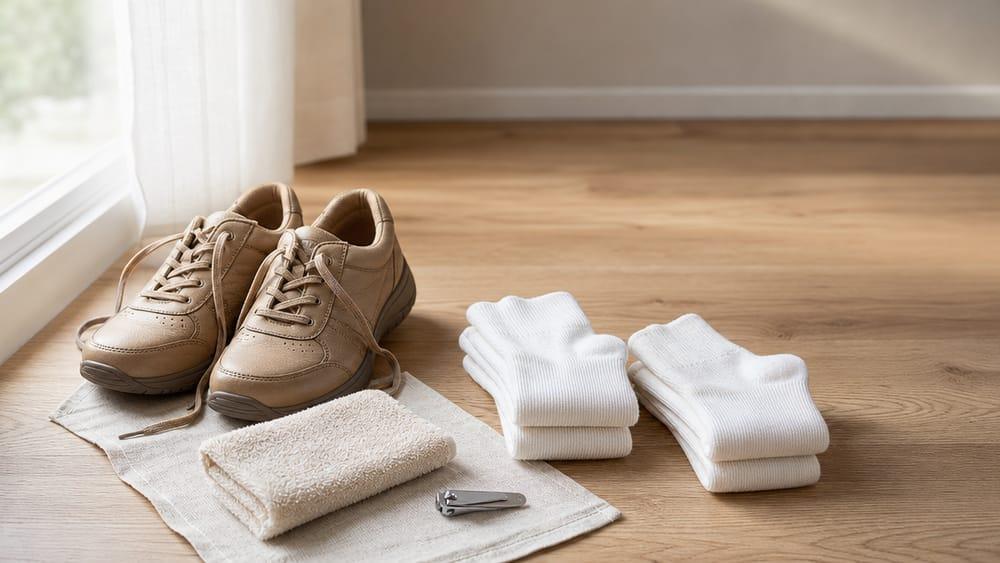
Against that, the cheapest instruction in this whole article is also one of the most useful: "visually inspect and manually feel inside all shoes before you put them on." A small stone, a bead, or a lifted edge of lining complains to nobody — but it presses on the same point with every step.
The guideline also insists on avoiding walking "barefoot, in socks without footwear, or in thin-soled slippers, whether at home or outside." That deserves a pause in our homes in particular: many of us leave shoes at the door and then move across hard floors for hours. The US National Institute of Diabetes and Digestive and Kidney Diseases (NIDDK) puts it without hedging: "Do not walk barefoot or in just socks – even when you are indoors."
On daily care, NIDDK adds small details that prevent large problems: check your feet every day, and "a good way to remember is to check your feet each evening when you take off your shoes"; wash with warm rather than hot water (it suggests testing with a thermometer or your elbow); do not soak them, since soaking dries the skin; trim nails straight across without cutting into the corners; and break new shoes in gradually, a few hours at a time. And one explicit warning that contradicts what many people do: do not cut calluses and corns yourself, and do not use medicated plasters or chemical removers, because "cutting and over-the counter corn removal products can damage your skin and cause an infection." A callus is a sign of excess load at that point — information to be read, not a bump to be removed at home.
When should you call a doctor immediately? ⚠️
This is the list worth memorising, drawn from NIDDK, Cleveland Clinic and the US Centers for Disease Control and Prevention (CDC):
- A cut, blister or bruise on the foot that does not start to heal after a few days.
- Skin that becomes red, warm or painful — "signs of a possible infection."
- A callus with dried blood inside it.
- A change in foot colour or swelling, or a toenail growing into the surrounding skin.
- An ulcer that is not healing, or a deep ulcer where bone is visible.
- Pain, redness, swelling or unusual warmth in the foot — early signs of Charcot foot.
- Any change in the shape of your foot.
- And if there are signs of gangrene (black colour and a foul smell): "Go to the emergency room."
The logic beneath that list is what Cleveland Clinic calls a "snowball effect": an unnoticed sore becomes infected, reduced blood flow slows healing, and "left untreated, infections can spread to other areas of your body and/or lead to gangrene." The good news is that the same equation runs in the opposite direction: "early treatment greatly reduces your risk of amputation." The unit of measurement here is days, not weeks — and the practical guideline states that a foot ulcer "should be assessed and treated immediately."
For a sense of scale: the CDC reports that "80% of LLAs [lower-limb amputations] are a result of complications from diabetes," and that diabetes-related hospitalisations due to amputation doubled between 2009 and 2019.
What do the Saudi numbers say? 🇸🇦
Here the picture comes much closer. In a cross-sectional study published in Frontiers in Public Health in September 2026 (AlKaabba and colleagues), covering 574 adults with diabetes across 11 outpatient facilities in Riyadh, the finding was this: 55.6% held that a foot wound needs attention only when it is painful, and about 65% said they would delay seeking care for a painless blister (65.0% in the abstract and 65.3% in the results — we report both figures as published).
Set that beside what you read a moment ago. A painless blister on a foot that has lost protective sensation is precisely the case that should accelerate a visit rather than postpone it. The contrast needs no arithmetic at all: an official instruction that says "immediately," and a local majority that says "not yet."
The study adds detail that explains why: only 28.4% distinguished nerve damage from circulatory impairment, only 45.6% had received structured foot care education, and 61.9% relied on the internet or social media as their information source, against 35.9% who relied on healthcare providers.
In fairness, the gap is not one-sided. In another study, published in the journal Medicina in 2023 (Alsheikh and colleagues) among 152 physicians in primary care centres in Riyadh, only 64.5% performed a foot inspection at every visit for high-risk diabetic foot patients — while the IWGDF table places category 3 on a check every one to three months. The barrier the physicians themselves cited most often was a "lack of DF management guidelines" (57.9%).
And here are the brakes this must be read with. Both are knowledge and practice studies — not prevalence studies, and not measured behaviour. The first rests on self-reported hypothetical intentions and a convenience sample from a single university-affiliated network in Riyadh, and states that its cross-sectional design "precludes determination of the temporal sequence or directionality of any observed associations." The second drew a 44.2% response rate, and its authors say outright that "the sample is not representative of all Saudi family medicine physicians and GPs." So this is not a picture of Saudi Arabia. It is an answer to a narrower and more useful question: which message arrived? And the message that arrived is "pain is the sign" — which is exactly the wrong one.
Who should be more careful? 🩺
Everything above is general education; the decision is individual. Pay closer attention if you have a history of ulceration or amputation (that alone places you in the highest risk category), a visible foot deformity, hammer toe or bony prominence, advanced kidney disease, or impaired vision or limited mobility that stops you seeing the soles of your feet — in which case the guideline states that such a person "cannot adequately do the inspection" alone and may need someone to help. And if the skin of your foot is warmer in one spot, the instruction is to reduce weight-bearing activity and consult the foot care team.
In every case: this article is educational and does not replace consulting your doctor or a specialist team. Do not start or stop any treatment, and do not buy a device or a "medical" shoe on the strength of an article — buy it on the strength of an examination of your own feet. And if you do not know your risk category, that is the question worth taking to your next visit.
Where does Bakery 8 stand in all of this?
In a very modest place, and honesty requires us to say so plainly. The practical guideline lists five key elements of prevention: identify the person with an at-risk foot; regularly inspect and examine the feet of a person at risk; provide structured education for patients, their family and healthcare professionals; encourage routine wearing of appropriate footwear; and treat risk factors for ulceration. Read the list again: there is not a single food on it. No bread, no almond flour, no product from our store.
Glycaemic control is a necessary condition for long-term nerve and artery health — and that is the boundary of what food reaches, as we wrote in our article on the HbA1c test. But the best diet in the world does not lift the load off the head of your metatarsal, does not feel inside your shoe, and does not find a painless blister. So: if you must choose today between spending on a correctly sized shoe or a foot examination, and spending in our store — start with the shoe and the clinic. We say that knowing exactly what it means for us.
More important still is a warning that includes us: the phrase "suitable for people with diabetes" on any product — ours among them — can create a sense that food covers the whole of the risk. It does not, and it does not come close. What we offer are options that help with dietary discipline alone: low-carbohydrate samoli bread and toast in place of white bread, and keto granola in place of sweetened breakfast cereal. That is one of five elements — and it is not the element that protects your foot.
Frequently asked questions
Does the absence of pain mean my foot is fine?
No. Pain is a signal that needs intact nerves to work, and in the diabetic foot those nerves may be the very thing that is damaged. That is why examination is built on looking, touching and periodic testing rather than on sensation. A painless blister or wound deserves a call to your doctor, not a wait.
What is "offloading," and who decides it?
It is shifting body weight away from the ulcer site using means such as a total contact cast or a knee-high device. The international guideline makes the non-removable device the first choice for healing plantar ulcers, but the choice, the fitting and the follow-up are strictly medical decisions made by a specialist team after examining your foot.
Are the "medical" shoes sold in shops enough for prevention?
Not every shoe called medical is equivalent. For someone who has healed from a plantar ulcer, the guideline requires a demonstrated pressure-relieving effect during walking — something measured with equipment, not judged by comfort. More importantly, a shoe is not a substitute for an offloading device while an existing ulcer is healing.
How often should a doctor examine my feet?
It depends on your risk category: from once a year when there is no loss of sensation and no artery disease, to once every one to three months when there is a history of ulceration or amputation. The guideline itself notes that these intervals rest on expert opinion, so treat them as a direction and leave the final number to your doctor.
Conclusion
A diabetic foot wound is not the beginning of the story but its end, which is why the most useful question is not "what do I put on it?" but "what pressed here, and for how many hours?" Every practical detail follows from that question: a hand feeling inside the shoe before putting it on, an evening look at the soles and between the toes, a correctly sized shoe, an appointment on the calendar set by risk category, and a prompt call at the first wound that does not heal — painful or not.
At Bakery 8 we help with the dietary part of the equation only, with sugar-free, low-carbohydrate options that make daily discipline easier. The part that protects your foot begins at your shoe and at your doctor — and that is what we hope stays with you from this article.
References
- Bus SA, Armstrong DG, Crews RT, Gooday C, Jarl G, Kirketerp-Møller K, Viswanathan V, Lazzarini PA, on behalf of the International Working Group on the Diabetic Foot — Guidelines on offloading foot ulcers in persons with diabetes (IWGDF 2023 update), 2023.
- Schaper NC, van Netten JJ, Apelqvist J, Bus SA, Fitridge R, Game F, Monteiro-Soares M, Senneville E, on behalf of the IWGDF Editorial Board — Practical guidelines on the prevention and management of diabetes-related foot disease (IWGDF 2023 update), 2023.
- International Working Group on the Diabetic Foot — Guidelines (2027 update), iwgdfguidelines.org (the 2023 edition is the current one; the next update is scheduled to be presented in May 2027).
- AlKaabba AF, AlHarbi Y, Al-Mutairi FZ, Alshaya FS, bin Jassas OF, Alkahtani FS, Al-Subaie MA, Alaswad FM, AlOtaibi A, Almesned AO, Almutairi RN — Misconceptions and health-seeking behavior among diabetic patients regarding foot ulcers: the hidden role of circulatory awareness in preventing amputation, Frontiers in Public Health, 2026; DOI: 10.3389/fpubh.2026.1924054.
- Alsheikh S, AlGhofili H, Alageel R, Ababtain O, Alarify G, Alwehaibi N, Altoijry A — Diabetic Foot Care: A Screening on Primary Care Providers' Attitude and Practice in Riyadh, Saudi Arabia, Medicina, 2023;59(1):64; DOI: 10.3390/medicina59010064.
- National Institute of Diabetes and Digestive and Kidney Diseases (NIDDK), NIH — Diabetes & Foot Problems.
- Cleveland Clinic — Diabetes-Related Foot Conditions: Symptoms & Treatment.
- Centers for Disease Control and Prevention (CDC) — Preventing Diabetes-Related Amputations.
Related keywords: diabetic foot care · diabetic foot ulcer prevention · offloading · loss of protective sensation · 10 g monofilament · diabetic footwear · Charcot foot · diabetes-related amputation · IWGDF risk categories.