

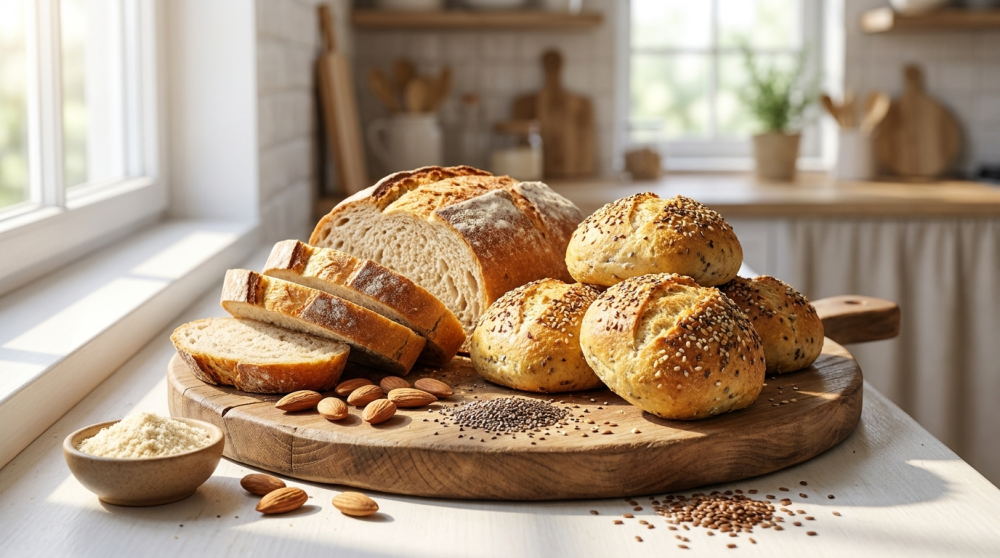
The glycemic index (GI) is a numerical scale from 0 to 100 that shows how quickly a carbohydrate-containing food raises your blood sugar level after you eat it. The higher the number, the faster and more pronounced the rise in your blood sugar; the lower the number, the slower and more moderate the rise. Understanding this simple number gives you a practical tool for choosing foods that keep your energy and blood sugar stable throughout the day.
In a society where the prevalence of diabetes among adults is projected to reach 23.1% by 2024, according to the International Diabetes Federation—meaning approximately 5.3 million people in Saudi Arabia—understanding how food affects blood sugar is no longer a luxury, but rather essential knowledge for every household. In this guide from Bakery 8 in Riyadh, Saudi Arabia, we explain the glycemic index step-by-step, using clear language and practical examples.
🔎 What exactly is the glycemic index?
The glycemic index (GI) is a ranking system that measures how carbohydrate-containing foods affect blood sugar levels compared to a fixed reference point. The reference point is pure glucose, with a maximum value of 100. A food with a GI of 50 raises blood sugar levels by approximately half that of glucose in the same amount of carbohydrates.
The key takeaway: Not all carbohydrates are created equal. A spoonful of sugar and a bowl of lentils may contain a similar amount of carbohydrates, but their effects on your blood sugar are very different. The former spikes quickly, while the latter is released slowly. The glycemic index is the tool that translates this difference into a number you can use.
🔢 Low, medium, and high: How do we read the numbers?
According to the Linus Pauling Institute at Oregon State University and the U.S. National Library of Medicine (MedlinePlus), foods are classified into three categories:
- Low glycemic index: 55 or less — the best option for stabilizing blood sugar.
- Average glycemic index: from 56 to 69.
- High glycemic index: 70 or higher — raises blood sugar rapidly.
The practical rule is simple: make most of your daily food choices from the low-index category, and make high-index foods the exception, not the rule.
⚖️ What is the difference between the glycemic index and the glycemic load?
Here's a point many people overlook. The glycemic index tells you how quickly food raises blood sugar, but it doesn't take into account the actual amount of carbohydrates in the portion you eat. That's why a more accurate measure called the "glycemic load" was developed.
The glycemic load is calculated using a simple equation:
Glycemic load = (Glycemic index × grams of available carbohydrates per serving) ÷ 100
Its values are classified as: low (10 or less), medium (11–19), high (20 and above).
The most common example is watermelon: its glycemic index is high (80), but a single serving contains very few carbohydrates, resulting in a very low glycemic load (only 5), according to Harvard Health. The lesson here: don't judge a food by its glycemic index alone; consider the serving size and quantity as well.
❤️ Why does the glycemic index matter to you?
High-glycemic index foods cause a rapid spike in blood sugar (known as a "sugar spike"), often followed by a rapid drop that leaves you feeling hungry, tired, and craving more carbohydrates—a vicious cycle many are familiar with. Low-glycemic index foods, on the other hand, release sugar slowly, giving you more sustained energy and longer-lasting satiety.
This is not just theoretical. A meta-analysis published in Diabetes Care in 2003 (Brand-Miller et al.) analyzed 14 trials involving 356 participants and found that low-glycemic index diets reduced glycated hemoglobin (HbA1c) by 0.43% compared to high-glycemic index diets. This was supported by a more recent systematic review published in the British Medical Journal (BMJ) in 2021, which included 27 randomized trials and 1,617 participants with diabetes, and found that low-glycemic index dietary patterns reduced HbA1c by 0.31%, fasting blood glucose by 0.36 mmol/L, and LDL cholesterol by 0.17 mmol/L, with a slight decrease in weight.
The Mayo Clinic notes that low-glycemic index dietary patterns may be associated with benefits including improved diabetes management, assistance with weight management, lower blood pressure and total cholesterol, and a reduced risk of cardiovascular disease.
Frequent sugar spikes: Why do they deserve your attention?
When the body consistently consumes high-glycemic-index foods, it experiences frequent blood sugar spikes that require a strong insulin response to lower blood sugar. While this is a natural mechanism, choosing foods that keep the rise gentle and gradual allows for more comfortable control of blood sugar, energy, and appetite throughout the day—rather than the spiral of hunger and fatigue that follows a rapid drop. This is why the Mayo Clinic includes low-glycemic-index patterns among those that may help improve diabetes management and reduce the risk of heart disease.
🍌 What factors change the food index?
The glycemic index is not a fixed number; the index of the same food can vary depending on its condition and how it is prepared. According to the Australian government's Better Health Channel, some of the most important factors include:
- Degree of ripeness: An unripe banana may have an index of around 30, rising to 51 when fully ripe.
- Fiber, fats and protein: The presence of soluble fiber, fats and protein slows digestion and reduces the glycemic response to a meal.
- Acidity: Acidic foods such as vinegar and lemon slow down stomach emptying, thus lowering the index.
- Degree of processing and particle size: The more ground and finer the food, the higher its index; because its particles are absorbed faster.
- Cooking and cooling: Cooling starches after cooking (such as potato salad versus hot baked potatoes) may lower their index.
One clever trick is that when you combine a high-index food with a low-index one, it "averages" the effect of the entire meal on blood sugar.
🥗 Practical menus: Low and high index foods
To make your daily choices easier, here is a simplified classification according to the U.S. National Library of Medicine (MedlinePlus):
Low-index foods (make them the foundation)
- Bulgur, barley, and wholegrain oats (crushed or rolled, not instant).
- Most legumes: lentils, beans, and chickpeas.
- Non-starchy vegetables, leafy greens, and carrots.
- Most nuts, and products made from almond flour.
Foods with a high index (reduce or balance them)
- White bread and bread made from refined flour.
- Most processed breakfast cereals and instant oats.
- Potatoes and white rice.
- Sugar and sweets sweetened with it.
Note that most low-index foods combine two qualities: they are high in fiber and have a less processed structure — which is exactly what slows down the absorption of sugar in your body.
🇸🇦 The glycemic index on the Saudi table
Many of the dishes on our daily tables rely on high-index carbohydrates: white bread, white rice in dishes like kabsa, and sugary desserts. This doesn't mean you have to deprive yourself of them, but rather balance them wisely.
- Reduce the portion of white rice, and add a side salad that is rich in fiber and a source of protein.
- Replace white bread with a low-carb option in your frequent meals, especially breakfast and dinner.
- Make sweets blood sugar-friendly by choosing sugar-free alternatives instead of those sweetened with sugar.
- Add lemon or yogurt to the meal to reduce the sugar response.
Frequent small substitutions of the foods most present on your table make a cumulative difference that outweighs any short-term diet.
🛠️ Practical guide: How to reduce the glycemic load of your meals?
- Start with the smartest alternative to white starches: replace white bread and white rice with whole-grain or low-carb options.
- Add fiber: Make non-starchy vegetables and legumes part of every meal; fiber slows down sugar absorption.
- Pair carbohydrates with protein or healthy fats: A handful of nuts, an egg, or almond butter with your meal will reduce the sugar spike.
- Don't overcook: Cook pasta and grains until they are slightly "al dente" because that keeps the index lower.
- Add a touch of acidity: Lemon or vinegar with the meal helps slow the rise in blood sugar.
- Watch your portion: Even low-glycemic index foods raise your blood sugar if you overindulge; the glycemic load is quantity-dependent.
💡 Quick tips to remember
- The number on food doesn't tell the whole story — always look at the overall nutritional value, not just the label.
- "Low index" does not automatically mean "healthy"; some low-index foods are high in fat or calories (such as whole milk).
- Use the glycemic index in conjunction with carbohydrate counting, not as a substitute for it.
- A low-energy breakfast will regulate your energy and appetite for the rest of the day.
🧠 Common myths about the glycemic index
- “All carbohydrates affect in the same way”: False; the glycemic index was created primarily to demonstrate that the type of carbohydrate makes a big difference in blood sugar.
- “Starchy foods are strictly forbidden”: The most important thing is the type, quantity, and accompaniments; legumes are starchy but low in calories thanks to their fiber.
- “A low index alone is sufficient for health”: No; it does not measure calories, fat, or overall food quality, and should be part of a comprehensive nutritional picture.
⚠️ Who should be paying attention?
The glycemic index is a helpful guide, but it is not a prescription. If you have diabetes (type 1 or type 2), take blood sugar-lowering medications or insulin, are pregnant, or have a medical condition that affects your blood sugar, changing your diet may require adjusting your medication dosage. Individual variability in how foods respond is real, and two numbers for the same food can differ from person to person.
Therefore, consult your doctor or a registered dietitian before making any major changes, especially if you have a chronic condition. This article is for general health education purposes only and does not replace professional medical advice.
🥖 Smart choices from Eight Bakery
The whole story revolves around reducing the glycemic load of your meals—and that's where low-carb bread and baked goods come in. Because Eight Bakery products are made with almond flour and sugar-free formulations, they have a lower glycemic load than traditional white bread (which has a glycemic index of 71). Here are some practical alternatives:
- Samoli bread and cloud bread — a daily alternative to white bread, made with almond flour, for your sandwiches and meals.
- Keto granola — a breakfast or snack with fiber and healthy fats instead of high-index sweetened breakfast cereals.
- Keto crackers and manakish — for craving crackers without the sugar rush.
All of these are suitable options for those following a low-carb or keto diet, and for those concerned about stabilizing their blood sugar — always adhering to your doctor's instructions.
❓ Frequently Asked Questions
What is the difference, in short, between the glycemic index and the glycemic load?
The glycemic index measures how quickly food raises blood sugar on a scale of 0 to 100, while the glycemic load combines this rate with the amount of carbohydrates in the actual serving. The glycemic load is more accurate for everyday use because it reflects the effect of what you eat in terms of the amount you eat.
Is bread always high on the glycemic index?
No. White bread is high on the glycemic index (around 71), but wholemeal or almond flour bread, which is low in carbohydrates, has a much lower glycemic index and load. The type of flour and the degree of processing make all the difference.
Does a low glycemic index help with weight loss?
It might help. Low-index foods promote longer-lasting satiety and reduce the hunger-triggering blood sugar spikes, and a 2021 review in the BMJ linked low-index patterns to a slight decrease in weight in people with diabetes. However, the outcome depends on the overall diet and calorie intake.
Does a "low index" always mean it's healthy?
Not necessarily. The index doesn't tell you anything about the rest of the nutritional value; some low-index foods are high in fat or calories. Look at the whole nutritional picture, not just the number.
What is the easiest way to reduce the blood sugar spike after eating?
Add fiber, protein, and healthy fats to your meals, reduce refined carbohydrates, include a touch of acidity like lemon, and watch your portion sizes. These simple steps will noticeably slow down sugar absorption.
Is the glycemic index beneficial for non-diabetics?
Yes. Even if you don't have diabetes, choosing low-glycemic-index foods gives you more sustained energy, longer-lasting satiety, and reduces frequent snacking. This is a beneficial pattern for those who are managing their weight or trying to reduce their long-term risk of prediabetes, focusing on overall food quality rather than just the number.
🎯 Summary
The glycemic index transforms a complex question—"How does this food affect my blood sugar?"—into a number you can act on. Remember the rule: lower numbers mean slower, more steady spikes; portion size matters as much as type; and the overall nutritional picture is more important than any single number. Start with one simple swap today—like swapping your white bread for a low-carb cucumber—and notice the difference in your energy and satiety within a few days. Consistency in small choices is what makes the real difference in the long run.
If you want to start off on a delicious and easy note, browse the range of low-carb bakery breads from Eight — healthy, tasty, and blood sugar-friendly.
📚 References
- Harvard Health Publishing, Harvard Medical School. "The lowdown on glycemic index and glycemic load." 2024.
- Linus Pauling Institute, Micronutrient Information Center, Oregon State University. "Glycemic Index and Glycemic Load." 2023.
- Brand-Miller J, Hayne S, Petocz P, Colagiuri S. “Low-glycemic index diets in the management of diabetes: a meta-analysis of randomized controlled trials.” Diabetes Care . 2003;26(8):2261–2267.
- Chiavaroli L, Kendall CWC, Jenkins DJA, et al. “Effect of low glycaemic index or load dietary patterns on glycaemic control and cardiometabolic risk factors in diabetes: systematic review and meta-analysis of randomized controlled trials.” BMJ . 2021;374:n1651.
- Mayo Clinic. "Glycemic index diet: What's behind the claims." 2024.
- Better Health Channel, Department of Health, Victoria State Government (Australia). “Carbohydrates and the glycaemic index.” 2023.
- MedlinePlus, US National Library of Medicine (NIH). "Glycemic index and diabetes." 2024.
- International Diabetes Federation. "IDF Diabetes Atlas — Saudi Arabia." 2024.
Related keywords: glycemic index, blood sugar index, glycemic load, low glycemic index foods, post-meal blood sugar, glycemic spike, foods suitable for diabetics, low-carbohydrate bread.