

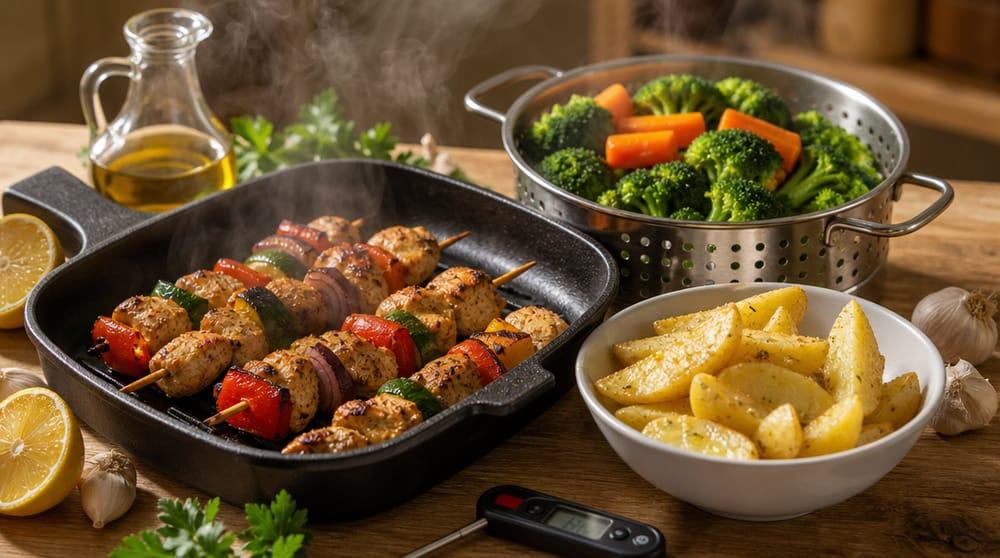
Cooking method is not a cosmetic detail — it is a step that changes what your food is made of. High heat on a dry surface does not merely warm food; it creates new compounds that were never present in the raw ingredient. The good news is that the variable driving this is not the name or reputation of your appliance. It is three things you already control in your own kitchen: temperature, time, and the presence of water. This guide explains what actually happens when heat meets food, why questions like "is an air fryer healthy?" are the wrong question, and which simple changes lower these compounds without costing you flavour or time.
What actually happens when heat meets food
When food turns golden and smells irresistible, what you are seeing is not simply "doneness" — it is a named chemical reaction. The European Food Safety Authority (EFSA) puts it plainly: "The chemical process that causes this is known as the Maillard Reaction; it also 'browns' food and affects its taste." That reaction is the source of much of the pleasure of eating — bread crust, the seared surface of grilled meat, caramelised onions — and it is simultaneously the factory where new compounds are built.
Three families of compounds are worth knowing, because each has a different raw material and therefore a different fix:
- Acrylamide: forms in starchy plant foods. The U.S. Food and Drug Administration (FDA) states that "acrylamide forms from natural sugars and the amino acid asparagine in foods," and that it "has been found primarily in food made from plants, such as potatoes, grain products, and coffee."
- Heterocyclic amines and polycyclic aromatic hydrocarbons (HCAs and PAHs): form in meat. The National Cancer Institute (NCI) defines them as "chemicals formed when muscle meat, including beef, pork, fish, or poultry, is cooked using high-temperature methods, such as pan frying or grilling directly over an open flame."
- Advanced glycation end products (AGEs): form in both. In a 2010 review in the Journal of the American Dietetic Association, Uribarri and colleagues reported that "dry heat promotes new dAGE formation by >10- to 100-fold above the uncooked state."
Notice the phrase common to all three definitions: high heat. None of these compounds exists in a raw potato or in a cut of meat before it touches the fire. You are not only choosing ingredients — you are choosing chemistry.
The single rule that explains everything: water is the brake
If you keep one sentence from this article, make it this one: wherever water is present, the surface of the food cannot climb much past the boiling point of water (around 100°C / 212°F), and at that temperature these reactions do not meaningfully get going.
EFSA links acrylamide formation to "high-temperature cooking (frying, baking, roasting and also industrial processing at +120°C and low moisture)." Both conditions matter: above 120°C and low moisture. That is exactly why the FDA observes that acrylamide "is typically found in plant-based foods cooked with high heat (e.g., frying, roasting, and baking), not raw plant-based foods or foods cooked by steaming or boiling."
So every cooking method can be placed on one simple ladder, from chemically quiet to chemically loud:
- Boiling, steaming and pressure cooking: the surface stays wet throughout, so it never exceeds water's temperature by much.
- Slow cooking, stewing and braising in sauce: the medium is liquid, and the liquid caps the heat.
- Microwaving: it heats the water inside the food, which is why the FDA notes that "boiling potatoes and microwaving whole potatoes with skin on to make 'microwaved baked potatoes' does not produce acrylamide."
- Baking and roasting: the surface dries out and passes 120°C, so colour and compounds arrive together.
- Deep frying and grilling directly over flame: the hottest, driest surface of all.
This ladder is not a list of forbidden methods. It simply tells you where the extreme heat lives — and therefore where your small adjustments buy the most.
Why "is an air fryer healthy?" is the wrong question
Here is the surprising part. Air fryers spread as a healthier alternative to deep frying, and that reputation has a reasonable basis. Cleveland Clinic, quoting registered dietitian Julia Zumpano, RD, LD, says "air frying is a healthier option because it essentially eliminates added oils," and that it may "cut calories that you'd normally get from deep frying foods by up to 80%." The same article cites a study showing "an air fryer can reduce acrylamide by 90%."
Now place beside that an experiment published in Frontiers in Nutrition in 2023, which compared acrylamide in potatoes cooked three ways and measured it by LC-MS/MS. The overall means were:
- Air frying (200°C for 15 minutes): 12.19 µg/kg
- Deep frying (180°C for 10 minutes): 8.94 µg/kg
- Oven frying (200°C for 15 minutes): 7.43 µg/kg
In other words, the air fryer was not the lowest in this experiment — it produced the highest number, though the researchers themselves note that "the difference between the acrylamide contents of the potatoes according to the cooking methods was not statistically significant" (p = 0.789). Their conclusion: "It is important to highlight the relatively low acrylamide levels found in oven-frying, lower than air frying in both washing and soaking groups."
How do you reconcile "a 90% reduction" with "no significant difference"? That reconciliation is the whole point of this article: the appliance is not the variable — the settings are. The air fryer in that experiment ran at 200°C for 15 minutes, which is hotter and longer than the deep fryer beside it (180°C for 10 minutes). An air fryer run hot and long behaves like a fryer. Run cooler and shorter, the very same machine gives a very different result.
And the most elegant finding in that study was not a machine at all: soaking the potato sticks in water before cooking lowered acrylamide across every method, and for deep frying the difference was statistically significant (p = 0.029). Ten minutes and a bowl of water outperformed buying a gadget.
Colour is the only thermometer you already own
If the variable is heat and time, you need an indicator you can read with your eyes. That indicator is colour — because browning is itself the product of the very reaction that creates these compounds. This is the logic behind the regulatory "go for gold" rule.
The FDA's practical guidance is direct:
- Colour: "Cooking cut potato products… to a golden yellow color rather than a brown color helps reduce acrylamide formation."
- Toast: "Toasting bread to a light brown color, rather than a dark brown color, lowers the amount of acrylamide."
- Soaking: "Soaking raw potato slices in water for 15-30 minutes before frying or roasting helps reduce acrylamide formation during cooking."
- Method ranking: "Frying causes the highest acrylamide formation. Roasting potato pieces causes less acrylamide formation, followed by baking whole potatoes."
- Storage: "Store potatoes outside the refrigerator, preferably in a dark, cool place, such as a closet or a pantry." Chilling raw potatoes raises their reducing sugars, which are one half of the reaction.
That last point surprises most people. Keeping potatoes in the fridge feels tidy and responsible, but it quietly feeds the reaction you are trying to avoid.
Meat and grilling: where the problem actually lives
In Saudi Arabia, grilling is not just a cooking method — it is a social occasion. And here a common impression needs correcting in both directions. In a cross-sectional study conducted in Riyadh and published in Frontiers in Public Health in 2025 with 334 analysed participants (67.7% female, 71.9% aged 18–24), researchers found that 74.3% incorrectly believed barbecuing food is unhealthy. The majority, in other words, judged the method by its reputation rather than by its mechanism.
The truth is more precise: grilling in itself is a reasonable method — fat drips away and no added oil is required. The problem lies in three specific details that the National Cancer Institute identifies:
- Heat and time: "meats cooked at high temperatures, especially above 300 ºF (as in grilling or pan frying), or that are cooked for a long time tend to form more HCAs."
- Flame and dripping fat: PAHs form when "fat and juices from meat grilled directly over a heated surface or open fire drip onto the surface or fire, causing flames and smoke."
- Degree of doneness: "Well-done, grilled, or barbecued chicken and steak all have high concentrations of HCAs."
The remedies the same institute lists are strikingly simple:
- "Using a microwave oven to cook meat prior to exposure to high temperatures can also substantially reduce HCA formation by reducing the time that meat must be in contact with high heat."
- "Continuously turning meat over on a high heat source can substantially reduce HCA formation."
- "Removing charred portions of meat and refraining from using gravy made from meat drippings can also reduce HCA and PAH exposure."
Add to this what the Uribarri review measured. The same chicken breast came in at 1,210 kU/100g boiled versus 8,244 kU/100g roasted with the skin on. Beef measured 707 kU/100g raw, 2,443 kU/100g stewed, and 10,058 kU/100g pan fried in olive oil. One ingredient; the entire difference is method. The authors report that these compounds are "significantly reduced by cooking with moist heat, using shorter cooking times, cooking at lower temperatures," and "by use of acidic ingredients such as lemon juice or vinegar."
Which reveals the quiet wisdom of the traditional kitchen: a lemon marinade before grilling is not only about flavour.
The oil changes too — not just the food
There is a third party in this equation that is easy to forget: the oil itself. Harvard Health explains that "most oils have a 'smoke point' between 400° and 500°," that "high heat causes molecules in oils to break apart, burn, become bitter, lose nutrients, and release smoke," and that "you lose the oil's health benefit when the high temperature breaks down fatty acids."
Practically, this means matching the oil to the heat rather than the other way around:
- For sautéing, stir-frying and roasting: higher-smoke-point oils such as avocado, canola, corn, grapeseed, regular or light olive, peanut, rice bran, safflower, soybean and sunflower.
- For dressing, salads and finishing after cooking: lower-smoke-point oils such as extra-virgin olive oil, flaxseed oil, nut oils and sesame oil.
And what about reusing oil again and again? The oil itself transforms. As reported by the Harvard T.H. Chan School of Public Health, canola oil "used to fry French fries for seven hours per day for seven days at 185°C (365°F) resulted in increasing the total trans-fatty acid content of the oil from 2.4% to 3.3%." The simple household rule: do not reuse frying oil repeatedly, and discard it once it darkens, foams, or develops a sharp smell. For more on choosing the fats themselves, see our article on healthy fats and cholesterol.
A six-step plan you can start today
- Make water your default. Steaming, boiling and cooking in sauce are not "bland" options — they are simply the methods where the surface never reaches the reaction zone. They are usually faster and cheaper too.
- Read the colour, not the clock. Light golden, never dark brown — for potatoes, toast and baked goods alike.
- Lower the temperature and extend the time slightly, rather than the reverse. 180°C for twenty minutes is chemically different from 220°C for twelve, even when the taste is similar.
- Soak potatoes for 10–30 minutes before roasting or frying, and store raw potatoes outside the fridge in a cool, dark place.
- At the grill: turn constantly, raise the grate away from the flame, cut off charred parts, and marinate with lemon or vinegar beforehand. You can also shorten heat exposure by pre-cooking.
- Match the oil to the heat, and do not reuse it repeatedly. Extra-virgin olive oil belongs on food after cooking, not in the bottom of a screaming-hot pan.
Four myths worth correcting
"The appliance decides whether food is healthy"
No — the settings decide. As Cleveland Clinic puts it, an air fryer is "only as healthy as the food you put inside," and it will not remove unhealthy fats from processed foods.
"Grilling is unhealthy"
A belief the 2025 Riyadh study found in 74.3% of participants, and it is imprecise. Grilling is a sound method; what needs managing is charring, direct flame and excessive doneness — not grilling itself.
"Potatoes are better kept in the fridge"
The opposite, where acrylamide is concerned: chilling raises the reducing sugars in the tuber, one half of the reaction. Raw potatoes belong in a cool, dark cupboard.
"These compounds exist anyway, so why bother?"
That is unnecessary surrender. The steps above cost no money and almost no time, and their effect accumulates across thousands of meals. But — and this is the next point — they do not deserve anxiety.
Being fair: how big is this really?
Honesty requires putting this in proportion, because the credible sources themselves do not speak with one voice — and the reason is that they are answering two different questions.
On the hazard side, EFSA states that "acrylamide and its metabolite glycidamide are genotoxic and carcinogenic," and that its experts "agree with previous evaluations that acrylamide in food potentially increases the risk of developing cancer for consumers in all age groups." It adds that "on a body weight basis, children are the most exposed age group."
On the side of what has actually been observed in people, the National Cancer Institute states that "a large number of epidemiologic studies (both case-control and cohort studies) in humans have found no consistent evidence that dietary acrylamide exposure is associated with the risk of any type of cancer" — while the National Toxicology Program "considers acrylamide to be reasonably anticipated to be a human carcinogen, based on studies in laboratory animals given acrylamide in drinking water."
The balanced practical takeaway: these are free, low-effort adjustments, so make them calmly. But do not let worry about a dark crust push you toward ultra-processed convenience meals instead of home cooking — by every measure of evidence, that is a losing trade. Tellingly, the 2025 Riyadh study also found that around 50% believed "healthy food takes more time to prepare," when steaming and boiling are among the fastest methods there are.
Who should pay closer attention?
- Children: because exposure is calculated per unit of body weight, and EFSA identifies them as the most exposed age group; fried potato products account for "up to half of all dietary exposure to acrylamide" for most children.
- Anyone relying heavily on fried and fast food daily: accumulation here is a matter of frequency, not of any single meal.
- People with diabetes or chronic conditions: discuss cooking patterns within your overall nutrition plan with your physician or dietitian rather than relying on general rules.
- People with digestive disorders or previous gastrointestinal surgery: fried and very fatty foods may be less suitable for other reasons, as we explained in our article on gallstones.
This article is for health education and awareness only and is not a substitute for medical advice. If you have a chronic condition or follow a prescribed diet, consult your physician or dietitian before making substantial changes.
Where this leaves your kitchen — and Bakery 8
No cooking method turns an unhealthy food into a healthy one. That has to be said first, and it applies to us as much as to anyone: toasting and baking happen at high heat, and every baked good — ours included — obeys the same laws of heat and colour. What we can influence is the ingredient, and what you do afterwards.
Practically, here is what is relevant from Bakery 8 in the context of this article:
- Samoli bread and cloud bread: if you love your toast, take it to light golden rather than dark brown — the same rule the FDA gives for any bread.
- Granola: a ready option that needs no additional heat exposure at home at all.
- Crackers and desserts: ready alternatives that spare you home frying when you want something crunchy.
The larger point is that choosing your ingredient and choosing your cooking method are two separate decisions — and both deserve your attention. For more on ingredient quality itself, read our article on protein quality, and on planning ahead, our guide to weekly meal prep.
Frequently asked questions
Is an air fryer really better than deep frying?
Usually yes in terms of oil and calories — Cleveland Clinic cites up to 80% fewer calories than deep frying. For acrylamide, it depends on the settings: in the 2023 Frontiers in Nutrition experiment, air frying at 200°C for 15 minutes recorded a higher value than deep frying, by a difference that was not statistically significant. The appliance is not the variable; heat and time are.
Does boiling strip food of its nutrients?
Some water-soluble vitamins leach into the cooking water, which is why steaming — or keeping the cooking liquid in a soup or sauce — is preferable. But that is a small trade-off against avoiding the hottest zones, and the choice is not all-or-nothing.
Does this mean I should stop eating grilled food?
No. The National Cancer Institute offers ways to reduce exposure, not prohibitions: turn the meat constantly, pre-cook it, keep it away from direct flame, and remove charred portions. Well-managed grilling is a perfectly sound method.
Does a lemon marinade genuinely make a difference?
According to the Uribarri review, advanced glycation end products are reduced "by use of acidic ingredients such as lemon juice or vinegar," alongside moist heat, shorter cooking times and lower temperatures. So the traditional marinade has a chemical basis, not only a culinary one.
Are raw foods better, then?
Not necessarily. Cooking improves digestibility, microbial safety and the availability of some nutrients. The message is not "don't cook" — it is "know where the extreme heat is, and manage it."
Does this matter specifically for people with diabetes?
Moist-heat cooking and shorter cooking times are a sound general recommendation for everyone, and they do not replace a treatment plan. Discuss the details of your diet and your cooking methods with your physician or dietitian.
Conclusion
Cooking is not a neutral step between ingredient and plate. It is the moment when new compounds are made, and how many depends on three things you fully control: heat, time, and the presence of water. Because browning is the visible signature of those same reactions, your eyes are enough of an instrument: light golden, not dark. Adjust these small details calmly and without anxiety — and start from ingredients worth the care in the first place. Bakery 8 offers keto, sugar-free and gluten-free options built for everyday kitchens in Riyadh, Saudi Arabia.
References
- U.S. Food and Drug Administration — Acrylamide and Diet, Food Storage, and Food Preparation.
- European Food Safety Authority (EFSA) — EFSA explains risk assessment: Acrylamide in food, 2015.
- European Food Safety Authority (EFSA) — Scientific Opinion on acrylamide in food, EFSA Journal, 2015.
- National Cancer Institute (NIH) — Acrylamide and Cancer Risk fact sheet.
- National Cancer Institute (NIH) — Chemicals in Meat Cooked at High Temperatures and Cancer Risk fact sheet.
- Uribarri J. et al. — Advanced Glycation End Products in Foods and a Practical Guide to Their Reduction in the Diet, Journal of the American Dietetic Association, 2010.
- Sansano M. et al. — Acrylamide formation in air-fried versus deep and oven-fried potatoes, Frontiers in Nutrition, 2023.
- Cleveland Clinic — Are Air Fryers Healthy? (Julia Zumpano, RD, LD).
- World Cancer Research Fund — What is the healthiest cooking method?
- Harvard Health Publishing — Expand your healthy cooking oil choices.
- Harvard T.H. Chan School of Public Health, The Nutrition Source — Ask the Expert: Concerns about canola oil.
- Healthy food and dietary patterns: a cross-sectional study in Riyadh, Saudi Arabia, Frontiers in Public Health, 2025.
Related keywords: healthy cooking methods, acrylamide in food, air fryer health, healthy grilling, cooking oil smoke point, steaming vs frying, advanced glycation end products, toasting bread.