

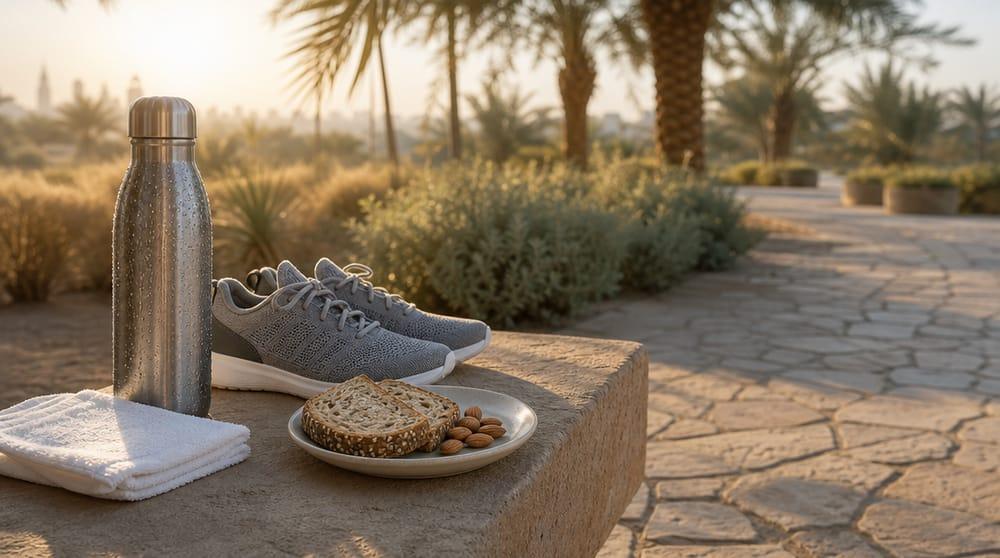
Exercising in extreme summer heat is not forbidden in Riyadh, but it runs on different rules from the rest of the year: the danger is not set by the thermometer alone, but by the mix of humidity, direct sun, how hard and how long you work, and how well your body has adapted to heat. The part almost everyone misses is that the body genuinely does adapt — heat acclimatization takes roughly 7 to 14 days of gradual exposure — and that shutting activity down for the whole summer is not "rest" but a measurable loss in fitness and in insulin sensitivity.
We write this from Riyadh, Saudi Arabia, where summer runs for months and "I'll start again in winter" costs more than it sounds. This article is general health education and does not replace your doctor's advice, especially if you live with diabetes, heart disease, kidney disease, or take medicines that affect fluid balance.
Why "Just Train Early in the Morning" Isn't Enough 🌅
The most repeated summer advice — avoid midday, go out early or in the evening — is sound, and the U.S. Centers for Disease Control and Prevention (CDC) gives exactly that guidance to people with diabetes. But it is incomplete, because it converts a decision that depends on conditions into a decision that depends on the clock. Conditions vary enormously within the same hour.
The thermometer is not the number that hurts you
What determines heat strain is not air temperature alone but your body's ability to shed heat. Sweat does not cool you because it appears; it cools you because it evaporates. That is why humidity changes everything. The U.S. National Weather Service gives a blunt example: 100°F (about 38°C) at 55% relative humidity feels like 124°F (about 51°C), while the same air temperature at 15% humidity feels like only 96°F (about 36°C).
Here is the paradox for a dry city like Riyadh: dry air is on your side, because sweat evaporates efficiently. But that same advantage is the trap — sweat evaporates before you feel wet, so you lose large volumes of fluid without the familiar sensation of being drenched. In dry heat, dehydration happens quietly. (We covered hydration and its effect on blood sugar in a separate article: Hydration and Blood Sugar in Summer Heat.)
A second factor gets forgotten every time: direct sun. The same agency notes that heat index values can rise by up to 15°F (about 8°C) in full sunshine compared with shade. A shaded route and an exposed route at the same hour are simply not the same workout.
The Saudi evidence: morning is not automatically safe
A narrative review published in the Journal of Umm Al-Qura University for Medical Science (2026) on heat-related illness in Saudi Arabia reports that summer temperatures routinely exceed 45°C and pass 50°C in some regions, and that wet-bulb globe temperature (WBGT) — the occupational index that combines heat, humidity, and solar radiation — frequently exceeds 31–33°C during morning hours, with roughly 78% of outdoor workdays above occupational exposure limits. The review explicitly recommends addressing "peak morning heat exposure" rather than relying on midday restrictions alone.
This does not cancel the "early or late" rule; it adds a condition to it: judge the conditions, not the clock. Seven in the morning on an exposed path after a hot night is not the same as seven in the morning on a shaded path with a breeze.
The midday work ban is a floor, not a ceiling
Saudi Arabia enforces an annual ban on work under direct sunlight in the private sector from mid-June to mid-September, daily from 12:00 to 15:00, to provide a safe work environment and reduce the risk of heat-related injuries and illness, according to the Ministry of Human Resources and Social Development. Read the policy for what it is: an official acknowledgment that physical effort under midday sun in this region is a real hazard. But it is a regulatory minimum, not a safety certificate for 11:45 or 15:15.
How Your Body Adapts to Heat 🔥
This is the piece missing from most summer advice, and practically the most useful. Heat acclimatization is not a metaphor or "getting used to it" psychologically — it is a documented set of physiological adaptations. The U.S. National Institute for Occupational Safety and Health (NIOSH) defines it as "the beneficial physiological adaptations that occur during repeated exposure to a hot environment," and lists:
- Increased sweating efficiency: earlier onset of sweating, greater sweat production, and reduced electrolyte loss in sweat.
- Stabilization of the circulation.
- The ability to perform work at a lower core temperature and heart rate.
- Increased skin blood flow at a given core temperature.
Note the first item: less salt lost in sweat. An acclimatized body holds on to sodium more efficiently, which is part of why heat feels "lighter" to adapted people even though the weather has not changed. (For sodium in everyday food, see Sodium and Salt.)
The acclimatization ladder: how many days, and how much?
NIOSH's guidance for workers new to hot environments transfers directly to training: start with no more than 20% of the usual exposure on day one, then increase by no more than 20% per day over 7 to 14 days. Workers with previous experience in the heat follow a faster schedule: 50% on day one, 60% on day two, 80% on day three, and 100% on day four.
Translated into training: if your usual outdoor walk is 50 minutes, do not open your summer with fifty minutes. Start with ten, then twelve, then fifteen — across one to two weeks.
Acclimatization is lost faster than it is built
NIOSH notes that workers retain their adaptations during short absences such as a weekend, but an absence of a week or more can mean a significant loss of the benefit, and regaining it usually takes 2 to 3 days after returning. Practically: after a week of travel, or a week spent only in an air-conditioned gym, do not return to your outdoor route at the same volume — drop by about a third for a few days.
And a necessary warning so none of the above is misread: acclimatization reduces risk; it does not remove it. Heat stroke strikes fit, adapted people too, and the case-fatality range reported for heat stroke in the Saudi review runs from 6.3% to 30%, with lasting neurological complications in 20–50% of survivors. Gradual progression is a way of lowering risk, not a licence to take one.
"I'll Start Again in Winter": The Price of a Four-Month Stop 📉
Pausing all activity through summer looks like a sensible decision. The problem is that the body does not read it as "a break" — it reads it as detraining, and detraining has numbers. A review in Frontiers in Physiology (2024) on the cardiorespiratory and metabolic consequences of detraining in endurance athletes collects the following:
- VO2max fell by about 7% after just 12 days of stopping in a group of runners and cyclists (Coyle et al., 1984).
- A decline of about 4.7% after 14 days in distance runners (Houmard et al., 1992).
- About 10.1% after five weeks, and roughly 20% after two months of complete cessation.
- Plasma volume dropped by about 12% over two to four weeks of complete detraining (Coyle et al., 1986).
Read that last line together with the acclimatization section and the full irony appears: one of the central gains of heat acclimatization is plasma volume expansion, which is exactly what makes heat easier to tolerate — and a summer shutdown does precisely the opposite. Withdrawing from the heat makes the heat harder on you when you return to it.
And for blood sugar, the window is measured in hours, not seasons
In the American Diabetes Association position statement published in Diabetes Care (Colberg et al., 2016), muscle glucose uptake remains elevated after exercise through insulin-independent mechanisms (about 2 hours) and insulin-dependent mechanisms lasting up to 48 hours. That is precisely why the recommendation is worded as it is: 150 minutes or more per week of moderate-to-vigorous activity spread over at least 3 days, with no more than 2 consecutive days without activity. Add 2–3 resistance sessions per week on non-consecutive days, and interrupt prolonged sitting with light activity every 30 minutes.
In other words, the insulin-sensitivity benefit of exercise is not a balance you can save up for winter. It is a window that closes within two days. A motionless summer is not a postponement of the benefit — it is cancelling it, repeatedly, about 120 times.
Where we actually stand
According to the 2024 physical activity statistics from Saudi Arabia's General Authority for Statistics (National Health Survey 2024), 58.5% of people aged 18 and above do 150 minutes or more of physical activity per week. Among ages 5 to 17, only 18.7% get 60 minutes daily — and the lowest figure was in Riyadh region, at 14.7%, while 35.3% spend more than three hours a day in sedentary activities. Globally, the World Health Organization estimates that 31% of adults (1.8 billion people) did not meet recommended activity levels in 2022, with the share projected to reach 35% by 2030.
If You Live With Diabetes, Heat Changes the Equation 🩺
This section is educational and does not replace your treatment plan, but it is the most practically important part. The CDC notes that people with diabetes — type 1 or type 2 — "feel the heat more than people who don't have diabetes," that damage to blood vessels and nerves "can affect your sweat glands so your body can't cool as effectively," that dehydration happens faster, and that not drinking enough can raise blood sugar.
- Medicines and devices: do not store insulin or oral diabetes medicine in direct sunlight or a hot car, and heat can damage your glucose monitor, insulin pump, and other supplies (CDC). Cleveland Clinic notes that most insulins tolerate temperatures up to about 93–95°F (33.9–35°C); above that the medication breaks down quickly.
- Absorption shifts: Cleveland Clinic specialists point out that dehydration reduces blood supply to the skin and therefore reduces the body's ability to absorb injected insulin — one more reason to measure more, not less, in summer.
- Measurement: the CDC advises checking blood sugar before, during, and after activity, notes you may need to change your insulin dose, and recommends avoiding outdoor activity during the hottest part of the day.
- A ceiling before you start: Cleveland Clinic physicians advise improving blood sugar control first, before heavy physical activity, for people whose readings are mostly above 250 mg/dL.
- Who should skip outdoor heat entirely: the ADA position statement says older adults with diabetes, or anyone with autonomic neuropathy, cardiovascular complications, or pulmonary disease, should avoid exercising outdoors on very hot and/or humid days.
Two more details. First, exercise-induced hypoglycemia is common in type 1 diabetes and, to a lesser extent, in people with type 2 using insulin or insulin secretagogues — carry treatment with you. (For telling a true low apart from post-meal symptoms: Blood Sugar Crashes After Eating.) Second, if you have numbness in your feet, hot surfaces, new shoes, and walking barefoot on scorching ground are compounded risks, because your alarm system is offline — see Diabetic Neuropathy and Foot Care, and check your feet after every summer session.
Warning Signs: When to Stop, and When to Call an Ambulance 🚨
Heat illness is a spectrum, and the gap between two links in that chain is the gap between a bad day and an emergency.
Heat exhaustion (core temperature 37–40°C)
Heavy sweating, weakness and dizziness, headache, nausea, muscle cramps, fast pulse, cool clammy skin. What to do: stop immediately, move to shade or air conditioning, loosen clothing, cool yourself with water and a fan, and drink fluids if you are fully alert. The Saudi review reports essentially zero mortality for heat exhaustion when it is treated promptly.
Heat stroke (core temperature above 40°C) — a medical emergency
Mayo Clinic defines it by a temperature of 104°F (40°C) or greater, with confusion or agitation, hot or heavily perspiring skin, nausea and vomiting, flushed appearance, rapid pulse and breathing, severe headache, and possibly fainting or seizures. Immediate actions:
- Call emergency services (997 in Saudi Arabia) right away.
- Move the person out of the heat into a cool or shaded place.
- Start cooling immediately and do not wait: immersion in cool water, spraying with a hose, sponging with cool water, ice packs to the neck, armpits and groin, or covering with damp sheets while fanning.
- Do not give fluids to someone who is confused or unconscious.
The governing rule: cooling starts where you are, not at the hospital. Every minute above the threshold counts.
A Two-Week Plan for Returning to Summer Training 📋
- Days 1–2: 20% of your usual outdoor volume, in shade, at an effort that still lets you speak a full sentence.
- Days 3–5: add about 20% per day. Build in a shade stop every 15–20 minutes.
- Days 6–9: keep increasing gradually. Measure yourself by effort and heart rate, not pace — the same pace costs more in heat.
- Days 10–14: approach your normal volume. If dizziness, headache, or nausea appears, step a full stage back.
- After any break of a week or more: restart at about two-thirds for two to three days.
Supporting rules that make a real difference:
- Choose your route for shade, not scenery — shade can be worth roughly 8°C.
- Light-coloured loose clothing and a cap; start hydrated rather than trying to catch up later.
- Pre-cool: a cold shower or a cold drink before heading out.
- Don't train alone in peak heat; tell someone your route and expected return time.
- Asphalt and concrete radiate stored heat after sunset — a shaded dirt park beats an asphalt walkway.
- Indoor options are full activity, not a fallback: mall walking, bodyweight circuits at home, stairs, and resistance work two to three times a week.
Who Should Be Extra Careful ⚠️
- Older adults (65+) and people with chronic conditions — heart disease, diabetes, respiratory and kidney disease — among the most vulnerable groups per the World Health Organization.
- Anyone with autonomic neuropathy, cardiovascular complications, or pulmonary disease (ADA position statement).
- Pregnant women, children, and outdoor workers.
- Anyone taking medicines that affect fluid balance or sweating (diuretics, some blood pressure and psychiatric medicines) — ask your doctor or pharmacist about your specific medication.
This article is general education. If you live with a chronic condition or plan a major change in your physical activity, talk to your doctor first. And although heat harms are predictable, the World Health Organization stresses they are "largely preventable."
Where Bakery 8 Fits In 🥖
Let's be direct: no bread protects you from heat stroke, and no food replaces shade, water, and gradual progression. What food does is decide what happens to your blood sugar around your training — no more, no less. If you live with diabetes or follow a low-carb pattern, choosing a starch base that doesn't spike you before or after a summer session simply makes the day easier to manage.
- Bread and toast — a base whose filling you control: eggs, cheese, tuna, avocado. A light meal before or after a morning walk without a sharp glucose swing.
- Keto granola — a practical pre- or post-activity snack with milk or yogurt.
- Crackers and manakish — a savoury alternative to packaged snacks; if you're watching sodium, read the label as we explained before, ours first.
- Sugar-free desserts — for summer-evening family gatherings without derailing your day.
The rule we keep repeating: don't buy any product — ours first — that doesn't fit your plan and your readings. Food is a tool; the plan is what decides.
Frequently Asked Questions ❓
Does exercising in the heat burn more calories?
Your temperature, heart rate, and sweat rate all rise, but that signals heat strain rather than meaningful extra fat burning. The weight you lose right after a hot session is water, and it returns as soon as you drink. Judge the session by its quality and safety, not by the scale afterwards.
How many days do I need to acclimatize to summer heat?
According to NIOSH, heat acclimatization usually takes 7 to 14 days of gradual exposure for those new to it, and less for people with previous experience working in heat. But an absence of a week or more can cost a large part of that gain, and you need two to three days to regain it.
Is training in an air-conditioned gym all summer enough?
For fitness and blood sugar, yes — indoor training is full activity. But be aware that you will not be acclimatized to outdoor heat, so don't assume fitness equals heat tolerance. When you go back outside, apply the gradual ladder again.
What is the difference between heat exhaustion and heat stroke?
Heat exhaustion runs at a core temperature of 37–40°C with sweating, weakness, and nausea, and improves with cooling, rest, and fluids. Heat stroke is an emergency in which core temperature passes 40°C accompanied by changes in consciousness such as confusion or agitation, and it requires calling an ambulance and cooling immediately.
Do I need sports drinks in summer?
For most walks or sessions under an hour, water is enough. Electrolytes matter more with long sessions, heavy sweating, or the first weeks of a low-carb diet. And if you monitor blood pressure or take heart or kidney medicines, ask your doctor before using potassium-rich salt substitutes.
Conclusion
Summer in Riyadh does not cancel physical activity, but it does reorder the rules: read the conditions rather than the clock, build your acclimatization over one to two weeks instead of jumping straight to your usual volume, don't let the summer gap turn into four months of measurable decline, and learn the line between heat exhaustion and heat stroke before you need it. And if you live with diabetes, summer is not a reason to stop — it is a reason to measure more often and plan more carefully. On our side at Bakery 8, we stay in the part we do well: sugar-free baked options that fit your plan, while movement, shade, and water stay yours.
References
- World Health Organization — Physical activity fact sheet: 31% of adults (1.8 billion) insufficiently active in 2022; projected 35% by 2030; 15% relative reduction target.
- World Health Organization — Climate change, heat and health fact sheet: risk groups, approximately 489,000 heat-related deaths per year (2000–2019), largely preventable.
- General Authority for Statistics / Ministry of Sport (Saudi Arabia) — Physical Activity Statistics 2024 (National Health Survey 2024): 58.5% of adults 18+; 18.7% of ages 5–17; Riyadh lowest at 14.7%; 35.3% sedentary more than 3 h/day.
- Ministry of Human Resources and Social Development (Saudi Arabia) / Saudi Press Agency — Ban on work under direct sunlight, 15 June to 15 September, 12:00–15:00.
- NIOSH (CDC) — Heat Stress: Acclimatization: definition, adaptations, 20%-per-day schedule over 7–14 days, 50/60/80/100 schedule for experienced workers, loss after a week away, 2–3 days to regain.
- National Weather Service (NOAA) — Heat Index: 100°F at 55% RH feels like 124°F; at 15% RH feels like 96°F; up to +15°F in full sunshine.
- Mayo Clinic — Heatstroke first aid: 104°F (40°C) threshold, symptoms, cooling methods, emergency call.
- Centers for Disease Control and Prevention — Managing Diabetes in the Heat: heat sensitivity, sweat gland damage, dehydration and blood sugar, storage of insulin and equipment, checking glucose before/during/after activity, outdoor timing.
- Cleveland Clinic — How to Manage Your Diabetes in Extreme Summer Heat: insulin tolerance up to about 93–95°F (33.9–35°C), dehydration and insulin absorption, caution above 250 mg/dL before heavy activity.
- Colberg SR, Sigal RJ, et al. — Physical Activity/Exercise and Diabetes: A Position Statement of the American Diabetes Association. Diabetes Care 2016;39(11):2065–2079.
- Codella R, et al. — Cardiorespiratory and metabolic consequences of detraining in endurance athletes. Frontiers in Physiology 2024.
- Almohammadi A — Heat-related illnesses in Saudi Arabia: prevention, early recognition, and public health strategies. Journal of Umm Al-Qura University for Medical Science 2026;12(1).
Related keywords: exercising in summer heat · working out in hot weather · heat acclimatization · heat stroke prevention · heat exhaustion signs · walking in Riyadh summer · physical activity and diabetes · early morning workouts in summer · indoor workouts summer · heat index and humidity